You type a sentence, wait a minute, and a moving video appears — realistic lighting, smooth motion, sometimes even a talking face. It can feel like magic, but underneath it’s actually one of the more elegant processes in modern computing. Here’s a plain-English breakdown of what’s really happening.
The Core Idea: Learning by Destruction
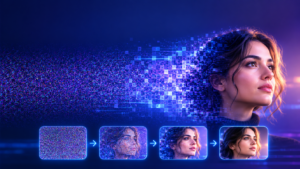
Almost every modern AI video tool is built on something called a diffusion model. The concept sounds counterintuitive at first: to teach an AI how to create something, you first teach it how to destroy it. During training, the AI is shown millions of real videos that get progressively corrupted with random visual noise — imagine watching a clear photo slowly dissolve into TV static. The model studies this destruction process closely and learns something valuable in reverse: exactly how to undo it, step by step, turning pure noise back into a coherent image.
Once trained, generation works backward from that lesson. You give the AI a text prompt, and it starts with a canvas of random noise, then gradually “denoises” it — refining that noise step by step until a coherent image emerges that matches what you asked for. Do this for every frame of a video in a coordinated way, and you get a moving clip instead of just one image.
The Hard Part: Making Frames Agree With Each Other
Generating one realistic image is difficult enough. Video adds a much harder problem: every frame needs to stay consistent with the frames before and after it. If each frame were generated independently, you’d get flickering, warping, and objects that randomly change shape — a person’s face might subtly shift between frames, or an object might change color halfway through a clip.
This challenge is called temporal coherence, and it’s exactly what separated the earliest AI video tools (short, flickery, 2-4 second clips) from what’s possible now. Modern models solve this using temporal attention layers — a part of the neural network specifically designed to “look across” the entire time span of the video at once, rather than generating each frame in isolation. This is what allows a person’s face to stay stable, a car to keep moving in a consistent direction, and lighting to remain steady from the first frame to the last.
The Three Main Types of AI Video Generation
- Text-to-video: You describe a scene in words, and the AI invents everything from scratch — best for concepts, creative b-roll, or scenes that would be impossible to film in real life.
- Image-to-video: You upload a still photo, and the AI animates it into motion, useful for bringing product photos or portraits to life.
- Avatar-driven synthesis: A digital presenter is generated and synced to an audio track, commonly used for talking-head content and faceless channels.
Why AI Video Sometimes Looks “Off”
Because the model is making informed predictions based on patterns from its training data — not literally recording reality — it occasionally produces physically impossible motion, like a hand with an extra finger or an object that briefly passes through another. This happens because the model is essentially making its best statistical guess about what should come next, rather than capturing something that actually happened. As models improve, they’re increasingly trained on physics-aware data specifically to reduce these artifacts.
Where This Technology Is Headed
A few clear trends are shaping AI video generation going forward: longer coherent generations (extending from a few seconds toward full minutes of consistent output), better physical realism as models are trained on more physics-grounded data, and finer creative control, allowing creators to direct specific elements like camera movement or character expression more precisely rather than relying purely on text description.
Why Understanding This Actually Helps You
Knowing the mechanics isn’t just trivia — it directly improves how you use these tools. Since AI video generation works by predicting patterns rather than recording reality, being specific and descriptive in your prompts (lighting, camera angle, motion, mood) gives the model clearer patterns to draw from, generally producing more accurate, controllable results than vague, one-line prompts.
Read More :- How to Make a YouTube Video Using Only AI Tools (2026 Beginner’s Guide) | Affitronix
Frequently Asked Questions
What is a diffusion model in simple terms?
It’s an AI system that learns to generate content by first learning how images get progressively destroyed with noise, then reversing that process to create something new from scratch.
Why do AI videos sometimes look glitchy or unnatural?
The AI is making statistical predictions based on training patterns rather than recording real footage, which occasionally results in physically inconsistent details, especially with complex motion.
Will AI video generation eventually look completely indistinguishable from real footage?
It’s trending in that direction — coherence, physical realism, and generation length have all improved significantly, though perfect consistency for longer videos remains an active area of research.