Nvidia is taking its AI infrastructure ambitions to Wall Street.
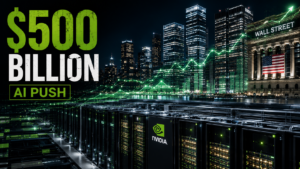
The chip giant has announced partnerships with six major financial institutions—Apollo, BlackRock, Blackstone, Brookfield, Goldman Sachs and KKR—to create financing platforms designed to mobilize more than $500 billion of third-party capital for AI infrastructure over time.
The announcement is significant for a reason that goes beyond the enormous dollar figure.
Nvidia isn’t simply selling more GPUs.
It is helping create a financing system around the data centers, AI factories, power infrastructure and computing capacity needed to turn those chips into revenue-generating AI systems.
And there is an important distinction that has already been blurred in some early headlines:
Nvidia is not putting $500 billion of its own money into this project.
The $500 billion figure represents the amount of third-party capital the new financing platforms aim to mobilize. Nvidia CEO Jensen Huang said Nvidia could potentially provide up to $125 billion, or roughly 25% of the potential deals, as a backstop.
Here’s what the deal actually means—and why Wall Street is suddenly becoming a much bigger part of the AI infrastructure boom.
Nvidia’s $500 Billion Plan Explained
At its simplest, Nvidia wants to make it easier to finance large-scale AI infrastructure.
That infrastructure includes:
- AI data centers
- Nvidia GPU systems
- Networking equipment
- Computing clusters
- Power infrastructure
- Cooling systems
- AI factories
- Cloud infrastructure
The company is partnering with major financial institutions to establish financing platforms that can bring institutional capital into these projects.
The goal is to mobilize more than $500 billion in third-party capital over time.
This matters because building AI infrastructure has become extraordinarily capital-intensive.
A company can have strong demand for AI computing but still struggle to build enough capacity because constructing the infrastructure requires enormous upfront investment.
Nvidia’s new model is designed to help solve that financing problem.
Who Is Nvidia Partnering With?
The group includes some of the biggest names in global finance:
| Financial institution | Role in the initiative |
|---|---|
| Apollo | Financing platform partner |
| BlackRock | Institutional capital partner |
| Blackstone | Private capital partner |
| Brookfield | Infrastructure investment partner |
| Goldman Sachs | Financial markets partner |
| KKR | Private capital partner |
Together, these firms represent enormous pools of institutional and private capital.
The significance isn’t simply the number of companies involved.
It’s the type of capital they represent.
These firms manage or deploy capital on behalf of institutional investors, pension funds, sovereign investors, insurers and other large-scale investors.
Nvidia is effectively trying to connect that capital with the rapidly growing demand for AI compute.
Is Nvidia Investing $500 Billion?
No.
This is the most important clarification.
The headline figure refers to third-party capital that Nvidia and its financial partners aim to mobilize.
Nvidia has said it could potentially backstop as much as $125 billion, equivalent to about 25% of the potential deals.
The remaining capital would come through the participating financial institutions and other sources of third-party funding.
So the structure is closer to:
Wall Street capital + financing platforms + Nvidia support → AI infrastructure projects
rather than:
Nvidia writes a $500 billion check.
That distinction matters when evaluating the scale of the announcement.
Why Does AI Need So Much Money?
AI has moved beyond the stage where companies simply need servers to train a model.
Modern AI systems increasingly require enormous amounts of computing capacity for everyday inference.
Every time an AI model:
- Answers a question
- Generates an image
- Creates a video
- Writes code
- Processes a document
- Runs an AI agent
- Handles an enterprise workflow
it consumes computing resources.
And as AI becomes embedded into more products, the demand for compute doesn’t stop after a model is trained.
It continues.
Nvidia has described this shift as the movement from model development toward continuously operating AI factories that generate tokens at scale.
That changes the economics of the infrastructure business.
What Is an “AI Factory”?
The term sounds futuristic, but the idea is relatively straightforward.
A traditional factory turns raw materials into physical products.
An AI factory uses computing infrastructure to turn data and computing resources into AI outputs—or “tokens.”
Instead of producing cars or electronics, the infrastructure continuously produces:
- AI responses
- Predictions
- Generated content
- Agent actions
- Enterprise AI workloads
Nvidia has increasingly positioned its accelerated-computing infrastructure around this concept.
That is why the company is no longer talking only about GPUs.
The bigger opportunity is the infrastructure ecosystem surrounding those GPUs.
Nvidia Wants AI Compute to Become an Investable Asset
This is perhaps the most important part of the announcement.
For decades, data centers were largely treated as physical infrastructure.
Now Nvidia wants AI compute capacity to become something investors can finance more like other infrastructure assets.
The basic idea is:
Build the AI factory → deploy Nvidia computing systems → customers pay for compute → revenue supports the infrastructure investment.
That creates a potentially repeatable financing model.
Nvidia described the initiative as a step toward making AI factory compute an investable asset class.
If that model works, it could change how future AI data centers are built.
Why Wall Street Is Getting Involved
AI infrastructure has become too expensive for many companies to finance entirely from their own balance sheets.
A company might need billions of dollars to:
- Acquire GPUs
- Construct a data center
- Secure electricity
- Install cooling
- Build networking infrastructure
- Connect the facility to the grid
That creates a financing gap.
Financial institutions can potentially provide the capital while AI infrastructure operators generate revenue by selling compute capacity.
For investors, the attraction is the possibility of long-term, recurring infrastructure revenue.
For AI companies, the attraction is access to compute without having to finance the entire infrastructure build themselves.
For Nvidia, the attraction is obvious:
More financed infrastructure means more potential demand for Nvidia’s computing systems.
Nvidia Is Moving Beyond the Chip Business
This announcement fits into a broader change in Nvidia’s strategy.
The company has increasingly invested in and partnered with companies across the AI infrastructure stack.
Earlier this year, Nvidia announced a $2 billion investment in Nebius as part of a partnership aimed at helping Nebius deploy more than 5 gigawatts of Nvidia systems by the end of 2030.
Nvidia also announced a $2 billion investment in Marvell in March as part of a broader collaboration around custom XPUs, networking and Nvidia’s NVLink Fusion ecosystem.
It separately announced a $2 billion investment in Lumentum to support advanced optics technology and US-based manufacturing for next-generation AI infrastructure.
These moves point toward a broader strategy:
Nvidia isn’t just selling the engine. It increasingly wants to help build the road, power system and financing structure around the engine.
The Financing Model Could Help Smaller AI Companies
Large technology companies have access to enormous amounts of capital.
Startups often don’t.
That creates a major disadvantage.
An AI startup might have:
- A strong model
- Paying customers
- High compute demand
but still lack the balance sheet required to build its own data center.
Nvidia’s infrastructure financing approach could potentially make high-performance computing more accessible to:
- AI startups
- Model developers
- Enterprise customers
- Research organizations
- Regional AI providers
Nvidia previously described its compute financing model as a way to expand access to large-scale infrastructure for emerging AI companies and other customers.
That could accelerate the number of companies able to build AI products.
What Does Nvidia Get Out of It?
The obvious answer is more demand for Nvidia hardware.
But there is a bigger strategic benefit.
If Nvidia helps finance the infrastructure that uses Nvidia systems, it can potentially influence the architecture of the next generation of AI data centers.
That could strengthen Nvidia’s ecosystem around:
- GPUs
- CPUs
- Networking
- NVLink
- Software
- AI factories
- Cloud infrastructure
The company has already been expanding this full-stack strategy.
The new Wall Street partnerships extend that strategy into finance.
Could This Create a Circular Financing Problem?
This is where the announcement becomes more complicated.
Some analysts have raised concerns about the possibility of circular financing.
The basic concern is:
Nvidia helps finance infrastructure that buys Nvidia products, while the success of that infrastructure creates more demand for Nvidia products.
That doesn’t automatically make the model unsound.
Infrastructure financing frequently depends on future revenue.
But it does mean investors need to understand where the underlying economic demand comes from.
The critical question isn’t simply:
“How much money can Nvidia mobilize?”
It’s:
“Will the AI infrastructure generate enough real revenue to support the capital being deployed?”
That distinction will become increasingly important as AI infrastructure investment grows.
The $500 Billion Number Is a Target, Not Cash Sitting in a Bank
Another important clarification is that the announced figure isn’t a pile of $500 billion ready to be spent tomorrow.
Nvidia has described the initiative as platforms designed to mobilize over $500 billion of third-party capital over time.
The company has not disclosed individual investment commitments, specific financial terms or a detailed deployment schedule for the full amount.
So readers shouldn’t interpret the announcement as:
“Nvidia just received $500 billion.”
That’s not what happened.
The better description is:
Nvidia and major financial institutions are building financing mechanisms that could mobilize more than $500 billion for AI infrastructure.
Why This Is Happening Now
The timing is not accidental.
AI infrastructure spending has exploded as companies race to secure computing capacity.
Nvidia says demand is shifting toward continuously operating AI factories as AI moves from research into production.
That means the industry needs more than individual GPU purchases.
It needs:
Power + land + data centers + networking + chips + cooling + financing.
The financing piece can become a bottleneck if the infrastructure required to meet AI demand is too expensive to build using conventional corporate spending.
Wall Street can potentially help unlock that capital.
What This Means for AI Data Centers
The impact could extend far beyond Nvidia.
If the financing model succeeds, it could accelerate construction of:
- Large AI campuses
- Hyperscale data centers
- AI cloud facilities
- Regional AI compute centers
- Dedicated enterprise AI infrastructure
That could increase demand for other parts of the infrastructure ecosystem as well.
AI data centers require much more than GPUs.
They need:
- Electricity
- Transformers
- Power-management equipment
- Cooling systems
- Networking
- Optical components
- Construction
- Land
- Fiber connectivity
That means Nvidia’s financing push could have ripple effects throughout the broader AI infrastructure economy.
Power Is Becoming a Critical Constraint
There’s another reason financing alone isn’t enough.
AI data centers need enormous amounts of electricity.
A company can secure billions in financing and still be unable to build a facility quickly if it can’t obtain sufficient power capacity.
That is why AI infrastructure increasingly involves discussions about:
- Grid capacity
- Nuclear power
- Renewable energy
- Natural gas
- Battery storage
- Transmission infrastructure
- Long-term power contracts
Capital solves one bottleneck.
It doesn’t automatically solve every physical bottleneck.
Nvidia’s Bigger AI Infrastructure Strategy
The Wall Street financing announcement is easier to understand when viewed alongside Nvidia’s other infrastructure partnerships.
The company has been expanding its role across the AI stack.
That includes:
Compute
Nvidia GPUs and accelerated systems.
Networking
NVLink, InfiniBand and Ethernet-based infrastructure.
AI factories
Large-scale computing systems designed for continuous AI workloads.
Cloud partnerships
Relationships with AI cloud providers.
Custom silicon
NVLink Fusion enables partners to develop custom compute components compatible with Nvidia’s ecosystem.
Infrastructure financing
The new Wall Street initiative.
The strategy is increasingly becoming:
Build the ecosystem around Nvidia compute—not just the chip itself.
What Could Go Wrong?
The scale of the investment also introduces risks.
AI demand may not grow as expected
If demand for AI compute slows, some infrastructure could become underutilized.
Construction costs could rise
Data centers are already expensive to build, and power and equipment shortages can increase costs.
Financing could become expensive
Higher interest rates or tighter credit markets could make projects less attractive.
Technology changes quickly
AI hardware becomes more capable rapidly.
An infrastructure project designed around one generation of hardware needs to remain economically useful as newer systems arrive.
Customers need sustainable revenue
An AI company that rents massive amounts of compute must generate enough revenue to justify those costs.
These risks don’t mean the financing model will fail.
They explain why the economics matter as much as the technology.
What Does This Mean for Nvidia’s AI Dominance?
The announcement could strengthen Nvidia’s position.
One of Nvidia’s biggest advantages is its ecosystem.
If AI infrastructure is increasingly designed around Nvidia systems, customers may become more deeply integrated into:
- Nvidia hardware
- Nvidia networking
- Nvidia software
- Nvidia developer tools
- Nvidia infrastructure architectures
Financing that infrastructure could reinforce those relationships.
The company isn’t just competing to sell the next generation of GPUs.
It is increasingly competing to become part of the infrastructure layer on which the AI economy runs.
Will $500 Billion Be Enough?
Probably not in the context of the entire global AI buildout.
The AI infrastructure market is enormous and growing rapidly.
Nvidia itself says AI investment is moving toward hundreds of billions of dollars annually, while Reuters reported estimates that AI investment could exceed $730 billion this year.
So $500 billion is enormous, but it should be viewed as part of a much larger global capital cycle.
The more interesting question is whether this financing model becomes repeatable.
If it does, the number could eventually become less important than the mechanism itself.
The Bigger Shift: AI Compute Is Becoming Infrastructure
For the first few years of the generative-AI boom, the focus was mostly on models.
Who has the best model?
Who has the best chatbot?
Who has the best AI assistant?
Now the competitive battle is increasingly about something more physical:
Who has enough compute?
That means AI is beginning to resemble other infrastructure-heavy industries.
You need:
- Capital
- Electricity
- Hardware
- Buildings
- Networks
- Long-term customers
And now, increasingly:
Institutional finance.
Nvidia’s partnership with Wall Street is a sign that AI infrastructure is moving into that phase.
What Jensen Huang’s Strategy Signals
Jensen Huang has repeatedly argued that AI is becoming a fundamental computing platform.
The new financing initiative takes that argument one step further.
If compute is infrastructure, then compute can potentially be financed as infrastructure.
That means Nvidia doesn’t necessarily need every customer to build a massive data center from its own balance sheet.
Instead, the broader financial system can help fund the infrastructure, while customers pay for the resulting computing capacity.
That could make the expansion of AI compute considerably faster.
Final Takeaway
Nvidia’s new Wall Street partnership is one of the biggest signs yet that the AI boom is moving from a technology story into an infrastructure-and-finance story.
The company is working with Apollo, BlackRock, Blackstone, Brookfield, Goldman Sachs and KKR on financing platforms designed to mobilize more than $500 billion of third-party capital for AI infrastructure over time.
But the headline number needs context.
Nvidia isn’t investing $500 billion itself.
The company could potentially backstop up to $125 billion, while the rest would come through third-party capital and financing structures.
The goal is to make AI infrastructure—including Nvidia-powered computing systems—easier to finance at enormous scale.
That could accelerate the construction of AI factories and data centers while giving startups, enterprises and AI clouds greater access to computing capacity.
It could also deepen Nvidia’s role in the AI economy.
The company started with the chip.
Then came the networking.
Then the full AI computing platform.
Now comes the financing.
And if Nvidia succeeds in turning AI compute into an investable infrastructure asset, Wall Street may become just as important to the next phase of the AI boom as the GPUs themselves.
Read More:- Claude AI Will Add Invisible Watermarks to Its Text: What Users Need to Know
FAQ
Is Nvidia investing $500 billion in AI infrastructure?
No. Nvidia and six major financial institutions are creating financing platforms designed to mobilize more than $500 billion of third-party capital over time. Nvidia could potentially backstop up to $125 billion of the potential deals.
Which Wall Street firms are partnering with Nvidia?
The announced partners are Apollo, BlackRock, Blackstone, Brookfield, Goldman Sachs and KKR.
What will the $500 billion fund?
The initiative is intended to finance AI infrastructure, including large-scale computing systems, data centers and AI factories that support growing demand for AI compute.
Why does Nvidia need Wall Street?
AI infrastructure requires enormous upfront capital. Financial institutions can potentially provide access to institutional and private capital, allowing AI infrastructure projects to be built without customers having to fund everything from their own balance sheets.
Is the $500 billion already available?
No. It is a target for mobilized third-party capital over time, not $500 billion of cash that Nvidia has already raised. Nvidia has not disclosed the complete deployment timeline or individual investment commitments.
How much could Nvidia contribute?
Nvidia CEO Jensen Huang said the company could potentially backstop up to $125 billion, or approximately 25% of the potential deals.
What is an AI factory?
An AI factory is large-scale computing infrastructure designed to continuously process AI workloads and generate outputs such as model responses, predictions and other AI services. Nvidia uses the term to describe the next generation of AI infrastructure.
Does the deal mean Nvidia will build all the new AI data centers?
No. The financing initiative is intended to help mobilize capital for infrastructure projects. Nvidia is partnering with financial institutions and infrastructure/AI companies rather than personally constructing every facility.
Could Nvidia’s financing strategy increase demand for its GPUs?
Potentially. If financing makes it easier to build AI factories and data centers, those projects could require large quantities of accelerated computing hardware, including Nvidia systems.
Is Nvidia’s $500 billion plan risky?
There are several potential risks, including slower-than-expected AI demand, high construction and energy costs, expensive financing and rapidly changing AI hardware. The economic success of individual projects will ultimately depend on whether they can generate sufficient revenue from AI compute.