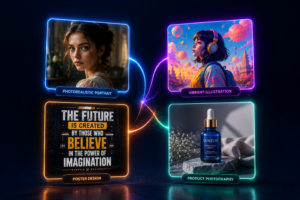
There’s no longer one single “best” AI image generator — the leading tools have each carved out a specific strength, and the right pick genuinely depends on what you’re making. Here’s an honest breakdown across the models people are actually comparing in 2026.
1. Midjourney — Best for Artistic, Eye-Catching Visuals
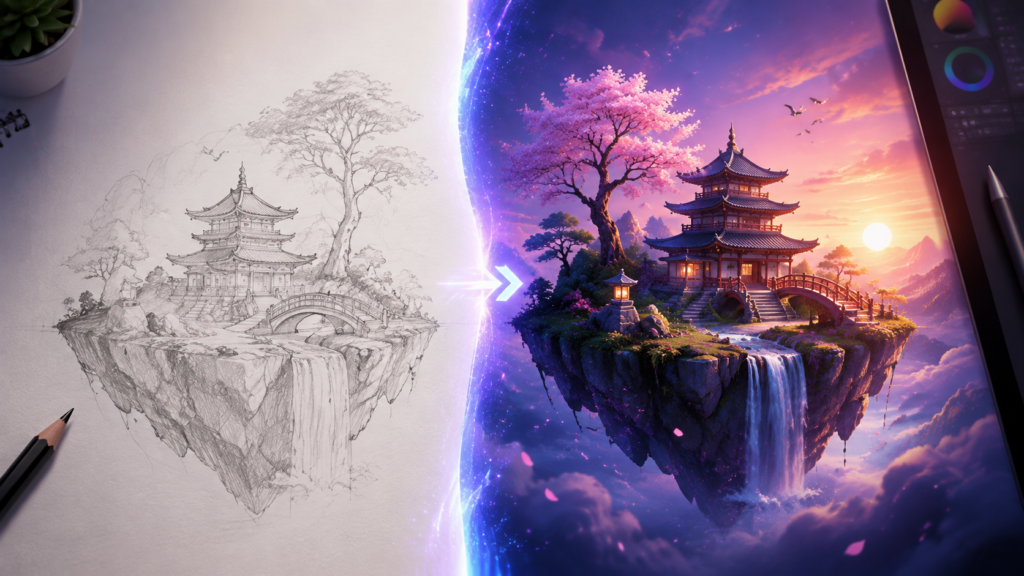
Midjourney has kept the same core advantage since it launched: a distinctive, polished aesthetic with strong lighting, composition, and color grading that other tools only match with significant extra effort. If a brief calls for imagery that looks conceptually designed rather than just technically accurate, Midjourney remains the most consistent choice.
Weakness: Text rendering inside images is weak (around 30-40% accuracy), and it’s subscription-only with no traditional free tier.
Best for: Concept art, mood boards, campaign hero imagery, stylized creative work.
2. DALL-E (via ChatGPT) — Best for Beginners and Quick Iteration
DALL-E’s real strength isn’t raw beauty — it’s correctness and ease of use. It follows complicated, detailed instructions faithfully, renders legible text far better than Midjourney, and supports conversational editing where you can simply say “make the background warmer” and it adjusts accordingly.
Weakness: Output tends to look more like a polished stock photo than a distinctive piece of art.
Best for: Beginners, social graphics with text, quick mockups, anyone already using ChatGPT Plus.
3. Flux (Black Forest Labs) — Best for Technical Control and Product Shots
Flux has emerged as the leading open-weight option, offering strong photorealism and significantly more technical control than closed alternatives — making it popular with developers and businesses building their own AI tools on top of it.
Weakness: Requires more technical comfort than a simple prompt box; less beginner-friendly.
Best for: Product photography, developers, businesses needing high-volume generation at low per-image cost.
4. Google Imagen — Best for Photorealism and Text-in-Image
Imagen has pushed hard on two specific fronts: top-tier photorealism and unusually accurate text rendering inside generated images — a combination that covers a significant share of commercial use cases like product photography and marketing graphics.
Best for: Photorealistic commercial imagery, marketing graphics requiring readable text.
5. Ideogram — Best for Text-Heavy Designs
When an image genuinely needs readable words — a poster, logo, sign, or thumbnail — Ideogram leads with roughly 90-95% text accuracy, dramatically ahead of art-focused tools like Midjourney.
Best for: Posters, logos, thumbnails, sticker designs, and any image where legible text matters.
Quick Decision Guide
- Want the most beautiful, artistic result? Midjourney.
- New to AI image tools, want something easy? DALL-E.
- Need images with readable text or a logo? Ideogram.
- Building a product or need high volume, low cost? Flux.
- Need realistic product photography? Imagen.
A Genuinely Free Way to Start
If you’re not ready to commit to a paid subscription yet, you don’t have to guess which style fits your needs — our own free AI Image Generator lets you experiment with multiple styles (realistic, digital art, anime, 3D) and models at no cost, which is a practical way to understand what you actually need before paying for a premium tool.
Frequently Asked Questions
Which AI image generator is completely free?
Ideogram offers a genuinely free daily tier with commercial rights, and free public tools (like ours) are also available for casual use without any subscription.
Which AI is best for a small business on a budget?
DALL-E via ChatGPT Plus or a free tool is usually sufficient for occasional use; Flux becomes more cost-effective at higher volume.
Is there one AI image generator that’s best at everything?
No — each leading tool has a specific strength (art, text accuracy, photorealism, or technical control), and many professionals use more than one depending on the project.