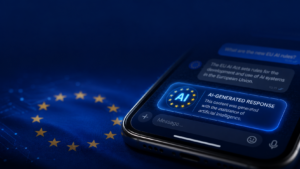
As of August 2, 2026, a new rule is quietly reshaping how AI tools have to behave in Europe. Article 50 of the EU AI Act is now legally enforceable, requiring AI systems to clearly disclose themselves — whether that’s a chatbot admitting it’s not human, or an AI-generated image being labeled as such.
What Article 50 Actually Requires
The rule breaks down into four specific situations, covering both the companies that build AI tools (providers) and the businesses that use them (deployers):
- Chatbots and AI assistants: Must clearly disclose that a user is interacting with AI, unless it’s already obvious from context.
- AI-generated content (images, audio, video, text): Must be marked in a machine-readable format so it can be detected as artificially generated.
- Deepfakes: Content depicting real people, places, or events that didn’t actually happen must be clearly labeled as manipulated or synthetic.
- Emotion recognition and biometric systems: Businesses using these must inform individuals they’re being analyzed this way.
Importantly, this applies to any AI system used in these four situations, not just tools officially classified as “high-risk.” In practice, that makes it relevant to almost any business using generative AI to produce content for an EU audience.
Who Actually Has to Comply
Here’s the detail that catches many businesses off guard: the AI Act applies globally to anyone whose AI outputs are used within the European Union — regardless of where the company itself is based. A business in India, the US, or anywhere else serving EU users or publishing content EU audiences will see falls within scope.
The Penalties Are Serious
Non-compliance can trigger fines of up to €15 million or 3% of worldwide annual turnover, whichever is higher. This isn’t a symbolic gesture — national authorities in EU member states now have the legal power to investigate and take enforcement action starting from August 2.
One Important Exception (Grace Period)
Not everything kicked in immediately. The specific technical requirement to add machine-readable marks to AI-generated content — the detection/watermarking piece — has a transitional period running until December 2, 2026, giving providers extra time to implement the technical marking standards. However, the core disclosure duties (telling users they’re talking to AI, labeling deepfakes) applied immediately on August 2 with no grace period.
What This Means If You Run an AI-Powered Website or Tool
If your website has an AI chatbot, an AI content generator, or you publish AI-generated images, text, or video for an EU audience, here’s a simple compliance checklist:
- Add a clear disclosure near any chatbot or AI assistant stating users are interacting with AI, unless it’s already obviously an AI tool
- Label AI-generated visuals — even a simple “AI-generated image” caption is a reasonable practical step while formal marking standards are finalized
- Don’t retroactively worry about old content — the obligation applies from August 2, 2026 forward; content published before that date doesn’t need retroactive labeling
- Watch for the Code of Practice — the EU has published a voluntary Code of Practice with recognized AI-content icons that providers can adopt to demonstrate compliance more easily
Why This Matters Beyond Just Legal Risk
Even outside strict legal necessity, this reflects a broader shift in how audiences expect AI content to be presented — transparently, not disguised as human-made. Being upfront about AI use in your own content or tools is increasingly becoming a trust signal rather than just a compliance checkbox.
Frequently Asked Questions
Does this apply to me if I’m not based in the EU?
Yes — the AI Act applies to anyone whose AI outputs or systems are used by individuals within the EU, regardless of where the business is located.
Do I need to label AI-generated images immediately?
The core disclosure duty applies from August 2, 2026, though the specific technical machine-readable marking standard has a transitional period until December 2, 2026.
What counts as “already obvious” and exempt from chatbot disclosure?
This is still being clarified through official guidelines, but generally refers to situations where it’s unmistakably clear to a reasonable user that they’re interacting with an AI system, such as a tool explicitly branded and marketed as an AI assistant.