IBM has unveiled a new dual-architecture processor designed to bring Arm-native workloads directly to IBM Z and LinuxONE mainframe systems, marking a major change in the company’s approach to enterprise computing.
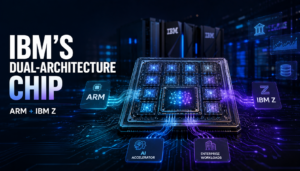
Announced on August 24, 2026, at the annual Hot Chips conference, IBM says the processor is the first dual-architecture mainframe processor designed to allow organizations to run Arm and IBM computing workloads on the same physical processor cores.
The new architecture is being developed for future IBM Z and LinuxONE systems and is intended to give enterprises access to the rapidly growing Arm software ecosystem without giving up the reliability, security and scalability associated with IBM’s mainframes.
IBM Brings Arm Directly to Mainframes
Arm has become one of the most important processor architectures in modern cloud and AI infrastructure.
Major technology companies use Arm-based systems across cloud computing, data centers and edge infrastructure.
IBM’s new processor is designed to bring that ecosystem into its traditional mainframe environment.
That could give enterprises another way to modernize applications while continuing to use IBM Z infrastructure for mission-critical workloads.
One Processor, Two Architectures
The most unusual part of IBM’s design is that it does not simply place separate Arm and IBM Z cores on the same chip.
IBM says each processor core can natively execute Arm and IBM Z instructions.
This means the same physical cores are designed to support both architectures rather than having a dedicated group of Arm cores and another group of IBM Z cores.
That is the key architectural feature behind IBM’s dual-architecture approach.
Why This Matters for Enterprise Computing
Traditional enterprise systems often have enormous software investments built around existing architectures.
Replacing that infrastructure can be expensive and risky.
IBM’s approach is designed to allow organizations to introduce Arm-native applications while continuing to operate established IBM Z workloads.
That could make modernization less disruptive.
IBM Z Workloads Can Continue Running
IBM Z systems are heavily used for mission-critical enterprise computing.
Organizations depend on them for workloads involving:
- Financial transactions
- Banking
- Insurance
- Government systems
- Large-scale databases
- Enterprise applications
The new processor is designed to preserve support for these IBM environments while adding Arm capabilities.
Arm Brings a Huge Software Ecosystem
According to IBM, the Arm software ecosystem includes more than 22 million developers worldwide.
That ecosystem spans cloud, edge and increasingly AI-related applications.
Bringing Arm into IBM Z could therefore give mainframe customers access to a much broader range of modern software.
AI Is a Major Reason Behind the Move
AI is one of the major forces driving the expansion of Arm-based infrastructure.
Modern AI software increasingly runs across heterogeneous computing environments.
IBM says the new processor is designed to help enterprises bring modern AI and cloud-native workloads closer to their mission-critical data.
Arm and AI Are Becoming Increasingly Connected
Arm has become deeply embedded in modern cloud and AI infrastructure.
Companies including AWS, Google, Meta, Microsoft and NVIDIA are using Arm-based technology across different parts of their infrastructure.
IBM’s partnership with Arm is therefore aimed at connecting the Arm ecosystem with a new category of enterprise systems.
The Processor Uses 2nm Technology
IBM says the new processor is being built using a 2-nanometer technology node.
The chip is designed with 11 high-performance cores operating at more than 5.7 GHz.
That makes it a highly ambitious processor design aimed at demanding enterprise workloads.
AI Acceleration Is Built In
The processor also includes dedicated AI inference accelerators.
IBM says these accelerators are designed to support workloads such as in-transaction fraud detection.
This is particularly relevant to financial institutions, where transactions need to be analyzed rapidly while maintaining strict security and reliability requirements.
Dedicated Data Processing Unit
IBM’s processor also includes a dedicated on-chip data processing unit designed to accelerate I/O operations.
That can help reduce the overhead associated with moving and processing large amounts of enterprise data.
Large Cache for Enterprise Workloads
The chip includes a large cache architecture designed for demanding enterprise workloads.
Large caches can help processors keep frequently accessed data closer to the cores, potentially reducing latency for certain workloads.
IBM Is Not Abandoning Its Mainframe Architecture
The goal isn’t to replace IBM Z with Arm.
Instead, IBM is attempting to combine both architectures within the same processor design.
That gives enterprises more flexibility in deciding which applications should run on which architecture.
Arm Linux Can Run Alongside z/OS
IBM says future systems using the processor will be designed to support Arm-native Linux environments alongside z/OS and Linux on IBM Z.
That creates an interesting combination:
Traditional mainframe workloads
plus
Modern Arm-native applications
on the same overall enterprise platform.
Why Linux Matters
Linux is one of the most widely used operating systems in modern cloud and enterprise infrastructure.
Arm-based Linux applications are already common in cloud environments.
Allowing Arm-native Linux workloads to run alongside traditional IBM Z environments could make it easier for enterprises to reuse existing software investments while adopting newer applications.
Enterprises Could Get More Software Choice
One of IBM’s main arguments for the new architecture is software choice.
Organizations won’t necessarily have to choose between maintaining their existing mainframe infrastructure and adopting Arm-native applications.
The new processor is intended to support both.
Modernization Without a Complete Migration
For large enterprises, moving critical applications from established systems to completely different infrastructure can take years.
IBM’s dual-architecture approach could provide another modernization path.
Companies could gradually introduce new applications while continuing to run existing systems.
The Architecture Could Be Important for AI
AI workloads increasingly need access to enterprise data.
For banks, insurers and other highly regulated organizations, moving sensitive data to external infrastructure isn’t always desirable or practical.
Running AI-related workloads closer to the data could therefore be valuable.
Fraud Detection Is One Example
IBM specifically highlights AI inference for in-transaction fraud detection.
A financial institution could potentially analyze transactions in real time while maintaining the data and processing environment within its enterprise infrastructure.
This is an area where IBM’s mainframe capabilities and AI acceleration can overlap.
Security Remains a Major Focus
IBM says Arm workloads on the new processor will benefit from the enterprise security capabilities associated with IBM Z and LinuxONE.
These include:
- Hardware-level fault detection
- Recovery capabilities
- Advanced encryption
- Secure key management
- Enterprise reliability
Reliability Is Another Key Advantage
Mainframes are designed for extremely demanding workloads where downtime can have significant financial consequences.
IBM wants the new architecture to bring Arm applications into that high-reliability environment.
IBM Z Can Scale to Huge Systems
IBM says its Z and LinuxONE platforms can scale to hundreds of cores and tens of terabytes of memory.
That scalability is important because the new processor isn’t designed simply for small experimental workloads.
It is intended for large enterprise systems.
IBM and Arm Started Working Together Earlier This Year
The new processor is the first major milestone from IBM and Arm’s strategic collaboration announced in April 2026.
The collaboration was designed to explore dual-architecture hardware and expand Arm’s software ecosystem into mission-critical enterprise computing.
The Partnership Goes Beyond One Chip
IBM and Arm’s broader collaboration focuses on:
- Software compatibility
- Virtualization
- Enterprise security
- Reliability
- AI workloads
- Data-intensive applications
- Long-term ecosystem development
Virtualization Is Part of the Strategy
IBM and Arm previously said they were exploring virtualization technologies that would allow Arm-based software environments to operate within IBM enterprise computing platforms.
That work is important because enterprises need ways to run different software environments without completely replacing existing infrastructure.
What Does Dual Architecture Actually Mean?
In simple terms, imagine a processor that can speak two different computing languages.
Traditional IBM Z software uses IBM’s architecture.
Modern Arm applications use the Arm architecture.
IBM’s new processor is designed so that the same physical core can understand both.
That is what makes the architecture different from a system that simply puts separate Arm and IBM Z cores next to each other.
Why Not Just Add Separate Arm Cores?
IBM could have built a chip containing traditional Z cores plus separate Arm cores.
Instead, it chose a design where each core supports both instruction architectures.
This could provide more flexibility in how computing resources are allocated between workloads.
Workloads Can Share the Same Infrastructure
The architecture is designed to let different types of workloads operate within the same overall system.
For example:
IBM Z workload → traditional enterprise application
Arm workload → cloud-native application
AI workload → AI-accelerated processing
This creates a more flexible enterprise computing environment.
The Chip Is Still Being Developed
One important detail is that IBM has announced the processor design, but it is being developed for future IBM Z and LinuxONE systems.
IBM has not announced general availability of systems based on this new processor in the August 24 announcement.
This Is Not a New IBM Z Product Launch
The announcement should not be confused with the recent IBM z17 and LinuxONE 5 product availability.
Those systems are already available.
The new dual-architecture processor represents a future processor direction for IBM’s platforms.
IBM’s Current Mainframe Generation
IBM’s current Z platform includes the z17 generation, which incorporates AI acceleration and other enterprise capabilities.
The new dual-architecture processor represents another step in IBM’s longer-term roadmap.
Why Mainframes Still Matter
Despite the rise of cloud computing, mainframes remain important for large organizations.
Banks, insurers and governments continue to depend on mainframes for workloads that require:
- High reliability
- Strong security
- Massive transaction processing
- Long-term availability
- Large-scale data processing
IBM’s strategy is to modernize the platform rather than abandon it.
Arm Could Help Modernize Mainframe Software
One of the biggest challenges for established enterprise platforms is keeping pace with modern software ecosystems.
Arm support could give developers another architecture to target.
That could make IBM Z more attractive to organizations building new applications.
Developers Get More Options
Developers already familiar with Arm-based Linux environments may be able to bring those skills into IBM’s enterprise ecosystem.
That could reduce some of the barriers associated with developing applications for traditional mainframe environments.
AI Developers Could Benefit
AI developers increasingly work with Arm-based infrastructure.
Bringing Arm to IBM Z could potentially make it easier to deploy certain modern AI software closer to enterprise data.
That could be especially relevant for regulated industries.
Financial Services Could Be a Major Use Case
Banks are among the most important users of IBM Z systems.
The combination of:
Mainframe reliability + Arm software + AI acceleration
could be particularly attractive for financial services.
Fraud detection is one example IBM specifically identifies.
Healthcare Could Also Benefit
Healthcare organizations process sensitive information and require strong security and reliability.
An enterprise architecture that can combine modern applications with highly controlled infrastructure could potentially be valuable in healthcare environments.
Government Workloads Are Another Potential Market
Government agencies often operate mission-critical systems that have long lifecycles.
The ability to introduce modern applications without completely replacing existing infrastructure could be useful for these environments.
IBM Is Targeting Mission-Critical AI
The announcement reflects a broader trend in enterprise AI.
Businesses increasingly want AI capabilities directly inside core business processes rather than isolated experiments.
IBM wants its mainframes to remain part of that transition.
AI and Mainframes Are Converging
The new processor represents an intersection between two traditionally different worlds:
Mainframe computing
and
modern AI/cloud infrastructure
Arm provides the bridge between those ecosystems.
What Could This Mean for Cloud Computing?
IBM’s approach could create another option for enterprises that want cloud-native software while keeping workloads inside their own controlled infrastructure.
This could be relevant to organizations with strict data sovereignty requirements.
Data Sovereignty Is Increasingly Important
Many organizations need to know where their data is processed and stored.
Keeping sensitive workloads on enterprise-controlled infrastructure can make compliance and data governance easier.
IBM’s Hybrid Cloud Strategy
IBM has increasingly positioned itself around hybrid cloud rather than requiring customers to move everything to public cloud.
The dual-architecture processor fits into that broader strategy by expanding what workloads can run on IBM infrastructure.
Competition With Other Enterprise Chips
The new architecture also puts IBM in an interesting position within the broader enterprise processor market.
Arm has become extremely important in cloud infrastructure, while IBM maintains a strong position in mission-critical mainframe computing.
Combining the two could help IBM defend its mainframe ecosystem while making it more compatible with modern infrastructure trends.
Could This Challenge x86?
The processor is not simply a direct replacement for x86.
Its primary purpose is to bring Arm capabilities into IBM’s Z and LinuxONE ecosystem.
However, the broader move reinforces the growing importance of Arm as an alternative processor architecture across enterprise computing.
The Bigger Industry Trend
The processor reflects a major trend in computing:
Architecture flexibility is becoming increasingly important.
Enterprises don’t necessarily want to commit every workload to one architecture.
They want infrastructure that can support different applications and workloads efficiently.
IBM Is Betting on Heterogeneous Infrastructure
Modern data centers increasingly combine different processor architectures and accelerators.
IBM’s dual-architecture processor takes that idea directly into the mainframe.
Instead of separate systems for every workload, organizations could potentially consolidate more applications onto a flexible platform.
What Happens Next?
The next major step will be the development and eventual deployment of IBM Z and LinuxONE systems based on the new processor.
IBM will need to provide additional details about:
- System configurations
- Performance
- Availability
- Pricing
- Software support
- Developer tools
- Customer deployments
Performance Will Be Closely Watched
The processor’s architecture is interesting, but real-world performance will ultimately determine its impact.
Enterprises will want to know how Arm workloads perform compared with conventional Arm servers and how IBM Z workloads perform compared with existing Z processors.
Software Compatibility Will Also Matter
Hardware alone cannot create a successful ecosystem.
IBM and Arm will need developers and software vendors to support the architecture.
The size of Arm’s existing software ecosystem gives IBM a strong starting point.
The 22 Million Developer Ecosystem Is Important
IBM highlights Arm’s more than 22 million developers as one of the major advantages of bringing the architecture to its platforms.
That ecosystem could help IBM expand the range of applications available to its enterprise customers.
Final Verdict
IBM has unveiled a potentially significant new processor architecture designed to bring Arm-native computing directly into IBM Z and LinuxONE mainframes.
The processor is notable because IBM says it is not simply combining separate Arm and IBM Z cores. Instead, each physical core is designed to natively execute both Arm and IBM Z instructions.
Built on a 2nm process, the design includes 11 high-performance cores running above 5.7 GHz, AI inference accelerators, an on-chip data processing unit and a large cache architecture.
For enterprises, the biggest potential benefit is flexibility.
Organizations could gain access to the enormous Arm software ecosystem while continuing to use IBM’s established mainframe infrastructure for mission-critical workloads.
The announcement also demonstrates IBM’s broader strategy of bringing AI and modern cloud-native software into environments where security, reliability and data sovereignty remain critical.
The processor is still being developed for future IBM Z and LinuxONE systems, so its ultimate impact will depend on availability, real-world performance and software adoption.
But if IBM succeeds, the new architecture could represent a significant evolution of the mainframe — bringing one of the industry’s oldest computing platforms closer to the architecture powering much of modern cloud and AI infrastructure.
Read More:- Anthropic Updates Claude Slack Agent to Read Full Conversations and Act Proactively
FAQ
What did IBM announce?
IBM announced a new dual-architecture processor for future IBM Z and LinuxONE systems that is designed to natively run both IBM Z and Arm workloads.
What is special about IBM’s new processor?
The processor is designed so the same physical cores can execute both Arm and IBM Z instructions. IBM says it does not use separate Arm and IBM cores on the chip.
Can the same core run Arm and IBM Z workloads?
Yes. IBM says each processor core can natively execute Arm and IBM Z, or Arm and LinuxONE, instructions concurrently.
What architecture does the new IBM processor support?
The processor supports IBM’s Z architecture alongside the Arm architecture, enabling Arm-native Linux environments to operate alongside traditional IBM workloads.
Is this a separate Arm chip inside IBM Z?
No. IBM specifically says the design does not contain separate Arm and IBM cores. The Arm instruction set is integrated directly into the processor cores.
What process technology is IBM using?
The processor is being designed using a 2-nanometer technology node.
How many cores does the processor have?
IBM says the design contains 11 high-performance processor cores.
What clock speed will the IBM chip reach?
The cores are designed to operate at more than 5.7 GHz.
Does the processor include AI acceleration?
Yes. IBM says the chip includes AI inference accelerators designed for workloads such as in-transaction fraud detection.
What is the DPU used for?
The processor includes a dedicated on-chip data processing unit designed to accelerate I/O operations.
Does the processor have a large cache?
Yes. IBM says it includes a large cache architecture designed for demanding enterprise workloads.
What operating systems can run on the new architecture?
IBM says future systems are being designed to run Arm-native Linux alongside z/OS and Linux on IBM Z.
Why is Arm important for IBM?
Arm has a large and rapidly growing software ecosystem. IBM says there are more than 22 million Arm developers worldwide, giving enterprise customers access to a broad range of modern applications.
Why does IBM want Arm on mainframes?
The goal is to give enterprise customers access to Arm-native applications while retaining IBM Z’s security, reliability, scalability and mission-critical computing capabilities.
Can existing IBM Z workloads continue running?
Yes. The processor is designed to support established IBM Z workloads while adding native Arm capabilities.
Is this processor available now?
No. IBM announced the processor as a design being developed for future IBM Z and LinuxONE systems. It is not being announced as a currently available commercial processor.
Is this the next IBM Z processor?
It is part of IBM’s future processor direction for IBM Z and LinuxONE, but IBM has not announced it as a currently shipping product.
Is this related to IBM z17?
The new processor represents a future architecture rather than the announcement of a new z17 system. IBM’s current z17 generation is already available.
Can Arm and IBM Z workloads run simultaneously?
IBM says the processor is designed to allow Arm and IBM Z or LinuxONE instructions to execute concurrently on the same cores.
Why is running both architectures on the same core important?
It could provide greater flexibility than a system containing separate Arm and IBM Z processor cores, potentially allowing computing resources to be used across different workload types.
Could the processor help enterprises modernize applications?
Yes. IBM is positioning the architecture as a way for organizations to adopt Arm-native and cloud-native applications without abandoning their existing mission-critical IBM infrastructure.
Could the processor be useful for AI?
Yes. IBM specifically highlights AI inference acceleration and says the processor is intended to help bring modern AI workloads closer to enterprise data and mission-critical applications.
What is an example of an AI workload?
IBM specifically identifies in-transaction fraud detection as an example of an AI inference workload that the processor’s accelerators are designed to support.
Why is fraud detection a good use case?
Financial transactions often need to be analyzed quickly. Running AI inference closer to transaction-processing infrastructure could potentially help organizations analyze transactions while maintaining enterprise security and reliability.
Could banks use this technology?
Banks are a major potential use case because IBM Z and LinuxONE are widely used for mission-critical financial workloads, and the new processor is designed to combine those capabilities with Arm and AI technologies.
Could healthcare organizations use it?
Potentially. Healthcare workloads often require strong security, reliability and data governance, making the combination of enterprise infrastructure and modern application support potentially useful.
Could governments use the processor?
Potentially. Government organizations with long-running mission-critical applications could benefit from an architecture that supports modernization without requiring an immediate migration away from established infrastructure.
Does the chip support Linux?
Yes. IBM says future systems will support Arm-native Linux as well as Linux on IBM Z.
Does the chip support z/OS?
IBM says the future platform is designed to allow Arm-native Linux environments to run simultaneously with z/OS and Linux on IBM Z.
Does the processor support cloud-native applications?
The architecture is designed to bring the Arm software ecosystem, which has extensive cloud-native software support, into IBM’s enterprise computing platforms.
How large is the Arm developer ecosystem?
IBM says the Arm ecosystem has more than 22 million developers worldwide.
How much memory can IBM Z and LinuxONE systems scale to?
IBM says its Z and LinuxONE platforms can scale to hundreds of cores and tens of terabytes of memory.
Does the processor improve security?
IBM says Arm workloads on the processor can benefit from IBM enterprise capabilities including advanced encryption, secure key management, hardware-level fault detection and recovery.
Is the processor designed for mission-critical workloads?
Yes. IBM is specifically targeting enterprise environments where reliability, security, scalability and availability are critical.
Is IBM replacing its Z architecture with Arm?
No. IBM is combining Arm support with its existing architecture rather than replacing IBM Z.
Could this reduce the need for separate servers?
Potentially. The architecture could allow organizations to consolidate different types of workloads onto IBM infrastructure, although the actual consolidation benefits will depend on workload and system configuration.
How is this different from having Arm and Z cores on one chip?
In a conventional multi-architecture design, separate cores could handle different instruction sets. IBM’s approach is different because the same processor cores are designed to execute both architectures.
When did IBM and Arm begin working together?
IBM and Arm established their strategic collaboration in April 2026. The new processor is the first major processor milestone announced from that collaboration.
Why is the IBM-Arm partnership important?
The partnership aims to expand Arm’s software ecosystem into mission-critical enterprise computing while allowing IBM customers to access modern software and AI technologies.
Could this compete with x86 processors?
The processor is not primarily positioned as a direct x86 replacement. Its main goal is to bring Arm capabilities into IBM Z and LinuxONE enterprise environments.
Could this increase Arm adoption in enterprise computing?
Potentially. Bringing Arm directly into IBM’s mainframe ecosystem could expose the architecture to organizations that traditionally rely on IBM’s own processor architecture.
What is the biggest advantage of the processor?
The biggest advantage is architectural flexibility: enterprises can potentially run traditional IBM workloads and modern Arm-native applications within the same broader infrastructure.
What is the biggest challenge?
The biggest challenge will be software compatibility, real-world performance and adoption. Hardware support alone is not enough; enterprises need applications and development tools that work effectively with the architecture.
When will IBM provide performance benchmarks?
IBM has not provided final commercial-system performance benchmarks in the August 24 announcement.
When will the processor be commercially available?
IBM has not announced a specific commercial availability date for systems using the processor.
Is this a production chip?
The processor is currently part of IBM’s development roadmap. IBM has not announced a generally available commercial system based on this design.
Why is this announcement important for AI?
It shows IBM is trying to bring modern Arm-based software and AI capabilities directly into the mission-critical infrastructure used by large enterprises.
What does this mean for the future of mainframes?
The processor suggests that mainframes could evolve beyond traditional workloads and become more flexible platforms for cloud-native applications and AI.
Could IBM’s new chip change enterprise computing?
Potentially. If the architecture performs as intended, it could make IBM Z and LinuxONE more attractive for organizations that want to combine traditional mainframe applications with modern Arm-based software.
What is the biggest takeaway?
IBM’s new processor is significant because it puts Arm and IBM Z execution on the same physical processor cores, giving future IBM Z and LinuxONE systems a way to combine traditional mainframe workloads with modern Arm-native applications and AI software.