Xiaomi has officially unveiled its next-generation Xring O3 smartphone processor, marking another major step in the company’s effort to build its own high-end semiconductor technology.
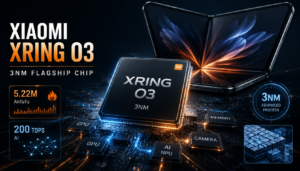
The new chip is manufactured using an advanced 3nm process, with Reuters reporting that Taiwan Semiconductor Manufacturing Co. (TSMC) will manufacture the processor. Xiaomi’s move strengthens its push to reduce dependence on external chip suppliers such as Qualcomm and MediaTek.
The Xring O3 arrives roughly a year after Xiaomi introduced the Xring O1, making it the company’s latest attempt to compete more directly with smartphone chip platforms developed by companies such as Apple, Samsung and Huawei.
The processor is expected to debut in Xiaomi’s upcoming flagship foldable smartphone, while Xiaomi has also announced another device that will use the chip.
Xiaomi’s Biggest Custom Chip Push Yet
Xiaomi’s decision to develop its own smartphone processors is about more than raw performance.
By controlling more of the chip design, Xiaomi can potentially gain greater control over:
- Performance
- Power efficiency
- AI processing
- Imaging
- Software optimization
- Product differentiation
- Supply-chain planning
That could become increasingly important as competition in premium smartphones intensifies.
Xring O3 Uses 3nm Technology
One of the biggest technical highlights of the Xring O3 is its 3nm manufacturing process.
TSMC is reported to be manufacturing the processor using its 3nm technology.
A smaller process node generally allows chip designers to fit more transistors into a given area and potentially improve performance and power efficiency.
However, process technology alone does not determine real-world performance.
Chip architecture, cooling, software optimization, memory and workload characteristics all matter.
Xiaomi Is Taking on Qualcomm and MediaTek
For years, Xiaomi has relied heavily on Qualcomm and MediaTek for smartphone processors.
The Xring project represents a strategic attempt to reduce that dependence.
Other smartphone manufacturers have followed a similar path.
Apple designs its A-series chips.
Samsung develops Exynos processors.
Huawei has developed its own Kirin platform.
Xiaomi is now trying to build a stronger position in the same ecosystem.
Huawei Is an Important Rival
The Xring O3 also arrives as Xiaomi competes more aggressively in China’s premium smartphone and foldable markets.
Huawei remains particularly strong in China’s foldable-phone segment.
According to Seoul Economic Daily, market-research data showed Huawei shipped about 1.6 million foldables in China during the second quarter, representing a reported 68% market share.
That makes Xiaomi’s upcoming foldable strategy strategically important.
Xring O3 Could Power Xiaomi’s New Foldable
One source familiar with Xiaomi’s plans told Reuters that the Xring O3 is expected to power an upcoming flagship folding phone.
The source estimated a shipment target of approximately 200,000 to 300,000 units.
The exact commercial rollout and final shipment numbers could change.
Xiaomi 18 Fold Is Expected to Use Xring O3
Xiaomi has announced that the Xiaomi 18 Fold will be among the first products to use the Xring O3.
The foldable is expected to launch in China in September 2026.
This makes the Xring O3 an important part of Xiaomi’s next flagship hardware generation.
Xiaomi Pad 9 Pro Max Will Also Use the Chip
The Xring O3 will not be limited to smartphones.
Reports indicate that Xiaomi’s Pad 9 Pro Max will also use the processor.
Both products are expected to launch in China in September.
Using the same high-end chip across multiple product categories could help Xiaomi spread the cost of its semiconductor development.
A 10-Core All-Big-Core CPU
According to launch reports, the Xring O3 features a 10-core CPU design made entirely from high-performance cores.
This is an unusual architecture compared with the traditional combination of performance and efficiency cores used in many smartphone processors.
The approach is designed to deliver strong performance across demanding workloads.
Xiaomi Claims a Major CPU Performance Increase
Xiaomi has reported significant performance improvements compared with the Xring O1.
Launch reporting indicates a claimed 60% CPU performance improvement over the previous generation.
Real-world performance will depend on the final devices, software and thermal management.
Xring O3 Uses a New GPU
The processor includes Xiaomi’s G2-Ultra NX GPU.
According to Xiaomi’s launch claims, the GPU delivers a major generational performance increase while also improving power efficiency.
Reported figures include:
- Up to 85% higher peak GPU performance
- Up to 182% improvement in ray-tracing performance
- Up to 64% better power efficiency
These are Xiaomi’s claimed figures and should be independently validated on retail devices.
Stronger Ray Tracing
Mobile ray tracing has become an increasingly important feature for premium smartphone processors.
The Xring O3’s GPU improvements could allow Xiaomi to target more demanding graphics workloads.
This could benefit:
- Mobile gaming
- Real-time rendering
- Visual effects
- Advanced UI effects
- AI-enhanced graphics
On-Device AI Gets a Major Upgrade
AI is another major focus of the Xring O3.
The chip reportedly includes an NPU capable of 200 TOPS tensor computing performance.
That gives Xiaomi additional hardware resources for running AI workloads directly on the device.
Why On-Device AI Matters
Running AI locally can provide several advantages.
Instead of sending every request to a cloud server, compatible AI workloads can potentially run directly on the phone.
That can improve:
- Response time
- Privacy
- Offline functionality
- Network independence
- AI feature availability
Xiaomi Is Connecting Xring to Its MiMo AI Strategy
Xiaomi is developing additional custom chips alongside the O3.
One of them is the Xring O100, an NPU designed to support Xiaomi’s MiMo large language model.
This indicates that Xiaomi’s semiconductor strategy extends beyond smartphone CPUs.
Xring O100 Targets AI
The O100 is designed specifically around AI processing.
Reuters and other reports say Xiaomi is developing the chip with TSMC, with the O100 expected to serve AI-related workloads.
The company is therefore building a broader custom-silicon portfolio.
Xiaomi Is Also Building an Automotive Chip
Another chip in Xiaomi’s new semiconductor lineup is the Xring D100.
The D100 is designed for intelligent driving and automotive applications.
This is particularly significant because Xiaomi is also expanding its electric-vehicle business.
Three Chips, Three Different Markets
Xiaomi’s latest semiconductor strategy can be summarized as:
Xring O3 → Smartphones and tablets
Xring O100 → AI
Xring D100 → Intelligent driving
This shows that Xiaomi wants its semiconductor capabilities to extend across multiple businesses.
Xiaomi Has Invested Billions in Chip Development
Reuters reports that Xiaomi has invested more than 20 billion yuan, or roughly $3 billion, in chip development.
That represents a substantial long-term investment for a company that only recently began expanding its proprietary silicon ambitions.
Xiaomi’s Semiconductor Team Is Growing
The company’s chip-development team has reportedly grown to more than 3,000 people, up from around 2,500 a year earlier.
That increase demonstrates the scale of Xiaomi’s commitment to semiconductor engineering.
Xring O1 Was the Starting Point
The Xring O3 is not Xiaomi’s first proprietary smartphone processor.
The company introduced the Xring O1 in 2025.
Xiaomi said cumulative shipments of devices powered by the O1 had surpassed 1 million units.
O1 Smartphone Shipments Were More Limited
Sources cited by Reuters estimated that Xiaomi sold approximately 150,000 O1-powered smartphones after the chip’s May 2025 launch.
The broader one-million-plus figure includes devices such as smartphones, tablets and watches.
Xiaomi Wants Wider Adoption With O3
The Xring O3 appears to represent a more ambitious strategy.
Rather than limiting the processor to a small number of devices, Xiaomi is expected to use it across multiple premium products.
That could improve the economics of Xiaomi’s custom-chip investment.
Why Custom Chips Matter to Xiaomi
Developing an in-house processor can give Xiaomi more control over the complete product.
Instead of relying entirely on an external chip vendor, Xiaomi can coordinate:
Chip → Software → AI → Camera → Display → Device
This vertical integration can create more opportunities for optimization.
Better Software-Hardware Integration
Apple has demonstrated the benefits of designing hardware and software together.
Xiaomi is increasingly trying to follow a similar model.
Its custom silicon can be tuned specifically for Xiaomi’s software and AI workloads.
Xiaomi Can Optimize AI More Deeply
A proprietary NPU gives Xiaomi greater control over how AI workloads are executed.
The company can optimize its AI models and device software around its own silicon.
That could become increasingly important as smartphone manufacturers compete on AI features.
AI Is Becoming a Smartphone Differentiator
Smartphone competition is no longer only about:
- Camera megapixels
- Display refresh rate
- Battery capacity
- Processor speed
AI capabilities are increasingly becoming a major differentiator.
Custom silicon can help manufacturers build specialized AI features that competitors may not easily replicate.
Xring O3 Could Strengthen Xiaomi’s Premium Position
Xiaomi has historically competed aggressively on value.
But the company has increasingly moved toward premium devices.
A powerful proprietary processor could help Xiaomi demonstrate that its flagship phones can compete at the high end.
The Foldable Market Is Especially Important
Foldables are among the most expensive smartphones.
They also require significant engineering investment.
Using proprietary silicon could help Xiaomi differentiate its foldable devices beyond display and hinge design.
Huawei Remains a Major Challenge
Huawei has built strong momentum in China’s foldable market.
Its proprietary Kirin chips and HarmonyOS ecosystem provide a vertically integrated alternative to Xiaomi.
The Xring O3 gives Xiaomi another way to compete.
Xiaomi Is Not Yet Fully Independent From External Chips
Despite its custom silicon efforts, Xiaomi remains dependent on external chip suppliers for substantial portions of its smartphone business.
The relatively limited projected shipment volume of the Xring O3-powered foldable suggests Xiaomi’s in-house chips are not yet replacing Qualcomm and MediaTek at scale.
The 3nm Node Is Important but Not Enough
The Xring O3 uses 3nm technology.
However, competing flagship processors are moving toward more advanced process nodes.
Reports indicate next-generation Qualcomm and MediaTek flagship chips are expected to transition toward 2nm.
That means Xiaomi must compete through architecture, AI capabilities, memory and software optimization rather than process node alone.
Xiaomi Is Betting on Architecture
The Xring O3’s all-big-core CPU design is one example of Xiaomi trying to differentiate its architecture.
The company is also focusing heavily on AI acceleration, graphics and memory technology.
LPDDR6 Support
One of the reported highlights of the Xring O3 is support for LPDDR6 memory.
Launch reports describe it as the first mobile processor to support LPDDR6, with reported memory bandwidth of approximately 113.8GB/s.
Faster memory can help feed demanding CPU, GPU and AI workloads.
AnTuTu Performance
The Xring O3 reportedly achieved an AnTuTu v11 score above 5.2 million.
One launch report cites a score of 5,228,014.
However, benchmark scores should not be treated as a direct measure of overall smartphone experience.
Why Benchmarks Need Context
Benchmark results can vary based on:
- Device cooling
- Software version
- Performance mode
- Battery level
- Temperature
- Test methodology
Independent testing on retail devices will be more useful for judging the Xring O3 against competing chips.
Gaming Could Be a Major Use Case
The combination of a powerful GPU, ray-tracing support and improved AI processing could make the Xring O3 attractive for gaming-focused users.
Xiaomi can potentially use the chip to improve graphics performance while controlling power consumption.
AI-Enhanced Graphics
The chip reportedly includes additional hardware accelerators for AI-powered graphics and image processing.
This could enable functions such as:
- AI upscaling
- Frame interpolation
- Image enhancement
- Noise reduction
- Advanced video processing
Camera Processing Could Improve
Smartphone image quality increasingly depends on computational photography.
The Xring O3 reportedly includes AI and image-processing hardware designed to accelerate these workloads.
That gives Xiaomi more control over the camera pipeline.
Better Night Video
Launch information indicates Xiaomi has integrated AI-related processing into the chip’s imaging architecture.
The company is targeting improvements in areas such as night-scene video noise reduction.
Xiaomi’s Semiconductor Strategy Is Expanding
The company is no longer treating chips as a single smartphone component.
Instead, Xiaomi is building a broader silicon portfolio.
That portfolio now spans:
Mobile computing
AI
Automotive
The EV Business Makes Custom Chips More Valuable
Xiaomi’s electric-vehicle business is expanding quickly.
Reuters reported that Xiaomi delivered more than 104,000 vehicles and generated 23.9 billion yuan in Q2 revenue from its EV-related business.
The D100 automotive chip could therefore become an important part of Xiaomi’s long-term technology strategy.
Xiaomi Is Following a Broader Industry Trend
The shift toward proprietary silicon is happening across the technology industry.
Apple designs its own processors.
Google has Tensor.
Samsung develops Exynos.
Huawei develops Kirin.
Amazon and Microsoft are also developing custom data-center silicon.
Xiaomi is now expanding in the same direction.
Supply-Chain Resilience Is a Major Reason
External chip suppliers can create dependencies.
Developing its own processor gives Xiaomi greater control over product planning and supply.
This becomes particularly valuable during periods of component shortages or geopolitical uncertainty.
Xiaomi Can Negotiate More Effectively
Even when Xiaomi continues buying external processors, having an internal alternative can strengthen its bargaining position with suppliers.
The company can potentially use its own silicon to reduce dependence.
China Is Pushing Semiconductor Self-Reliance
Xiaomi’s chip strategy also fits into China’s broader push to develop domestic technology capabilities.
Advanced semiconductor manufacturing remains difficult, making proprietary chip design strategically important.
TSMC Still Plays an Important Role
Although Xiaomi designs the Xring processor, Reuters reports that TSMC will manufacture the O3 using its 3nm technology.
This means chip design independence does not necessarily mean manufacturing independence.
Designing a Chip Is Extremely Expensive
Modern flagship SoCs require enormous engineering resources.
They involve:
- CPU design
- GPU architecture
- NPU design
- ISP
- Memory controllers
- Connectivity
- Security
- Power management
- Software drivers
Xiaomi’s growing semiconductor team reflects the scale of this challenge.
Xiaomi’s $3 Billion Investment Shows Long-Term Intent
Spending more than 20 billion yuan on chip development demonstrates that Xiaomi is not treating custom silicon as a short-term experiment.
The company appears to be building a long-term semiconductor organization.
The Biggest Challenge Is Scale
Designing a powerful chip is only one part of the challenge.
The company must sell enough devices using the chip to justify its development costs.
That is why broader adoption of Xring O3 could be strategically important.
The Biggest Opportunity Is Vertical Integration
If Xiaomi successfully combines:
Xring
HyperOS
MiMo AI
Xiaomi hardware
it could create a more tightly integrated technology ecosystem.
Xiaomi Could Eventually Reduce Qualcomm Dependence
If future generations of Xring become competitive enough, Xiaomi could potentially use them across a much larger percentage of its premium lineup.
That would reduce its dependence on Qualcomm and MediaTek.
But the company is not at that point yet.
The O3 Is an Important Step
Even if Xring O3 does not immediately dominate the smartphone chip market, its development represents progress.
The company has moved from launching its first proprietary processor to developing a broader family of chips.
What Does This Mean for Consumers?
For Xiaomi users, the biggest potential benefits are:
- Faster performance
- Better AI processing
- Improved power efficiency
- Better camera processing
- More optimized software
- Stronger gaming performance
The real-world benefits will depend on how Xiaomi implements the chip in its devices.
What Does This Mean for Huawei?
The Xring O3 increases Xiaomi’s ability to compete with Huawei in premium Chinese smartphones.
However, it does not mean Xiaomi has already overtaken Huawei.
Huawei still has major advantages in its domestic market, particularly in foldables and its own hardware-software ecosystem.
What Does This Mean for Qualcomm?
A stronger Xiaomi custom-chip strategy could reduce Qualcomm’s potential share of Xiaomi’s premium-device business.
But Xiaomi’s initial O3 volumes are still relatively small.
What Does This Mean for MediaTek?
MediaTek faces a similar long-term challenge.
If Chinese smartphone manufacturers increasingly develop their own processors, external chip vendors could face more competition in premium devices.
The Bigger Story Is China’s Chip Ambition
The Xring O3 is not just another smartphone processor.
It represents a Chinese technology company’s attempt to control more of its semiconductor stack.
That could become increasingly important as competition around advanced chips intensifies globally.
Final Verdict
Xiaomi’s Xring O3 represents a major step in the company’s transition from a smartphone manufacturer that primarily relies on external processors to a company developing its own high-end silicon.
Built using a 3nm process and reportedly manufactured by TSMC, the O3 combines a 10-core all-big-core CPU, a new G2-Ultra NX GPU, advanced AI processing and LPDDR6 support.
The chip is expected to power Xiaomi’s upcoming Xiaomi 18 Fold, while the Xiaomi Pad 9 Pro Max is also set to use the processor.
For Xiaomi, the goal goes beyond beating a particular competitor.
The company wants greater control over its technology, reduce dependence on Qualcomm and MediaTek, improve hardware-software integration and build a semiconductor platform that can serve smartphones, AI systems and vehicles.
Huawei is an especially important rival because of its strength in China’s premium and foldable smartphone market.
But the Xring O3 does not automatically make Xiaomi the leader.
The chip still uses a 3nm process while some competing next-generation processors are moving toward 2nm, and Xiaomi’s initial O3-powered device volumes are expected to remain relatively limited.
The real significance of Xring O3 is therefore Xiaomi’s long-term silicon strategy.
If Xiaomi can continue improving Xring chips and expand them across more devices, the company could gradually gain greater control over one of the most important components inside its products.
And that could make Xiaomi a much more serious semiconductor player in the global smartphone industry.
Read More:- Apple Foldable iPhone Ultra Could Launch Above $2,000 in September
FAQ
What is the Xiaomi Xring O3?
The Xring O3 is Xiaomi’s latest flagship smartphone system-on-chip (SoC), designed in-house for high-end mobile devices.
Is the Xring O3 officially launched?
Yes. Xiaomi officially unveiled the Xring O3 on August 24, 2026.
What process is the Xring O3 built on?
The Xring O3 is built using a 3nm manufacturing process. Reuters reports that TSMC will manufacture the chip using its 3nm technology.
Which phones will use the Xring O3?
The Xring O3 is expected to debut in the Xiaomi 18 Fold. It will also be used in the Xiaomi Pad 9 Pro Max, with both products expected to launch in China in September 2026.
How many CPU cores does the Xring O3 have?
The Xring O3 features a 10-core CPU using an all-big-core architecture.
What CPU performance does Xiaomi claim?
Xiaomi claims up to a 60% improvement in CPU performance compared with its previous-generation platform.
What GPU does the Xring O3 use?
The chip features a 16-core G2-Ultra NX GPU. Xiaomi claims up to 85% higher graphics performance and 64% better power efficiency.
Does the Xring O3 support ray tracing?
Yes. The new GPU architecture includes enhanced graphics capabilities, including ray-tracing support.
How powerful is the Xring O3 for AI?
Xiaomi rates the Xring O3 at up to 200 TOPS of tensor computing performance and 3.13 TFLOPS of vector computing performance.
How much better is the NPU?
Xiaomi claims approximately a 45% improvement in NPU performance compared with the previous generation.
Does the Xring O3 support LPDDR6?
Yes. It is Xiaomi’s first mobile chip with LPDDR6 memory support, with reported bandwidth of up to 113.8GB/s.
What AnTuTu score does the Xring O3 achieve?
Xiaomi’s reported benchmark result is 5,228,014 points on AnTuTu V11. This makes it the first mobile SoC reported to cross the five-million mark.
Is the 5.22-million AnTuTu score independently verified?
The 5.22-million figure is a reported launch benchmark. Independent retail-device testing is still needed to determine sustained real-world performance.
Is the Xring O3 faster than Apple’s chips?
The available launch benchmarks are not enough to conclusively establish that the Xring O3 is faster overall than Apple’s processors. Different benchmarks and workloads can produce very different results.
Is the Xring O3 faster than Qualcomm Snapdragon chips?
The Xring O3 appears highly competitive on paper, but independent testing is needed for a reliable chip-to-chip comparison with Qualcomm’s latest flagship platforms.
Is the Xring O3 designed by Xiaomi?
Yes. Xiaomi developed the Xring O3 as part of its in-house silicon strategy, although manufacturing is reportedly handled by TSMC.
Why is Xiaomi making its own smartphone chips?
Xiaomi wants greater control over product features, performance, software optimization and its supply chain while reducing dependence on external chip suppliers such as Qualcomm and MediaTek.
Is Xiaomi trying to replace Qualcomm completely?
Not yet. Current reporting suggests Xring volumes remain relatively small, while Qualcomm and MediaTek will continue supplying much of Xiaomi’s smartphone lineup.
How many Xring-powered devices has Xiaomi shipped?
Xiaomi said cumulative shipments of devices powered by the previous Xring O1—including smartphones, tablets and watches—have surpassed 1 million units.
How many smartphones used the Xring O1?
Sources cited by Reuters estimate around 150,000 smartphones powered by the Xring O1 have been sold since its May 2025 launch.
How many Xring O3 phones could Xiaomi ship?
Sources cited by Reuters estimate that the upcoming flagship foldable using the O3 could ship around 200,000 to 300,000 units.
Why are Xring O3 volumes relatively small?
Xiaomi appears to be using the O3 as a premium showcase for its custom-silicon capabilities rather than immediately replacing third-party processors across its entire smartphone portfolio.
Is the Xring O3 made by TSMC?
Reuters reports that TSMC will manufacture the O3 using its 3nm technology, based on information from people familiar with the matter. Xiaomi and TSMC did not immediately confirm the manufacturing arrangement to Reuters.
Does Xiaomi manufacture the Xring O3 itself?
No. Xiaomi designs the chip, while reported manufacturing is handled by TSMC.
Is 3nm the most important feature of the Xring O3?
Not necessarily. The architecture, CPU configuration, GPU, NPU, memory subsystem, software optimization and thermal management all contribute to real-world performance.
What other chips did Xiaomi announce?
Alongside the O3, Xiaomi unveiled the Xring O100 for AI workloads and the Xring D100 for intelligent-driving applications.
What is the Xring O100?
The Xring O100 is an AI-focused neural processing chip designed to support Xiaomi’s MiMo large language model on consumer devices. Reuters reports it is a 6nm chip.
What is the Xring D100?
The Xring D100 is a chip designed for autonomous-driving applications and is reported to use a 3nm process.
What does the three-chip strategy show?
It shows that Xiaomi is expanding its custom-silicon strategy beyond smartphones into AI and intelligent vehicles.
How much has Xiaomi invested in chip development?
Reuters reports that Xiaomi has invested more than 20 billion yuan, roughly $3 billion, in Xring chip development.
How large is Xiaomi’s semiconductor team?
Sources cited by Reuters say Xiaomi’s semiconductor design team has grown to more than 3,000 people, compared with around 2,500 a year earlier.
How long did Xiaomi develop the Xring O3?
Launch reports say development took approximately 459 days.
Is the Xring O3 Xiaomi’s first custom smartphone chip?
No. Xiaomi’s previous-generation Xring O1 was its first proprietary smartphone processor.
When was the Xring O1 launched?
The Xring O1 was launched in May 2025.
Is the Xring O3 better than the Xring O1?
Yes, based on Xiaomi’s claimed CPU, GPU and NPU improvements. The O3 also adds LPDDR6 support and a substantially redesigned architecture.
Is the Xring O3 a Huawei Kirin competitor?
It is positioned as part of Xiaomi’s effort to compete at the high end of the Chinese smartphone market, where Huawei’s Kirin-powered devices are an important competitor.
Is Xiaomi trying to beat Huawei?
Xiaomi is increasing its ability to compete with Huawei in premium devices, especially foldables, but it would be premature to claim that Xring O3 has already surpassed Huawei’s chips or smartphones.
Why is Huawei important in this comparison?
Huawei has built a strong position in China’s premium smartphone and foldable market while also developing its own Kirin processors.
Does Xiaomi have the same chip restrictions as Huawei?
No. Xiaomi is developing its own chips for strategic reasons rather than because it has been cut off from major external chip suppliers in the same way Huawei has been affected by U.S. restrictions.
Can Xiaomi use Qualcomm chips alongside Xring?
Yes. Xiaomi is expected to continue using external processors in much of its product lineup.
What is the biggest advantage of Xring O3?
Greater hardware-software integration and control over the processor are among its biggest strategic advantages.
Can Xiaomi optimize HyperOS specifically for Xring?
In principle, yes. Proprietary silicon gives Xiaomi greater control over how its software interacts with the hardware.
Can Xring improve Xiaomi’s AI features?
Potentially. The O3’s dedicated NPU and reported 200 TOPS tensor performance provide additional hardware resources for on-device AI.
Does on-device AI improve privacy?
Potentially. When AI processing happens locally, some workloads may not need to send data to cloud servers.
Does on-device AI work without an internet connection?
Some AI functions can potentially run locally, but the exact offline capabilities depend on the application and software implementation.
Is the Xring O3 good for gaming?
Its high-performance CPU and G2-Ultra NX GPU make it a strong candidate for demanding mobile gaming, although independent gaming tests will provide a better picture of sustained performance.
Does the O3 support advanced graphics?
Yes. Xiaomi’s new GPU is designed for high-end graphics and includes advanced rendering capabilities.
Does the O3 improve camera processing?
The SoC integrates imaging processing alongside CPU, GPU and AI capabilities, giving Xiaomi more control over computational photography and video processing.
What is the biggest technical highlight?
The combination of a 10-core all-big-core CPU, 16-core G2-Ultra NX GPU, LPDDR6 support and 200 TOPS AI processing makes the O3 a substantial step beyond Xiaomi’s first Xring generation.
Will the Xring O3 be available globally?
Xiaomi has not yet provided complete global availability details for O3-powered devices.
When will the first O3 devices launch?
The Xiaomi 18 Fold and Pad 9 Pro Max are expected to launch in China in September 2026.
What is the Xiaomi 18 Fold?
It is Xiaomi’s upcoming flagship foldable smartphone expected to be powered by the Xring O3.
Why use the O3 in a foldable?
A premium foldable provides Xiaomi with a high-end showcase for its custom processor without requiring the chip to immediately power millions of mainstream smartphones.
Is the Xiaomi 18 Fold already available?
Preorders have reportedly opened in China ahead of the September launch.
Will Xring O3 reduce Xiaomi’s dependence on Qualcomm?
Potentially over the long term. For now, its relatively small production volume means Qualcomm and MediaTek remain important suppliers.
What does Xring O3 mean for Qualcomm?
A successful Xiaomi custom-chip program could eventually reduce Xiaomi’s reliance on Qualcomm in selected premium devices.
What does Xring O3 mean for MediaTek?
The long-term expansion of proprietary silicon by smartphone manufacturers could increase competitive pressure on MediaTek’s flagship mobile-chip business.
Is Xiaomi becoming more like Apple?
In one important respect, yes. Xiaomi is moving toward greater vertical integration by designing its own silicon, similar to Apple’s hardware-software strategy.
Is Xiaomi becoming a semiconductor company?
It is increasingly developing semiconductor capabilities, but smartphones, consumer electronics, software and electric vehicles remain central to its broader business.
What is Xiaomi’s biggest challenge with Xring?
Scaling production economically while maintaining competitive performance and power efficiency will be a major challenge.
Can Xiaomi make enough Xring chips?
The initial O3 production target appears relatively small. Scaling to much larger volumes would require more manufacturing capacity and stronger economics.
What is the biggest risk for Xring O3?
High development costs, limited initial volumes, competition from Qualcomm and MediaTek, and the rapid pace of semiconductor innovation could all create challenges.
Could Xring eventually power Xiaomi cars?
The O3 itself is designed for mobile devices, while Xiaomi’s separate Xring D100 is aimed at intelligent-driving applications.
What is the long-term goal of Xiaomi’s chip strategy?
The broader goal appears to be greater control across smartphones, AI, automotive technology and other connected devices.
Is Xring O3 a threat to Apple?
It is more accurate to describe it as a sign that Xiaomi wants to compete more seriously in the premium hardware market. Whether it can match Apple’s overall chip performance and ecosystem remains to be seen.
Is Xring O3 a threat to Huawei?
It increases Xiaomi’s technical competitiveness, particularly in premium devices, but there is not enough evidence yet to say that it has overtaken Huawei.
Is Xring O3 a threat to Qualcomm?
It could become a long-term competitive threat if Xiaomi expands its proprietary chips across a much larger portion of its lineup.
What is the most important takeaway?
The Xring O3 is significant not simply because of its benchmark numbers, but because it shows Xiaomi is investing heavily in proprietary silicon. The company is building its own chips for phones, AI and intelligent vehicles while attempting to gain greater control over its technology and supply chain.