Apple is taking a different approach to artificial intelligence in China.
Instead of relying entirely on Chinese third-party AI models, Apple has reportedly trained its own large language model specifically for the Chinese market, with technical support from Alibaba.
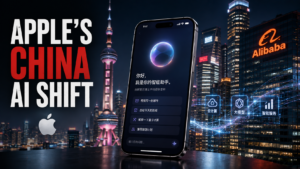
The development marks a major shift in Apple’s China AI strategy and could finally clear the way for a broader Apple Intelligence rollout on iPhones and other Apple devices in mainland China.
According to Reuters, Apple has already trained the China-specific model, while Alibaba provided important technical assistance during the process. The full details of how Apple’s model will work alongside Alibaba’s Qwen and other Chinese AI technology have not yet been disclosed.
The timing is important.
Apple Intelligence has been delayed in China while Apple navigated the country’s AI regulations and worked with local technology companies. Now, the company appears to be moving toward a hybrid strategy: Apple controls its own China-focused AI model while working with Alibaba to meet local technical and regulatory requirements.
Apple Has Built Its Own AI Model for China
The biggest news is simple:
Apple has trained a proprietary AI model specifically for the Chinese market.
This is different from Apple’s earlier approach.
Apple had been expected to depend heavily on domestic Chinese AI companies to power Apple Intelligence features because many major U.S. AI services are unavailable in mainland China due to regulatory restrictions.
Instead, Apple has now developed its own model with Alibaba’s support.
That doesn’t necessarily mean Alibaba has disappeared from the equation.
In fact, Alibaba’s Qwen model is still expected to play a role in Apple’s Chinese AI ecosystem.
The exact division of responsibilities between Apple’s own model, Qwen and other technologies remains unclear.
Why Apple Needed a Different AI Strategy in China
Apple Intelligence was designed as a global AI platform, but China presents a very different environment.
Services such as ChatGPT and other U.S.-developed AI models face restrictions in mainland China.
That means Apple cannot simply take the same AI infrastructure it uses elsewhere and activate it for Chinese users.
Apple therefore needs technology that can operate within China’s regulatory framework.
At the same time, Chinese smartphone manufacturers have already invested heavily in AI features.
Companies such as Huawei and other domestic competitors have been promoting AI capabilities on their smartphones, increasing pressure on Apple to catch up.
For Apple, this makes China more than just another market.
It is a strategic AI battleground.
Why Alibaba Is So Important to Apple’s China AI Plans
Alibaba is one of China’s largest technology companies and has developed a major AI ecosystem around its Qwen family of models.
Apple’s relationship with Alibaba therefore gives the company access to local AI expertise while allowing Apple to continue developing its own technology.
Alibaba’s own corporate filings show that Qwen has become a central part of its AI and cloud strategy, alongside infrastructure, model services and AI applications.
This gives Apple an interesting combination:
Apple’s AI technology + Alibaba’s China AI expertise + Apple’s hardware and software ecosystem.
That could be very different from simply licensing another company’s chatbot.
Apple and Alibaba Are Building a Hybrid AI Strategy
The easiest way to understand the new strategy is to think of it as a hybrid.
Apple’s role
Apple can provide:
- Its own China-specific AI model
- iOS integration
- Siri integration
- Apple Intelligence features
- Hardware and software integration
- User experience
Alibaba’s role
Alibaba can provide:
- Qwen technology
- Technical expertise
- China-specific AI infrastructure
- Local cloud capabilities
- Experience navigating China’s AI ecosystem
Potential additional partners
Reuters reports that Baidu technology may also be involved in Apple’s China AI plans.
That suggests Apple could eventually use multiple AI technologies rather than relying on one model for every task.
Apple Had Previously Planned to Use Chinese AI Models
Before this new development, Apple was reportedly working with Chinese AI companies to bring Apple Intelligence to the country.
Alibaba’s Qwen was expected to be part of that strategy.
Baidu technology was also reportedly under consideration.
Apple even published instructions showing Mac users in mainland China how to connect Alibaba’s Qwen AI service to Siri and Writing Tools.
The instructions were subsequently removed without Apple publicly explaining why.
That episode now looks more interesting in hindsight.
It may have been part of Apple’s broader experimentation with how AI services could operate on Chinese devices.
Apple’s Own Model Changes the Equation
If Apple were simply using Qwen or another third-party model, the company would have less direct control over the AI layer.
By training its own China-specific model, Apple could potentially control more of:
- Model behavior
- Apple Intelligence integration
- Product experience
- AI feature development
- Model updates
- How AI interacts with Apple’s operating systems
That doesn’t mean Apple is becoming completely independent from Chinese AI companies.
Alibaba’s involvement remains important.
But the strategic balance appears to be changing.
This Could Be a Major Apple Intelligence Shift
Apple Intelligence has been one of Apple’s biggest software initiatives in recent years.
The company wants AI to become deeply integrated into its devices rather than existing as a separate chatbot app.
That includes capabilities across:
- Siri
- Writing Tools
- Notifications
- Image generation
- Productivity
- Device assistance
- App interactions
But Apple’s China rollout has been much more complicated.
The new China-specific model suggests Apple is adapting the underlying AI architecture itself rather than simply translating its global strategy into the Chinese market.
That is a significant change.
Apple Intelligence Could Finally Reach Chinese iPhones
Apple has already cleared an important regulatory hurdle.
China’s cyberspace regulator registered Apple’s generative AI service in July, paving the way for Apple Intelligence to become available in mainland China.
The service is expected to arrive through a future software update, although Apple has not publicly announced a definitive launch date.
Reuters reports that Apple Intelligence is expected to launch in China in the coming months after completing the necessary regulatory process.
For Chinese iPhone users, that could finally mean access to Apple’s built-in generative AI features.
Why China Matters So Much to Apple
China remains one of Apple’s most important markets.
But the company has faced increasing competition from domestic smartphone manufacturers.
Huawei in particular has strengthened its position with premium smartphones and AI-focused features.
That puts Apple in an uncomfortable position.
While iPhone users in other markets have increasingly gained access to Apple Intelligence, Chinese customers have had to wait.
The longer that gap continues, the more difficult it becomes for Apple to position the iPhone as a leading AI smartphone in China.
The new model could help close that gap.
Apple Is Facing an AI Smartphone Problem
The smartphone market is changing.
For years, the main competition was about:
Camera → Display → Battery → Processor
Now AI is becoming another major selling point.
Smartphone manufacturers are increasingly promoting:
- AI assistants
- AI photo editing
- Generative writing
- Translation
- Search
- Personal assistants
- On-device intelligence
- AI-powered productivity
Chinese manufacturers have been particularly aggressive in this area.
Apple therefore needs Apple Intelligence to become more than a software feature.
It needs to become part of the iPhone’s competitive identity.
Why Apple Couldn’t Simply Use ChatGPT
In markets where Apple Intelligence is available, Apple has integrated third-party AI services such as ChatGPT into certain experiences.
But China is different.
OpenAI’s ChatGPT is not broadly available in mainland China.
That means Apple needs an alternative AI ecosystem that complies with local regulations.
This is one reason Alibaba’s involvement is so strategically important.
Instead of asking:
“How can Apple bring ChatGPT to China?”
Apple is effectively asking:
“How can Apple build an AI experience for China using technology that can operate within China’s regulatory environment?”
The answer appears to involve Apple’s own model plus local partners.
What Does Alibaba Get From the Partnership?
Alibaba also has something to gain.
Apple has an enormous installed base of iPhones and other devices in China.
Becoming part of Apple’s AI ecosystem could give Alibaba’s AI technology significant exposure.
Qwen is already an important part of Alibaba’s broader AI strategy.
Alibaba’s 2026 corporate reporting describes Qwen as part of a full-stack AI business spanning models, cloud infrastructure and AI applications.
An Apple relationship could further strengthen that ecosystem.
Could Apple Eventually Reduce Its Dependence on Qwen?
Possibly, but that is not confirmed.
Apple’s China-specific model may allow the company to handle more AI workloads itself.
However, Reuters reports that Qwen is still expected to be incorporated into Apple Intelligence for compatible Apple devices in China, while Baidu technology may also be involved.
So the more likely near-term model is not:
Apple replaces Alibaba.
It is:
Apple builds its own model while continuing to use local AI partners where useful or necessary.
Apple’s China AI Strategy Could Look Very Different From Its Global One
This is perhaps the most interesting part of the story.
Apple may effectively have different AI architectures for different markets.
Outside China, Apple Intelligence can work with Apple’s own models and selected international AI partners.
Inside China, Apple needs to work within local regulations and the domestic AI ecosystem.
That means the same iPhone could potentially provide different AI capabilities depending on where it is sold.
This isn’t necessarily unique to Apple.
Global technology companies increasingly have to adapt their AI products to different regulatory environments.
But Apple’s approach is notable because the company is building a market-specific foundation model rather than simply changing a few product settings.
Apple Could Become the First Foreign Company With Its Own Approved AI Model in China
Reuters reports that Apple’s approach could make it the first foreign company to receive Beijing’s approval to offer its own proprietary AI model in China.
If that happens as reported, it would be a significant development.
China maintains strict oversight over generative AI services and algorithms.
For a major U.S. technology company to deploy a proprietary model within that framework would demonstrate how important the Chinese market remains.
It would also show that foreign technology companies can potentially participate in China’s AI ecosystem by adapting their technology to local requirements.
What About User Privacy?
Privacy will be an important question once Apple Intelligence launches in China.
Apple has historically emphasized privacy as a major differentiator for its AI strategy.
But AI systems need access to information to provide useful assistance.
The exact architecture Apple uses in China—including which processing happens on-device, which requests go to Apple’s infrastructure and which are handled by local partners—will therefore matter.
Apple has not yet publicly detailed every aspect of the China-specific model’s deployment.
Until those technical details are released, it would be premature to claim that the Chinese version will have exactly the same privacy architecture as Apple Intelligence in other markets.
What Happens to Siri?
Siri is expected to be one of the major interfaces through which Apple Intelligence reaches users.
Alibaba’s Qwen was previously shown as an option for connecting AI capabilities to Siri and Writing Tools on Macs in China.
The new Apple-trained model could give Apple greater control over how Siri handles China-specific requests.
That could be particularly important for:
- Chinese-language understanding
- Local information
- Cultural context
- China-specific services
- Regulatory compliance
- Device-level AI features
The exact task allocation between Apple’s model and Qwen has not yet been disclosed.
What Does This Mean for Alibaba’s Qwen?
Qwen is not disappearing from the picture.
Alibaba’s model family has become one of China’s most prominent AI platforms, and Alibaba continues to invest heavily in models, cloud infrastructure and AI agents.
Its partnership with Apple could give Qwen an unusual role:
Helping power AI features inside one of the world’s most valuable consumer technology ecosystems.
That could be valuable for Alibaba both technically and strategically.
What Does This Mean for Chinese AI Competition?
Apple’s entry into the domestic AI ecosystem could increase competition.
Chinese AI companies already include major players such as:
- Alibaba
- Baidu
- Tencent
- Huawei
- ByteDance
- DeepSeek
Apple now appears to be entering the model layer itself, although with significant assistance from a Chinese technology partner.
That could create an interesting dynamic.
Apple is competing with Chinese smartphone manufacturers while simultaneously partnering with Chinese AI companies.
In other words:
Apple may compete with China on smartphones while cooperating with China on AI.
Apple and Alibaba: Competitors and Partners at the Same Time
This isn’t unusual in technology.
Companies can compete in one layer while cooperating in another.
Apple and Alibaba have overlapping interests in areas such as consumer technology and digital services, but they also have complementary strengths.
Apple brings:
Hardware + operating systems + global consumer ecosystem
Alibaba brings:
China cloud infrastructure + AI models + local ecosystem
The partnership combines those strengths.
Why the Timing Matters
Apple’s China AI push comes at a time when the global AI industry is becoming increasingly fragmented.
There is no longer one universally available AI ecosystem.
Different regions have different:
- Regulations
- Models
- Cloud providers
- Data rules
- Content requirements
- AI standards
That means global technology companies increasingly need regional AI strategies.
Apple’s China model could be an early example of this new reality.
Could Apple Build More Regional AI Models?
That remains unknown.
But the China strategy raises an interesting possibility.
If Apple can build a specialized model for one market, it could theoretically develop or adapt models for other regions with different:
- Languages
- Regulations
- Cultural expectations
- Data requirements
Apple hasn’t announced such a strategy.
But the China model demonstrates that the company is willing to customize its AI stack at a deeper level when market conditions require it.
The Bigger Apple AI Problem
Apple’s biggest challenge isn’t simply launching an AI model.
It needs to make AI genuinely useful.
Consumers don’t buy smartphones because a company has a large language model.
They buy them because the technology helps them do something better.
For Apple, the real test will therefore be whether Apple Intelligence can make the iPhone meaningfully more useful in China.
That could mean:
- Better Siri
- Better writing assistance
- Smarter notifications
- More useful translation
- More capable image tools
- Better contextual assistance
- Deeper app integration
The model itself is only the foundation.
Will Apple’s China AI Catch Up With Huawei?
That’s impossible to know yet.
Huawei and other Chinese manufacturers already have a head start in positioning AI as part of their smartphone experience.
Apple’s advantage is its tightly integrated hardware and software ecosystem.
If Apple Intelligence eventually becomes deeply embedded into iOS in China, Apple could use that ecosystem to compete more effectively.
But the quality of the underlying model will matter too.
A strong Apple-designed model could improve Apple’s position.
A mediocre one would make the partnership strategy much less meaningful.
The Biggest Question: How Much of Apple’s AI Will Actually Be Apple’s?
This may be the most interesting unanswered question.
Apple has trained its own model.
Alibaba has provided technical support.
Qwen is expected to be involved.
Baidu technology may also play a role.
So the Chinese version of Apple Intelligence could end up being a multi-model system.
The key question will be:
Which model handles which task?
For example, Apple could potentially use:
- Its own model for core Apple Intelligence features
- Qwen for selected China-specific tasks
- Other local technology for specialized services
But Apple has not publicly explained the final architecture.
Until it does, headlines claiming that Apple has completely replaced Alibaba—or that Alibaba is simply powering all of Apple’s China AI—would be inaccurate.
What Apple Intelligence in China Could Mean for the iPhone
If Apple successfully launches the service, it could remove one of the biggest AI disadvantages faced by the iPhone in China.
Instead of Chinese consumers seeing the iPhone as a premium smartphone without the latest Apple AI features, Apple could finally offer a localized AI experience.
That could become increasingly important as consumers compare smartphones based on AI capabilities.
Final Takeaway
Apple’s China AI strategy is changing.
According to Reuters, Apple has trained a proprietary large language model specifically for the Chinese market, with technical support from Alibaba.
That’s a major departure from the simpler strategy of relying entirely on third-party Chinese AI models.
But Alibaba isn’t being pushed out.
Qwen is still expected to play a role in Apple Intelligence in China, while Baidu technology may also be involved.
The result could be a hybrid AI architecture in which Apple controls its own China-specific model while using local partners to navigate China’s technical and regulatory environment.
For Apple, the stakes are high.
The company needs Apple Intelligence to compete in a smartphone market where AI is becoming increasingly important—and where Chinese manufacturers are moving quickly.
For Alibaba, the partnership could give Qwen a potentially important role inside Apple’s enormous hardware ecosystem.
And for the broader AI industry, Apple’s move highlights a larger trend:
The future of AI may not be one global model serving everyone. It may be a collection of regional AI systems built around local regulations, partners and infrastructure.
Apple is now betting that its own AI model, combined with Alibaba’s China expertise, can make that strategy work.
Read More:- Nvidia Partners With Wall Street to Mobilize $500 Billion for AI Infrastructure
FAQ
Did Apple build its own AI model for China?
Yes. Reuters reports that Apple has trained a large language model specifically for the Chinese market, with technical support from Alibaba.
Is Apple replacing Alibaba’s Qwen?
Not necessarily. Qwen is still expected to be incorporated into Apple Intelligence for China, while Apple has also developed its own China-specific model. The exact division of tasks has not been disclosed.
When will Apple Intelligence launch in China?
Apple Intelligence is expected to launch in China in the coming months, following regulatory approval, although Apple has not announced a definitive public launch date.
Why does Apple need a separate AI model for China?
China has different AI regulations and restrictions on access to several U.S.-developed AI services. Apple therefore needs an AI strategy that works within China’s regulatory and technology ecosystem.
What is Alibaba’s role in Apple’s China AI strategy?
Alibaba has provided technical support for Apple’s China-specific model and its Qwen model is expected to be part of Apple’s China AI offering.
Will Apple Intelligence in China use Qwen?
Reports indicate that Alibaba’s Qwen is expected to be incorporated into Apple Intelligence in China. Apple’s own China-specific model is also expected to be part of the service.
Could Baidu also be involved?
Yes. Reuters reports that Baidu technology may also be included in Apple’s China AI strategy, although the exact role has not been disclosed.
Why is Apple building a China-specific model?
The strategy gives Apple greater control over its AI technology while allowing it to adapt the system to China’s regulatory requirements and local market conditions.
Does this mean Apple is becoming an AI company?
Apple is increasingly treating AI as a core part of its software and device strategy. However, its approach remains focused on integrating AI into the Apple ecosystem rather than becoming a standalone AI-model provider.
Will Chinese iPhones finally get Apple Intelligence?
That is the expectation. Apple has cleared an important regulatory step for its generative AI service, and the company is preparing for a China rollout.