Microsoft is preparing its next move in the AI-chip race.
The company is reportedly planning to unveil its Maia 300 AI accelerator as early as September 2026, marking another major step in Microsoft’s effort to build more of its own computing hardware instead of relying so heavily on Nvidia’s AI processors. Reuters reported the planned unveiling on August 10, citing a report from The Information.
The timing matters.
Microsoft is spending enormous amounts on AI infrastructure for Azure, Copilot and its growing AI business. Nvidia remains one of the most important suppliers of the accelerators powering that infrastructure, but Microsoft has been developing its own Maia silicon for years.
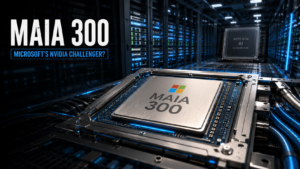
Now, the company reportedly wants to scale Maia 300 much more aggressively.
Microsoft is said to be discussing manufacturing capacity with TSMC for more than 300,000 Maia 300 chips for delivery in 2027, while its longer-term goal could eventually extend beyond one million chips. Those figures are reported plans, not confirmed production numbers.
That makes Maia 300 more than another custom chip announcement.
It could become a test of whether one of the world’s largest cloud providers can meaningfully reduce its dependence on Nvidia.
What Is Microsoft Maia 300?
Maia 300 is Microsoft’s reported next-generation custom AI accelerator, designed to power AI workloads inside Microsoft’s cloud infrastructure.
Unlike a general-purpose CPU, an AI accelerator is designed specifically to perform the massive amounts of mathematical computation involved in machine-learning workloads.
Microsoft’s Maia family is part of the company’s broader strategy to design AI infrastructure from the silicon level upward.
The company introduced its first Maia AI accelerator in 2023 and followed it with Maia 200 in January 2026.
Maia 300 is expected to be the next major generation.
However, there is an important caveat:
Microsoft has not publicly released the complete Maia 300 specifications yet.
That means claims about its exact performance, memory configuration, power consumption or direct Nvidia equivalent should be treated as speculation until Microsoft officially announces the chip.
What we know currently comes primarily from reporting about Microsoft’s plans rather than an official Maia 300 product specification sheet.
When Will Microsoft Launch Maia 300?
Microsoft is reportedly planning to unveil Maia 300 in fall 2026, potentially as early as September.
Reuters reported on August 10 that Microsoft could publicly unveil the chip as soon as next month, citing The Information.
That means the exact launch date is not yet confirmed.
There is also an important difference between an unveiling and a full-scale deployment.
Even if Microsoft introduces Maia 300 in September, large-scale production and deployment could take much longer.
The reported manufacturing discussions with TSMC point toward substantial 2027 production.
Why Is Microsoft Building Its Own AI Chips?
The answer comes down to cost, supply, performance and control.
Microsoft operates one of the world’s largest cloud platforms through Azure. It needs enormous amounts of computing hardware to support:
- Azure AI services
- Microsoft Copilot
- AI model training
- AI inference
- Microsoft Foundry
- Internal AI research
- OpenAI-related workloads
- Enterprise AI applications
Buying every accelerator from Nvidia gives Microsoft access to extremely capable hardware, but it also leaves the company dependent on an external supplier.
Custom silicon gives Microsoft another option.
Instead of designing its cloud around whatever general-purpose hardware is available, Microsoft can optimize a chip for the workloads it actually runs.
That can potentially improve:
- Performance per dollar
- Power efficiency
- Hardware availability
- Data-center integration
- Software optimization
- Long-term infrastructure costs
Microsoft has already described this as part of a broader heterogeneous infrastructure strategy rather than an effort to eliminate Nvidia hardware completely. In its January 2026 earnings call, Microsoft said its infrastructure uses Nvidia, AMD and its own Maia chips across multiple generations.
Microsoft Has Already Built Maia 200
To understand Maia 300, it helps to look at its predecessor.
Microsoft introduced Maia 200 on January 26, 2026 as an AI accelerator designed primarily for large-scale inference.
The chip was built using TSMC’s 3-nanometer process and includes:
- More than 140 billion transistors
- 216 GB of HBM3e memory
- 7 TB/s memory bandwidth
- 272 MB of on-chip SRAM
- Native FP8 and FP4 tensor cores
- More than 10 petaflops of FP4 performance
- More than 5 petaflops of FP8 performance
- A 750W SoC thermal design power
These are Microsoft’s published Maia 200 specifications.
Microsoft also said Maia 200 delivered 30% better performance per dollar than the latest-generation hardware previously in its fleet.
That is Microsoft’s own comparison, rather than an independent benchmark against every current Nvidia product.
The company deployed Maia 200 in Azure and said it would be used for workloads including inference, synthetic-data generation, Microsoft Copilot and Microsoft Foundry.
This gives Maia 300 an important starting point.
Microsoft is not beginning its custom-silicon program from scratch.
Maia 300 Could Be Much More Important Than Maia 200
Maia 200 demonstrated that Microsoft can build and deploy a sophisticated AI accelerator.
Maia 300 could be about something bigger:
scale.
The reported plan for more than 300,000 chips in 2027 would represent a significant increase in Microsoft’s custom-AI-hardware ambitions if it materializes.
The company is also reportedly looking beyond its own internal Azure requirements.
Reuters reported that Microsoft wants to encourage major cloud customers, including Anthropic, to use Maia 300.
That would change the significance of Maia.
Instead of being simply Microsoft’s internal accelerator, Maia could become part of a broader Azure hardware platform.
Maia 300 vs Nvidia: Can Microsoft Really Compete?
This is the question behind the headline.
The short answer is:
Maia 300 could challenge Nvidia’s position in Microsoft’s own infrastructure, but it is far too early to say that it can replace Nvidia across the AI industry.
There are several reasons.
Nvidia’s biggest advantage is not just the chip
Nvidia has spent years building an entire AI-computing ecosystem.
That includes:
- GPUs
- Networking
- Software
- CUDA
- Libraries
- Developer tools
- AI frameworks
- Enterprise support
- Rack-scale systems
- Cloud partnerships
That ecosystem makes Nvidia hardware difficult to replace even when another accelerator offers competitive hardware economics.
A custom chip can be extremely fast and efficient.
Getting thousands of developers and AI workloads to run smoothly on it is another challenge.
CUDA Is a Major Nvidia Moat
One reason Nvidia has maintained such a powerful position in AI computing is CUDA.
CUDA gives developers a mature programming environment for Nvidia GPUs and is deeply integrated into the modern AI software stack.
For Microsoft, building Maia hardware is only part of the challenge.
The company also has to make sure developers can efficiently run AI workloads on Maia without completely rewriting their software.
Microsoft has therefore invested in the Maia SDK, including PyTorch integration, Triton support, optimized kernels and lower-level programming tools.
That software layer could become just as important as the silicon itself.
Microsoft’s Strategy Is Probably Not “Kill Nvidia”
It is tempting to frame the story as:
Microsoft vs Nvidia
But that is probably too simplistic.
Microsoft’s own infrastructure strategy is heterogeneous.
The company has explicitly said that Nvidia, AMD and Maia chips all contribute to its fleet.
That makes strategic sense.
If Microsoft can use Nvidia GPUs for some workloads, AMD accelerators for others and Maia chips for workloads where custom silicon offers better economics, Azure gets more flexibility.
The goal is not necessarily to eliminate Nvidia.
The goal is to make sure Microsoft does not have only one option.
Why Custom AI Chips Matter for Azure
Azure is competing with other hyperscale cloud providers that have also developed custom silicon.
Google has its TPU family.
Amazon has Trainium and Inferentia.
Microsoft has Maia.
This is becoming a major competitive layer in cloud computing.
Customers may never see the physical chip.
They may simply notice that a particular AI workload costs less, responds faster or scales more efficiently.
That is where custom silicon becomes strategically important.
If Microsoft can offer AI services at lower infrastructure costs, it can potentially improve Azure’s economics even if customers never know which accelerator is running underneath.
Microsoft Is Following Google and Amazon
Microsoft is not the first hyperscaler to develop custom AI chips.
Google developed its Tensor Processing Unit, or TPU, specifically for machine-learning workloads.
TPUs have become an important part of Google’s AI infrastructure.
Amazon
Amazon has developed its own Trainium and Inferentia accelerators for AWS.
Amazon has increasingly promoted custom silicon as a way to improve the economics of AI training and inference.
Microsoft
Microsoft is following a similar path with Maia.
The difference is that Microsoft’s custom silicon effort is arriving at a time when AI infrastructure spending has reached an enormous scale.
The competition is no longer just about building a faster accelerator.
It is about controlling the entire AI infrastructure stack.
What We Know About Maia 300’s Production Plans
This is currently one of the most interesting parts of the story.
According to Reuters’ report, Microsoft is discussing TSMC capacity for more than 300,000 Maia 300 chips for 2027 delivery. The company is reportedly also aiming eventually to secure capacity for more than one million chips.
Those numbers should be treated as reported plans, not confirmed shipments.
Semiconductor production at this scale involves several bottlenecks.
The chip itself is only one part of the system.
Microsoft also needs:
- Advanced packaging
- High-bandwidth memory
- Substrates
- Networking components
- Power systems
- Cooling
- Servers
- Data-center capacity
- Software
- Manufacturing capacity
Reuters noted that component availability and TSMC’s production capacity could constrain the plans.
Why TSMC Matters
TSMC is one of the world’s most important semiconductor manufacturers.
Microsoft does not fabricate Maia chips in its own semiconductor factories.
Instead, it relies on external manufacturing.
Maia 200 was built using TSMC’s 3nm process.
For Maia 300, securing enough advanced manufacturing capacity is therefore critical.
This is one reason the reported 300,000-chip plan is significant.
The AI-chip race is also a race for manufacturing capacity.
Even the best chip design cannot ship at scale if there is insufficient advanced packaging, memory or foundry capacity.
What Could Make Maia 300 Successful?
Several factors could determine whether Maia 300 becomes a serious Nvidia alternative.
1. Performance per dollar
Raw benchmark performance is not enough.
Microsoft needs Maia 300 to produce useful AI work at an attractive cost.
2. Energy efficiency
AI data centers consume huge amounts of electricity.
A more efficient accelerator can reduce operating costs at massive scale.
3. Software compatibility
Developers need reliable tools and frameworks.
If Maia requires extensive code changes, adoption becomes harder.
4. Availability
If Microsoft can manufacture large numbers of Maia chips when Nvidia hardware is constrained, that alone becomes strategically valuable.
5. Azure integration
Microsoft controls both the cloud platform and the chip.
That gives it an opportunity to optimize the complete stack.
6. Customer adoption
If companies such as Anthropic begin using Maia at scale, the case for Microsoft’s custom silicon becomes much stronger.
Reuters reported that Microsoft is seeking adoption among major cloud customers.
What Could Stop Maia 300?
There are also significant risks.
Software maturity
Nvidia’s software ecosystem has a substantial head start.
Manufacturing constraints
Advanced AI chips require scarce manufacturing and packaging resources.
Memory supply
AI accelerators increasingly depend on high-bandwidth memory, which can become a bottleneck.
Rapid Nvidia innovation
Microsoft is not competing against a stationary target.
Nvidia continues releasing new generations of AI hardware and systems.
Workload differences
A chip optimized for inference may not automatically be the best choice for AI training.
This is particularly important because AI workloads are becoming more diverse.
Maia 300 Could Change Microsoft’s Relationship With Nvidia
This may ultimately be the most important part of the story.
Microsoft is one of Nvidia’s major customers.
At the same time, Microsoft is building a competing accelerator.
That sounds contradictory, but it actually makes sense.
Microsoft needs huge amounts of AI compute.
The more hardware options it has, the greater its negotiating flexibility.
If Maia can handle a meaningful portion of Azure’s workloads, Microsoft can potentially reduce how much of its infrastructure depends on Nvidia.
That does not require Nvidia to disappear.
Even shifting a portion of workloads to custom silicon could have a major economic impact at Microsoft’s scale.
What About AMD?
AMD is another important part of this changing AI-hardware landscape.
Microsoft has already said its Azure infrastructure uses both Nvidia and AMD alongside its own Maia chips.
That creates a three-way hardware strategy:
Nvidia + AMD + Microsoft Maia
For Microsoft, this provides redundancy and flexibility.
It also means Nvidia is facing pressure from multiple directions.
Google has its TPUs.
Amazon has Trainium.
Microsoft has Maia.
AMD is expanding its accelerator portfolio.
Specialized AI-chip companies are developing inference-focused hardware.
The AI-chip market is becoming much more competitive than it was a few years ago.
Does Maia 300 Threaten Nvidia’s AI Dominance?
Potentially—but not immediately.
The most realistic interpretation is that Maia 300 could weaken Nvidia’s dominance inside Microsoft’s own AI infrastructure rather than suddenly overturn Nvidia’s position across the entire market.
Nvidia’s advantages in hardware, software, networking, developer adoption and ecosystem scale remain substantial.
Microsoft, however, has something most chip startups do not:
an enormous cloud platform on which to deploy its own silicon.
Azure can provide Maia with a built-in environment for testing, optimization and large-scale deployment.
That gives Microsoft a powerful advantage.
Why Maia 300 Matters for AI Users
Most people using ChatGPT, Copilot or another AI service will never physically interact with a Maia chip.
But they could still benefit from the competition.
More competition among AI accelerators can potentially lead to:
- Lower inference costs
- More available computing capacity
- Better energy efficiency
- More cloud-provider choice
- Faster AI services
- Less dependence on one chip supplier
If Microsoft can reduce the cost of running AI workloads inside Azure, those savings can eventually influence the economics of AI services.
That matters because inference—the process of actually generating responses from trained AI models—is becoming one of the industry’s biggest infrastructure expenses.
Maia 200 Already Shows Microsoft’s Direction
The Maia 200 launch gives us a useful clue about what Microsoft cares about.
Microsoft did not position Maia 200 simply as a chip with the highest theoretical performance.
It emphasized inference economics.
The company said Maia 200 delivered 30% better performance per dollar than the latest-generation hardware previously in its fleet.
That is revealing.
For a cloud company, the important question is not always:
“Which chip is fastest?”
It can instead be:
“How much useful AI work can we deliver for every dollar and every watt?”
That could be the philosophy behind Maia 300 as well, although its final specifications and performance have not yet been publicly confirmed.
What Happens Next?
The next major milestone will be Microsoft’s official Maia 300 unveiling.
If the reported September timing is accurate, Microsoft could soon reveal the specifications that currently remain unknown.
The industry will be watching several things closely:
- Chip manufacturing process
- HBM capacity
- Memory bandwidth
- FP4/FP8 performance
- Power consumption
- Training capabilities
- Inference performance
- Networking architecture
- Cluster scalability
- Performance per dollar
- Azure availability
- Customer adoption
Those details will determine whether Maia 300 is simply another internal accelerator or a serious commercial competitor to Nvidia hardware.
The Bigger AI-Chip Battle
The Maia 300 story is part of a much larger change in the AI industry.
During the early generative-AI boom, Nvidia’s GPUs became the default infrastructure for many AI workloads.
Now the biggest cloud companies are asking a different question:
Why buy every accelerator when we can design some of them ourselves?
Google has already demonstrated the value of custom silicon.
Amazon is scaling its own AI accelerators.
Microsoft is building Maia.
And Nvidia continues pushing its own hardware and software ecosystem forward.
The result is an AI-chip market that is becoming increasingly fragmented and competitive.
That could ultimately benefit the entire AI ecosystem.
Final Takeaway
Microsoft’s reported Maia 300 is shaping up to be one of the more important custom AI-chip projects of 2026.
The chip has not yet been officially unveiled, so its final specifications and performance remain unknown. But Reuters reports that Microsoft could reveal it as early as September and is discussing TSMC capacity for more than 300,000 chips for 2027 delivery, with longer-term ambitions potentially exceeding one million units.
That would represent a major expansion of Microsoft’s custom-silicon strategy.
But the real story is not simply Microsoft versus Nvidia.
Microsoft is building a broader hardware portfolio that combines Nvidia, AMD and its own Maia accelerators.
If Maia 300 delivers strong performance per dollar, scales efficiently across Azure and attracts outside customers, Microsoft could significantly reduce its dependence on Nvidia for some workloads.
It would not mean Nvidia’s AI dominance disappears overnight.
Instead, it would mean something potentially more important:
Nvidia may no longer be the only viable answer for hyperscale AI computing.
And as AI becomes an increasingly expensive infrastructure business, having more than one answer could become one of the industry’s biggest competitive advantages.
Read More:- Amazon’s Huge AI Data Center Power Project Explained
FAQ
What is Microsoft’s Maia 300 AI chip?
Maia 300 is Microsoft’s reported next-generation custom AI accelerator for Azure and other Microsoft AI infrastructure. Microsoft has not yet publicly released the complete specifications; current details come primarily from reporting about the planned chip.
When will Microsoft launch Maia 300?
Microsoft is reportedly planning to unveil Maia 300 in fall 2026, potentially as early as September. The exact launch date has not been officially confirmed.
Can Maia 300 replace Nvidia GPUs?
It is too early to say. Maia 300 could reduce Microsoft’s reliance on Nvidia for certain Azure workloads, but Nvidia’s hardware, software and CUDA ecosystem remain major competitive advantages.
How many Maia 300 chips is Microsoft planning?
Reuters reports that Microsoft is discussing TSMC capacity for more than 300,000 Maia 300 chips for 2027 delivery. Longer-term ambitions reportedly could exceed one million chips, but these are reported plans rather than confirmed shipments.
What is Maia 200?
Maia 200 is Microsoft’s second-generation custom AI accelerator, introduced in January 2026. It is primarily designed for AI inference and uses TSMC’s 3nm process, with 216GB of HBM3e and more than 140 billion transistors.
Is Maia 200 faster than Nvidia?
Microsoft has claimed that Maia 200 provides 30% better performance per dollar than the latest-generation hardware previously in its fleet. That is Microsoft’s own comparison and should not be interpreted as proof that Maia 200 universally outperforms Nvidia’s latest accelerators.
Why is Microsoft making its own AI chips?
Microsoft wants greater control over AI infrastructure costs, supply, performance and optimization. Custom accelerators can also be designed around the specific workloads Microsoft runs across Azure.
Does Microsoft still use Nvidia GPUs?
Yes. Microsoft has explicitly said its Azure infrastructure uses Nvidia, AMD and its own Maia accelerators across multiple generations of hardware.
Who manufactures Microsoft’s Maia chips?
Maia 200 was built using TSMC’s 3nm process. For Maia 300, Microsoft is reportedly discussing production capacity with TSMC.
Why is Maia 300 important for the AI industry?
If Microsoft successfully deploys Maia 300 at large scale, it could demonstrate that hyperscalers can reduce dependence on Nvidia by combining custom silicon with their own cloud infrastructure, software and data centers.