Artificial intelligence is creating a problem that has little to do with algorithms.
It needs electricity—an enormous amount of it.
Amazon is now showing just how big that problem can become.
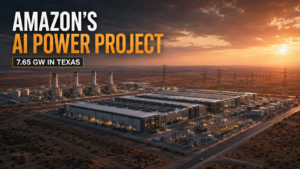
The company is developing a major AI-focused data center campus in Pecos County, West Texas, and instead of relying entirely on Texas’ already crowded electricity grid, Amazon plans to use dedicated on-site power generation.
The project is tied to GW Ranch, a massive power development being built by Pacifico Energy. The planned facility can generate up to 7.65 gigawatts of electricity from natural gas turbines, according to permitting and project documents. The power plant has also received a permit allowing up to 33 million tons of greenhouse-gas emissions per year—a figure that has triggered intense environmental criticism.
Amazon says the project is designed to provide the power its new data center needs without shifting the cost of that electricity infrastructure onto Texas households.
But the bigger story goes beyond Amazon.
This project shows how the AI boom is changing the relationship between data centers, electricity generation and the power grid.
What Is Amazon Building in Texas?
Amazon is developing a large data center campus in Pecos County, Texas, in the western part of the state.
The campus is being built around the rapidly growing demand for computing power needed for artificial intelligence and cloud services.
Instead of waiting entirely for a conventional grid connection, Amazon plans to purchase electricity from the power generation facility being developed by Pacifico Energy at the GW Ranch site.
Recent reporting says Amazon has already begun developing the data-center site, including construction permitting and land-clearing activity.
The arrangement is significant because it represents a different approach to building hyperscale AI infrastructure.
Rather than:
Data center → utility grid → power
the model is closer to:
Natural gas generation → private power system → AI data center
At least initially, the project is expected to operate without drawing its primary power from the Texas grid. Amazon says it is designed to eventually transition to grid-connected service as interconnection timelines allow.
How Much Power Will Amazon’s AI Data Center Need?
The numbers are enormous.
The associated GW Ranch power project has permits for up to 7.65 gigawatts (GW) of natural-gas generation using 35 turbines.
To understand the scale, 1 GW equals 1,000 megawatts.
So:
7.65 GW = 7,650 MW
That is an extraordinary amount of electricity for a single power project.
The project was originally conceived as a large private-grid campus designed to serve hyperscale data centers. Earlier project plans also included 750 MW of solar generation and 1.8 GW of battery storage, although the exact buildout and timing can change as the project develops.
This is why AI data centers are increasingly being treated as energy infrastructure projects rather than simply large buildings filled with servers.
Why Does Amazon Need So Much Electricity?
Traditional data centers already consume substantial electricity.
AI-focused facilities can require significantly more because they are designed to run large numbers of specialized accelerators and other computing hardware for:
- AI model training
- AI inference
- Generative AI applications
- Cloud computing
- Machine learning
- Large-scale data processing
AI workloads can also create very concentrated power demand.
A hyperscale campus may need hundreds of megawatts—or eventually several gigawatts—of continuous electricity capacity.
The problem is that electricity infrastructure does not expand as quickly as AI computing demand.
A company can order servers relatively quickly.
Building transmission lines, substations, generation facilities and grid connections can take much longer.
That mismatch is pushing technology companies toward alternative approaches.
Why Amazon Is Building Its Own Power Supply
One of the biggest reasons is speed.
Connecting a huge new data center to an existing electricity grid can involve years of planning, transmission upgrades and interconnection studies.
Texas has become one of the world’s biggest destinations for data-center development, but that growth is also putting pressure on the state’s energy infrastructure.
The GW Ranch model attempts to bypass some of those constraints by creating a private power system close to the data center.
Pacifico Energy has promoted GW Ranch as a private-grid project designed specifically to support hyperscale data centers and avoid dependence on the ERCOT grid during its initial development.
For Amazon, that can potentially provide a faster route to the electricity required for its AI infrastructure.
What Does “Off-Grid” Mean in This Project?
“Off-grid” does not mean the data center has no electricity infrastructure.
It means the facility is initially designed to generate and manage its electricity independently rather than relying primarily on the state’s main power grid.
In Amazon’s case, the planned arrangement uses new on-site generation.
Amazon has said the project is designed so that the new generation will cover its operational needs without increasing electricity costs for Texas families. The company also says it expects to transition toward grid-connected service as interconnection becomes available.
This approach is increasingly known as behind-the-meter or private-grid power.
The concept is becoming more important as AI data centers compete for scarce grid capacity.
Why Natural Gas?
The obvious question is: if Amazon is investing heavily in sustainability, why use natural gas to power an AI data center?
The answer is largely about availability, reliability and speed.
Natural gas plants can provide electricity continuously and can generally be deployed faster than some large-scale alternatives.
West Texas also sits close to major oil and gas production infrastructure.
The GW Ranch site is near the Waha natural gas hub, an important regional center for gas pipelines and production.
That gives developers access to abundant natural gas while avoiding some of the constraints associated with transporting electricity long distances.
For an AI data center, reliable power is critical.
A training run involving thousands of AI accelerators cannot simply be interrupted every time electricity becomes scarce.
The Environmental Controversy
This is where the Amazon project becomes much more controversial.
The GW Ranch natural-gas facility has been permitted to emit up to approximately 33 million tons of greenhouse gases per year, according to reporting on the project’s Texas environmental permit.
That number represents a maximum permitted level, not a guarantee that the plant will actually emit that amount every year.
Power plants often operate below their permitted maximum.
Nevertheless, the potential scale has attracted significant attention because the permitted emissions level is higher than that of the largest individual U.S. power-plant emitters reported in recent comparisons.
The criticism is straightforward:
AI companies are building increasingly powerful computing infrastructure, but some of the electricity needed to operate that infrastructure is coming from fossil fuels.
That creates a tension between AI expansion and corporate climate commitments.
What Does Amazon Say About the Environmental Impact?
Amazon says its sustainability goals have not changed.
The company has committed to reaching net-zero carbon emissions across its operations by 2040 through The Climate Pledge.
At the same time, Amazon says it is exploring ways to reduce the environmental footprint of the Texas project.
The company has said it is considering:
- Solar power
- Battery storage
- Non-potable water for cooling
- Cooling technologies designed to reduce water consumption
- Potential beneficial uses for produced water
Amazon says it intends to use water that is not suitable for drinking or irrigation and minimize pressure on the local watershed.
That means the project is not simply a natural-gas-only story.
The initial power system is heavily dependent on gas generation, but Amazon says additional energy and water strategies are being considered.
Why Texas Has Become an AI Data Center Hotspot
Texas has several characteristics that make it attractive to data-center developers.
1. Large amounts of available land
West Texas has huge areas of relatively undeveloped land, making large industrial-scale projects easier to site.
2. Natural gas availability
The state is one of the country’s most important oil and natural-gas producing regions.
3. Growing renewable generation
Texas has also built enormous amounts of wind and solar capacity.
4. Business-friendly development environment
Texas has attracted major technology and infrastructure investment with relatively fast development compared with some other U.S. markets.
5. AI demand
The rapid expansion of generative AI is creating a new wave of demand for large computing campuses.
But there is a catch.
The same characteristics that make Texas attractive to AI companies are also creating concerns about electricity demand, water consumption, emissions and infrastructure costs.
Amazon’s Project Is Part of a Much Bigger Trend
Amazon is not the only technology company looking for dedicated energy sources.
Across the United States, companies are exploring combinations of:
- Natural-gas turbines
- Nuclear power
- Solar farms
- Battery storage
- Private microgrids
- Existing power plants
- Long-term electricity contracts
The basic problem is the same:
AI infrastructure is growing faster than traditional power infrastructure can easily accommodate it.
Texas has already seen other large data-center projects pursue dedicated generation.
For example, Chevron and Microsoft have been working on a separate West Texas arrangement involving natural-gas generation for a large data-center project.
This suggests that private power could become a standard part of the next generation of hyperscale AI campuses.
Why the 7.65 GW Number Matters
The 7.65 GW figure is more than an impressive headline.
It illustrates how dramatically the scale of AI infrastructure is changing.
A conventional cloud data center might have been discussed primarily in terms of server racks, storage capacity and network bandwidth.
AI data centers increasingly have to be discussed in terms of:
megawatts, gigawatts, cooling systems, substations and power generation.
That is a fundamental change.
The future AI race may not be determined only by who has the best models or chips.
It could also depend on who can secure enough electricity to run those models.
What Is a “Behind-the-Meter” AI Data Center?
A behind-the-meter data center receives electricity from a dedicated generation source located close to the facility rather than depending entirely on a conventional utility connection.
The model can provide several advantages.
Potential benefits
- Faster deployment
- Greater control over electricity supply
- Reduced dependence on grid interconnection
- Potentially predictable energy costs
- Dedicated power for high-density computing
Potential drawbacks
- Higher dependence on fossil fuels if gas is the primary source
- Local air pollution
- Greenhouse-gas emissions
- Water and land-use concerns
- Additional environmental scrutiny
- Complex infrastructure requirements
The Amazon project demonstrates both sides of this equation.
Could Amazon’s Power Strategy Become the New Normal?
It could.
As AI computing continues expanding, technology companies will increasingly have to think about energy supply at the same time they plan computing capacity.
The old model was relatively simple:
Find land → build data center → connect to grid
The emerging AI model may look more like:
Find land → secure electricity → build generation/storage → build data center → connect to grid later
That is a major shift.
Research into AI data-center infrastructure increasingly treats power and computing as interconnected systems rather than separate problems.
Amazon’s Texas project is therefore important even beyond Amazon.
It could be an early example of what large AI infrastructure development looks like when grid capacity becomes the limiting factor.
Will Amazon’s Texas Data Center Increase Electricity Bills?
Amazon says the initial private-generation approach is intended to avoid increasing electricity costs for Texas households.
Because the data center is initially expected to use dedicated generation rather than drawing its primary electricity from the state’s grid, Amazon argues that it will pay the costs associated with powering the facility itself.
That is an important distinction from projects that depend heavily on grid upgrades funded through broader utility infrastructure.
However, the wider impact of data-center growth on Texas electricity markets is still a subject of intense debate.
The state is experiencing rapid growth in large electricity-consuming facilities, and regulators are increasingly examining how those projects affect grid reliability, infrastructure investment and consumers.
What Happens to Amazon’s Climate Goals?
This is one of the biggest questions surrounding the project.
Amazon has a long-term goal of reaching net-zero carbon emissions by 2040.
Yet its AI expansion is increasing demand for computing infrastructure, and some of that infrastructure is now being paired with natural-gas generation.
That creates a difficult balancing act.
Amazon can invest in renewable energy elsewhere, add batteries, improve efficiency and eventually connect projects to cleaner grid resources.
But the immediate electricity needed to power large AI systems still has to come from somewhere.
The Texas project highlights the gap between long-term climate targets and short-term AI energy demand.
What This Means for the AI Industry
Amazon’s Texas project points toward several trends that could define AI infrastructure over the next few years.
AI will become an energy story
The conversation around AI has traditionally focused on chips, models and software.
Power is becoming equally important.
Data centers may increasingly bring their own power
Private generation can help companies avoid long grid-connection queues.
Natural gas may remain important
Despite major investments in renewable energy and nuclear power, natural gas can provide dispatchable electricity while AI infrastructure expands rapidly.
Nuclear power could become more attractive
Amazon itself has also been investing in nuclear energy options, including plans involving small modular reactors in Washington and a power agreement connected to the Susquehanna nuclear plant.
Batteries will become more important
Large-scale storage can help smooth the power requirements of AI facilities and improve the flexibility of generation assets.
The result could be a much more complicated energy mix around future AI campuses.
The Bigger Question: How Much Power Will AI Need?
Amazon’s project is a reminder that AI’s physical infrastructure is becoming enormous.
Training and serving advanced models requires large computing clusters, and those clusters require electricity and cooling.
As models become more capable and AI agents perform more tasks continuously, demand could continue rising.
That creates a three-way challenge:
More AI → more computing → more electricity
The technology industry therefore needs to solve not just the software problem, but also the infrastructure problem.
That includes:
- Electricity generation
- Transmission
- Grid reliability
- Cooling
- Water management
- Battery storage
- Renewable energy
- Nuclear power
- Natural gas
- Environmental regulation
Amazon’s Texas project sits directly in the middle of that debate.
What Happens Next?
The project is still developing, so several details can change as construction progresses.
The immediate focus will be on the buildout of the data-center campus and the associated power infrastructure.
Amazon has said the project is a long-term commitment expected to create thousands of jobs in the region.
The company also says it intends to explore additional solar, battery and water-management strategies.
Meanwhile, regulators and communities will continue watching the project’s environmental footprint.
The bigger question is whether the private-power model spreads to other AI campuses.
If it does, the United States could see a new generation of AI power campuses—large computing facilities developed alongside dedicated electricity generation.
Final Takeaway
Amazon’s huge Texas AI data-center project is not simply another AWS expansion.
It is a glimpse into the infrastructure challenge behind the AI boom.
The project associated with GW Ranch could generate up to 7.65 GW of natural-gas power, while its environmental permit allows up to 33 million tons of greenhouse-gas emissions annually.
Amazon says the dedicated power strategy will allow it to cover the costs of powering the new campus without putting additional pressure on Texas electricity customers, while the company explores solar, battery storage and lower-water cooling approaches.
But the controversy shows the difficult trade-off facing the AI industry.
The world wants more powerful AI.
Building that AI requires more data centers.
And those data centers require enormous amounts of electricity.
The next phase of the AI race may therefore be fought not only in computer labs—but also at power plants, substations, gas fields, solar farms and nuclear facilities.
For Amazon, the Texas project is one of the clearest examples yet of that shift.
Read More :- OpenAI Retires GPT-5.3 Chat: What ChatGPT Users Need to Know
FAQ
What is Amazon’s huge AI data center power project?
Amazon is developing a large AI-focused data center campus in Pecos County, Texas, with dedicated power generation from the GW Ranch project. The associated power facility is permitted for up to 7.65 GW of natural-gas generation.
How much power will Amazon’s Texas AI data center use?
The associated GW Ranch project has permits for up to 7.65 GW of gas-fired generation. The actual amount of power consumed by Amazon’s data-center operations can differ from the project’s total permitted generation capacity.
Why does Amazon need its own power plant?
Large AI data centers require enormous amounts of reliable electricity. Building dedicated generation can help Amazon avoid some of the delays associated with connecting a hyperscale facility to an already-constrained electricity grid.
Where is Amazon’s AI data center being built?
The project is in Pecos County, West Texas, in the Permian Basin region. Amazon has acquired the GW Ranch site and begun developing the data-center campus.
Is Amazon’s Texas data center powered by natural gas?
The associated GW Ranch project uses natural-gas turbines for its primary permitted generation capacity. The broader project has also included plans for solar and battery storage.
How much pollution could the power plant produce?
The plant’s permit allows up to approximately 33 million tons of greenhouse-gas emissions per year. That is a permitted maximum, not a prediction that the facility will necessarily emit that amount annually.
Will Amazon’s data center use the Texas power grid?
Initially, Amazon says the project will rely on new on-site generation rather than drawing its primary electricity from the Texas grid. Amazon has said it is designed to transition toward grid-connected service as interconnection timelines allow.
Is Amazon still investing in clean energy?
Yes. Amazon continues to pursue renewable and nuclear energy initiatives and says it is exploring solar power and battery storage for the Texas campus. It also has separate nuclear-energy projects intended to support its broader electricity needs.
Why is Texas attracting so many AI data centers?
Texas offers large amounts of land, abundant energy resources and a growing technology infrastructure. Its large natural-gas supply and renewable generation also make it attractive for energy-intensive data-center development.