
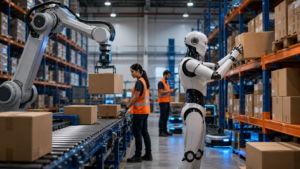
For years, AI mostly lived inside a screen — writing text, analyzing data, answering questions. But 2026 is turning out to be the year that changes. AI is stepping out of the browser tab and into the physical world, and nowhere is that more visible than inside warehouses. Robots powered by something called “embodied AI” are now picking, sorting, and moving inventory with a level of independence that wasn’t commercially realistic even a year or two ago. Here’s what’s actually driving this shift.
What Is Embodied AI, Exactly?
Put simply, embodied AI is artificial intelligence with a physical body — robots, machines, or devices that perceive their surroundings and take real-world action, rather than just processing information on a screen. Unlike a chatbot that only deals with text, an embodied AI system has to see its environment, understand instructions, and physically move something without breaking it.
The technology making this possible is called Vision-Language-Action, or VLA, models. These systems combine three things at once: computer vision to see the environment, language understanding to interpret instructions, and motor control to actually execute movement. Instead of a robot being hardcoded with rigid, step-by-step instructions for every task, VLA-powered robots can generalize — meaning they can adapt to a new product, an odd-shaped box, or a slightly different shelf layout without needing to be reprogrammed from scratch.
Why Warehouses Specifically?
Warehouses turn out to be the perfect testing ground for this technology, and it’s easy to see why. The environment is semi-structured — predictable enough to train a model on, but chaotic enough that rigid, rule-based robots have always struggled. Boxes get damaged, inventory shifts, and workers move around unpredictably.
VLA-powered robots are increasingly able to handle exactly this kind of messiness. They can pick and place items with precision, adapt to new product types without reprogramming, and even work safely alongside human staff in shared spaces. That combination of flexibility and safety is a big deal, because it’s exactly what earlier generations of warehouse robots couldn’t reliably do.
The Numbers Behind the Boom
This isn’t just a tech-conference buzzword — the market data backs up the shift. The broader embodied AI market is projected to grow from roughly $4.44 billion in 2025 to about $23 billion by 2030. On the hardware side, humanoid robot units now reportedly range from $30,000 to $150,000 depending on configuration, with some warehouse deployments showing payback periods as short as 12 months.
That payback timeline is a big part of why 2026 is being called the beginning of mass production for these systems. When a robot pays for itself in about a year through labor savings and efficiency gains, adoption stops being a research experiment and starts becoming a straightforward business decision.
It’s Not All Smooth Sailing
That said, embodied AI still faces real hurdles before it becomes fully mainstream. Experts point out that many systems perform impressively in lab demonstrations but struggle once they’re deployed in messy, real-world conditions — a gap often referred to as the “sim-to-real” problem. Differences in lighting, camera quality, or unexpected obstacles can expose weaknesses that never showed up during testing.
Safety is another ongoing concern. Because these robots operate physically alongside human workers, engineers are building in multiple layers of protection — from hardware sensors that prevent collisions to software systems that can trigger an emergency stop if something goes wrong. Human-robot safety in shared spaces remains an active area of research rather than a fully solved problem.
What This Means Going Forward
For now, large-scale enterprise warehouses and logistics companies are leading adoption, but that’s expected to change. Industry analysts suggest that by 2027–2028, VLA-powered robots could become genuinely affordable for small and mid-sized businesses too, particularly in warehousing, retail, and light manufacturing. In other words, this isn’t just a story about massive corporations — it’s likely to trickle down to much smaller operations within the next couple of years.
Read More :- GPT-5.6 Luna Price Cut 80%: What It Means for AI Tool Users in 2026
Conclusion
The embodied AI boom marks a real turning point in how we think about artificial intelligence — moving from something that only processes text and data to something that can physically act in the world. Warehouses are just the starting point. As VLA models keep improving and hardware costs keep falling, expect this shift from digital AI to physical AI to show up in more industries a lot sooner than most people expect.
FAQs
Q1: What is embodied AI?
Embodied AI refers to artificial intelligence systems with a physical form — like robots — that can perceive their environment, understand instructions, and take real-world physical action.
Q2: What are Vision-Language-Action (VLA) models?
VLA models combine computer vision, language understanding, and motor control into one system, allowing robots to interpret instructions and physically execute tasks without needing task-specific programming.
Q3: Why are warehouses adopting embodied AI so quickly in 2026?
Warehouses offer a semi-structured environment ideal for these systems, and with payback periods as short as 12 months, the technology has become a practical business investment rather than just a research project.
Q4: Will embodied AI be affordable for small businesses?
Not yet widely, but analysts expect VLA-powered robots to become more accessible for small and mid-sized businesses by 2027–2028, especially in warehousing, retail, and light manufacturing.