NVIDIA’s AI server business could be heading toward another major price increase as surging memory costs put additional pressure on the rapidly expanding artificial intelligence infrastructure market.
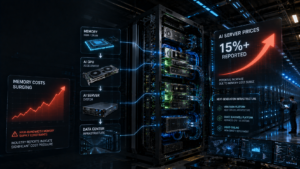
According to a Bloomberg report cited by Reuters, some of NVIDIA’s largest customers have reportedly been notified that prices for certain AI server systems could rise by more than 15%. The reported increases are expected to affect systems shipping in early 2027.
However, the increase has not been officially confirmed by NVIDIA. Reuters said it could not independently verify Bloomberg’s report.
The reported pricing pressure highlights a growing challenge for the AI industry: companies are investing unprecedented amounts in AI infrastructure, but the hardware required to power those systems is becoming increasingly expensive.
NVIDIA AI Server Prices Could Rise More Than 15%
The reported price increases could affect some of NVIDIA’s next-generation AI server systems.
The exact increase is expected to vary depending on factors such as:
- NVIDIA chip generation
- Memory configuration
- Server design
- Amount of memory
- Overall system specifications
This means the reported 15%+ increase should not be interpreted as a universal price increase across every NVIDIA AI product.
Instead, individual customers could see different pricing depending on the systems they order.
Why Are NVIDIA AI Server Prices Increasing?
The biggest factor reportedly driving the increase is rising memory costs.
AI servers require enormous amounts of high-performance memory to train and operate modern AI models.
As companies continue building increasingly large AI data centers, demand for advanced memory has surged.
This is putting pressure on the semiconductor supply chain and increasing the cost of components used in AI servers.
AI Is Creating Huge Demand for Memory
Modern AI systems depend on more than just powerful GPUs.
An AI server typically requires:
- GPUs
- High-bandwidth memory
- DRAM
- CPUs
- Networking hardware
- Storage
- Power systems
- Cooling infrastructure
As AI models become larger and AI agents perform more complex tasks, the amount of computing and memory required continues to increase.
This has made memory one of the most important components in the AI hardware supply chain.
HBM Is Especially Important
One of the most important technologies in modern AI computing is High Bandwidth Memory, or HBM.
HBM allows AI accelerators to access large amounts of data at extremely high speeds.
That makes it particularly valuable for workloads involving:
- Large language models
- Generative AI
- AI training
- AI inference
- Scientific computing
- AI agents
The rapid growth of these workloads has increased demand for advanced memory.
Samsung, SK hynix and Micron Are Key Memory Suppliers
Companies including Samsung Electronics, SK hynix and Micron are major players in the global memory market.
The AI boom has created an enormous new source of demand for their products.
As AI companies and cloud providers continue expanding their data-center capacity, demand for HBM and other memory technologies could remain strong.
NVIDIA’s Vera Rubin Systems Could Be Affected
One of the next-generation platforms reportedly included in the pricing discussions is Vera Rubin.
Vera Rubin is designed for large-scale AI computing and is expected to become an important part of NVIDIA’s future data-center portfolio.
The platform is designed to support increasingly demanding AI workloads as companies move toward more powerful models and AI agents.
Grace Blackwell Systems Could Also See Higher Costs
The reported price changes could also affect NVIDIA’s Grace Blackwell systems.
Grace Blackwell combines NVIDIA’s Grace CPU technology with Blackwell GPUs for high-performance AI and accelerated computing.
These systems are designed for large-scale data-center deployments and are already an important part of the AI infrastructure buildout.
Major Cloud Companies Could Feel the Impact
Large technology companies operate some of the world’s biggest AI data centers.
Companies such as:
- Microsoft
- Oracle
could therefore be among the organizations affected by higher AI server costs.
These companies purchase enormous amounts of computing infrastructure to support cloud services and AI applications.
Even a relatively small percentage increase can become significant when applied to large infrastructure orders.
A 15% Increase Could Mean Billions
The scale of modern AI data centers makes percentage increases particularly important.
A 15% increase on a small server may not dramatically change a company’s budget.
But AI companies increasingly deploy thousands of accelerators across massive data centers.
When the total infrastructure investment reaches billions of dollars, a double-digit percentage increase can create a substantial additional cost.
AI Data Centers Are Already Extremely Expensive
Building an AI data center involves much more than buying GPUs.
Companies also need:
- Land
- Buildings
- Electricity
- Transformers
- Cooling systems
- Networking
- Storage
- Servers
- Backup power
- Fiber connections
Power availability alone has become a major constraint for new AI data centers.
Higher server costs add another challenge.
AI Infrastructure Spending Continues to Grow
Despite rising costs, technology companies continue to spend enormous amounts on AI infrastructure.
The reason is straightforward.
AI services require massive computing capacity.
Companies are building infrastructure to support:
- Chatbots
- AI search
- AI coding assistants
- AI agents
- Image generation
- Video generation
- Enterprise AI
- Scientific AI
The demand for compute remains extremely strong.
AI Agents Could Increase Hardware Demand
The rise of AI agents could make the situation even more significant.
Traditional chatbots generally respond to individual user requests.
AI agents can perform multiple steps to complete a task.
An agent could:
- Understand a goal
- Search for information
- Use external tools
- Write and execute code
- Analyze results
- Correct mistakes
- Complete the task
Each additional step can require more model inference.
As agent-based AI becomes more common, infrastructure demand could increase further.
AI Inference Is Becoming a Major Cost
AI infrastructure isn’t used only to train models.
Once an AI model becomes available to users, companies must continuously run inference workloads.
Every question, image request, coding task or agent action consumes computing resources.
This makes efficient and affordable AI servers increasingly important.
Higher Server Prices Could Affect AI Startups
Large technology companies may be able to absorb higher infrastructure costs.
Smaller AI startups could have less flexibility.
Many startups rent GPU capacity from cloud providers rather than building their own data centers.
If cloud providers face higher hardware costs, some of those expenses could eventually be passed to customers.
Could AI Services Become More Expensive?
Possibly, but a hardware price increase does not automatically mean AI subscriptions will become more expensive.
Cloud and AI companies have several ways to manage rising costs.
They can:
- Improve GPU utilization
- Optimize models
- Reduce unnecessary inference
- Use smaller models
- Improve caching
- Negotiate hardware contracts
- Absorb some costs
Only if those measures are insufficient might higher infrastructure costs eventually affect consumer pricing.
NVIDIA Has Strong Pricing Power
NVIDIA remains one of the dominant companies in AI computing.
Its advantage isn’t limited to GPUs.
The company has built a large ecosystem around:
- CUDA
- AI libraries
- Networking
- Software tools
- Developer platforms
- Data-center systems
This ecosystem makes NVIDIA hardware particularly attractive to AI developers and cloud providers.
Switching Away From NVIDIA Isn’t Easy
Major customers are increasingly developing alternative AI accelerators.
However, replacing NVIDIA hardware can be difficult.
Companies would need to consider:
- Software compatibility
- Developer tools
- Model optimization
- Existing infrastructure
- Engineering costs
- Performance
- Networking
This gives NVIDIA significant influence over the AI hardware market.
AMD Could Benefit From Higher NVIDIA Prices
One potential beneficiary of higher NVIDIA system costs is AMD.
AMD’s Instinct accelerators provide an alternative for organizations looking to diversify their AI hardware supply.
If NVIDIA’s prices rise significantly, some customers may have greater motivation to evaluate competing platforms.
Custom AI Chips Could Gain Momentum
Major cloud companies are also developing their own AI chips.
Custom accelerators allow companies to design hardware specifically for their workloads.
If NVIDIA systems become more expensive, the financial argument for developing custom silicon could become stronger.
However, designing advanced AI chips requires enormous investment and engineering resources.
Memory Could Become the Next AI Bottleneck
The AI industry initially focused heavily on securing GPUs.
Now the bottleneck is increasingly becoming the entire infrastructure supply chain.
Companies need enough:
GPU + HBM + DRAM + Networking + Power + Cooling + Data Center Capacity
A shortage in any one of these areas can slow the expansion of AI infrastructure.
AI Hardware Supply Chains Are Becoming More Strategic
The current situation demonstrates how important semiconductor supply chains have become to the AI industry.
AI companies are no longer simply buying computers.
They are building enormous computing factories.
Every component matters.
Memory availability can determine how quickly servers can be assembled.
Power availability can determine where data centers can be built.
Networking can determine how efficiently thousands of GPUs can work together.
Memory Production Cannot Expand Overnight
Another challenge is that semiconductor manufacturing requires significant time and capital.
Increasing memory production requires:
- New manufacturing capacity
- Specialized equipment
- Advanced packaging
- Skilled engineers
- Large capital investments
That means a sudden increase in demand can create pricing pressure before new supply becomes available.
The AI Boom Is Creating Hardware Inflation
The traditional technology industry often benefits from falling hardware prices over time.
AI infrastructure is behaving differently.
Demand is growing so rapidly that certain components can become more expensive even as manufacturing technology improves.
This creates a new form of infrastructure inflation.
AI Data Center Projects Could Become More Expensive
If higher memory costs continue, AI data-center projects could face increasing budgets.
Companies planning massive facilities may have to reconsider:
- Hardware quantities
- Deployment timelines
- Server configurations
- Power requirements
- Financing
Some projects could potentially be delayed if costs rise significantly.
Efficiency Will Become More Important
Higher infrastructure costs could push AI companies to focus more heavily on efficiency.
That could lead to increased investment in:
- Smaller AI models
- Quantization
- Better inference engines
- Memory optimization
- Model compression
- Efficient architectures
- Better GPU utilization
The goal is simple:
Get more AI work from every dollar of hardware.
NVIDIA’s Next Earnings Report Could Be Important
NVIDIA is scheduled to report its fiscal second-quarter results on August 26, 2026.
Investors and customers will be watching closely for information about:
- AI demand
- Data-center growth
- Memory supply
- Blackwell demand
- Vera Rubin
- Gross margins
- Future infrastructure spending
The reported pricing changes could become an important topic during the company’s earnings discussion.
NVIDIA Has Not Confirmed the Reported Increase
It is important to separate reporting from confirmed company policy.
The reported 15%+ increase comes from Bloomberg reporting cited by Reuters.
NVIDIA had not publicly confirmed the increase when Reuters published its report.
Reuters also said it could not independently verify the Bloomberg information.
Therefore, the development should currently be described as a reported potential price increase, not an official NVIDIA announcement.
What It Means for the AI Industry
The story highlights a broader issue facing artificial intelligence.
The biggest challenge is no longer simply creating more powerful AI models.
Companies also need to build the physical infrastructure required to run them.
That infrastructure requires enormous quantities of:
- GPUs
- Memory
- Servers
- Networking equipment
- Electricity
- Cooling systems
As demand grows, every part of the supply chain becomes increasingly important.
What It Means for Consumers
Consumers may not immediately notice the impact.
AI chatbot subscriptions, image generators and other services are not directly priced according to individual server costs.
However, if infrastructure expenses continue rising over the long term, companies could eventually adjust pricing, usage limits or service tiers.
What It Means for Investors
For investors, the story highlights the growing importance of semiconductor supply chains.
NVIDIA remains a central player, but memory manufacturers could also benefit from strong AI demand.
Companies controlling critical components may gain additional pricing power as AI infrastructure spending increases.
The Bigger AI Hardware Race
The AI industry is entering a phase where performance alone isn’t enough.
Companies must also consider:
- Cost
- Power efficiency
- Memory availability
- Supply security
- Cooling
- Data-center capacity
The winner may not simply be the company with the fastest AI chip.
It could be the company that can deliver the best performance at the lowest total infrastructure cost.
Final Verdict
NVIDIA AI server prices could reportedly rise by more than 15% as surging memory costs put additional pressure on the AI hardware supply chain.
The reported increases are expected to affect some systems shipping in early 2027, including platforms based on NVIDIA’s next-generation technologies.
However, the increase has not been officially confirmed by NVIDIA, so the 15%+ figure should currently be treated as a reported potential increase rather than a confirmed company-wide price hike.
The bigger story is the growing cost of the global AI infrastructure race.
As companies build increasingly large AI data centers, demand for GPUs, HBM, memory, networking, power and cooling continues to rise.
If memory costs remain elevated, AI infrastructure could become even more expensive — potentially pushing companies to improve efficiency, develop custom chips and explore alternatives to NVIDIA.
For now, the industry will be watching NVIDIA’s upcoming earnings report and future customer pricing closely.
One thing is increasingly clear:
The AI race is no longer just about who can build the most powerful chips. It’s also about who can afford to build enough of them.
FAQ
Could NVIDIA AI server prices rise by more than 15%?
According to a Bloomberg report cited by Reuters, some of NVIDIA’s largest customers have reportedly been notified about AI-related server price increases of more than 15% in some cases.
When could NVIDIA AI server prices increase?
The reported price increases are expected to affect systems shipping in early 2027.
Has NVIDIA officially confirmed the 15%+ price increase?
No. NVIDIA had not publicly confirmed the reported increases when Reuters published its report. Reuters also said it could not independently verify the Bloomberg report.
Why are NVIDIA AI server prices expected to rise?
The main reported reason is the sharp increase in memory costs as demand for AI infrastructure continues to grow.
How are memory costs affecting AI servers?
Modern AI servers require large amounts of high-performance memory, including HBM and other memory technologies. Rising demand has put additional pressure on memory supply and pricing.
Which NVIDIA platforms could be affected?
The reported increases could affect systems based on NVIDIA’s Vera Rubin and Grace Blackwell platforms.
What is NVIDIA Vera Rubin?
Vera Rubin is NVIDIA’s next-generation AI computing platform designed for large-scale artificial intelligence and accelerated-computing workloads.
What is NVIDIA Grace Blackwell?
Grace Blackwell is NVIDIA’s AI computing platform combining Grace CPUs with Blackwell GPUs for demanding data-center workloads.
Which companies could be affected by higher NVIDIA server prices?
Large cloud and technology companies such as Microsoft, Google and Oracle could potentially be affected because they operate major AI data-center infrastructure.
Could higher NVIDIA server prices make AI more expensive?
Potentially. Higher hardware costs could increase the capital required to build and operate AI infrastructure.
Could AI cloud services become more expensive?
Possibly. Cloud providers could absorb higher hardware costs, improve infrastructure efficiency or eventually pass some of the additional costs to customers.
Could AI startups be affected?
Yes. AI startups that rely on rented GPU and cloud infrastructure could face higher costs if providers pass increased hardware expenses through to customers.
Why is memory so important for AI chips?
AI models process enormous amounts of data. High-bandwidth memory allows AI accelerators to access that data at extremely high speeds, making it a critical part of modern AI systems.
What is HBM?
HBM stands for High Bandwidth Memory. It is a high-performance memory technology widely used with advanced AI accelerators.
Which companies manufacture AI memory?
Major memory manufacturers include Samsung Electronics, SK hynix and Micron.
Could memory shortages continue?
They could. AI infrastructure demand remains extremely strong, while expanding semiconductor and memory production requires significant time and investment.
Could NVIDIA competitors benefit from higher prices?
Potentially. Higher NVIDIA system costs could encourage customers to consider alternatives from AMD and companies developing custom AI accelerators.
Could custom AI chips become more popular?
Yes. Higher infrastructure costs could give large cloud providers additional motivation to develop their own AI chips and reduce dependence on third-party accelerators.
Why don’t companies simply replace NVIDIA GPUs?
NVIDIA’s advantage extends beyond its hardware. Its CUDA software ecosystem, libraries, networking technologies and developer ecosystem make switching to alternative platforms more complicated.
Could higher server costs slow AI data-center construction?
Higher hardware prices could add pressure to already expensive AI infrastructure projects, which also face challenges involving electricity, cooling, construction and financing.
Could the reported price increase affect NVIDIA’s profit margins?
It is too early to determine. Higher memory costs could increase expenses, while pricing changes could potentially help offset some of those costs.
Why is NVIDIA’s AI business important?
NVIDIA is one of the leading suppliers of GPUs and complete computing platforms used to train and run advanced AI models.
When is NVIDIA expected to report earnings?
NVIDIA is scheduled to report its fiscal second-quarter results on August 26, 2026. Investors will be watching its comments on AI demand, supply constraints, margins and next-generation systems.
What should investors watch for?
Investors will likely focus on AI demand, data-center growth, memory availability, Blackwell and Vera Rubin deployments, margins and customer spending.
Does the 15% figure apply to every NVIDIA AI server?
No. The reported increase varies depending on factors such as the NVIDIA chip generation, memory configuration and overall server specifications.
Is this a confirmed NVIDIA price hike?
No. It should currently be described as a reported potential price increase, rather than an officially announced NVIDIA pricing policy.
What does this mean for the AI industry?
The development highlights how rising memory demand is becoming an important constraint on the rapidly expanding AI infrastructure market.
What is the biggest takeaway?
The AI boom is creating enormous demand for computing infrastructure, but the cost of building that infrastructure is also rising. Memory is emerging as one of the most important cost pressures in next-generation AI servers.