
Europe’s robotaxi race is accelerating.
Uber and Chinese autonomous-driving company Pony.ai are planning to deploy more than 2,000 robotaxis across Europe, expanding a partnership that has already produced a commercial robotaxi service in Zagreb, Croatia.
The expansion will extend beyond Zagreb into four additional European cities, although the companies have not yet disclosed the locations or provided a timetable for the full 2,000-plus vehicle rollout. The partnership is also expected to expand into the Middle East.
The announcement is significant because this is no longer just an autonomous-driving experiment.
Robotaxis are beginning to move from controlled pilots toward real commercial ride-hailing networks.
And Uber wants to be one of the platforms through which that transition happens.
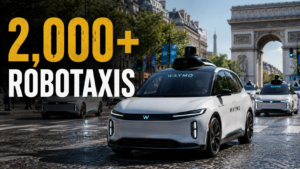
Uber and Pony.ai’s 2,000-Robotaxi Plan
The new agreement is designed to scale Pony.ai’s autonomous vehicles through Uber’s mobility platform.
The companies are targeting more than 2,000 robotaxis across Europe over the broader deployment program. The initial European service began in Zagreb, where Pony.ai, Uber and Croatian mobility company Verne launched commercial robotaxi operations in April 2026.
The next phase will expand into four additional European cities.
The exact cities have not yet been announced.
That means the 2,000-vehicle figure should be understood as a deployment target, not a fleet that will suddenly appear across Europe.
Zagreb Was the Starting Point
Zagreb is already an important milestone for the partnership.
In April, Pony.ai announced that its robotaxi service had officially started commercial operations in Croatia’s capital, calling it Europe’s first commercial robotaxi service.
The initial service covered roughly 90 square kilometers around Zagreb’s wider city center and included Zagreb Airport.
The service initially operated from 7 a.m. to 9 p.m., using Pony.ai’s seventh-generation autonomous-driving technology.
Passengers could initially book through Verne’s app, with Uber integration planned as part of the partnership.
That makes Zagreb more than a technology demonstration.
It is the first real-world foundation for what Uber and Pony.ai now want to scale across Europe.
How the Uber-Pony.ai Robotaxi Model Works
The partnership divides the responsibilities between different companies.
Pony.ai
Pony.ai provides the autonomous-driving technology and robotaxi platform.
Uber
Uber provides its ride-hailing network and customer-facing mobility platform.
Verne
Verne acts as the local fleet owner and service operator in the European partnership.
This creates an asset-light model where the companies don’t all need to build every part of the business themselves.
Pony.ai focuses on autonomous driving.
Uber focuses on connecting riders with vehicles.
Local partners handle fleet operations and regulatory execution.
That structure could make international expansion easier.
Why Uber Wants Thousands of Robotaxis
Uber has been preparing for a future in which not every ride requires a human driver.
The company’s advantage isn’t necessarily the autonomous-driving technology itself.
Its advantage is the massive ride-hailing network already used by millions of customers.
If autonomous vehicles become commercially viable, Uber can potentially connect those vehicles with existing demand rather than building an entirely new ride-hailing service.
That’s a major strategic advantage.
A rider doesn’t necessarily need to download a new app.
Instead, the autonomous vehicle could simply appear as another option inside the Uber experience.
Pony.ai Gets Something Equally Important
For Pony.ai, the partnership provides access to an international customer network.
Building autonomous vehicles is only one part of the robotaxi business.
A company also needs:
- Customers
- Fleet operations
- Local permits
- Insurance
- Maintenance
- Charging
- Vehicle deployment
- Ride-hailing infrastructure
Uber already has much of the customer and mobility infrastructure.
That makes the partnership attractive for Pony.ai as it expands beyond China.
Europe Is Becoming a Robotaxi Battleground
The Uber-Pony.ai announcement comes as several autonomous-driving companies accelerate European expansion.
Uber is also working with other autonomous-driving companies.
For example, Uber and WeRide announced plans for commercial robotaxi operations in the Greater Zurich Region, subject to regulatory approval.
Uber has also partnered with WeRide and AVOMO for a robotaxi pilot in Madrid.
Separately, Uber, Stellantis and Wayve are working together on Level 4 autonomous mobility.
That means Uber isn’t betting on a single autonomous-driving technology.
Instead, it appears to be building a broader ecosystem in which multiple autonomous vehicle providers can operate through its platform.
What Makes This Different From a Robotaxi Test?
A pilot demonstrates that the technology can work.
A commercial service asks a much harder question:
Can the technology operate reliably enough for real customers to pay for rides?
That’s a completely different challenge.
A commercial robotaxi needs to deal with:
- Traffic
- Pedestrians
- Cyclists
- Road construction
- Weather
- Emergency vehicles
- Unusual intersections
- Local driving rules
- Parking
- Pickup and drop-off locations
And it needs to do this repeatedly.
Zagreb therefore gives Pony.ai and Uber something valuable: real-world operating experience in Europe.
Pony.ai’s Gen-7 Technology Is Behind the Service
The Zagreb deployment uses Pony.ai’s seventh-generation autonomous-driving system, known as Gen-7.
The system is deployed on the Arcfox Alpha T5 robotaxi platform.
Pony.ai says its approach is designed for large-scale commercialization rather than only experimental testing.
The company has also been working on reducing vehicle and deployment costs as it expands.
That cost question will be critical.
A robotaxi business cannot succeed simply because the vehicle can drive itself.
It needs to eventually make economic sense.
The Biggest Challenge Is Regulation
Autonomous driving isn’t governed by one European rulebook that instantly allows robotaxis everywhere.
Each market has its own regulatory requirements, road conditions and approval processes.
Pony.ai’s European strategy therefore involves working with local partners that understand the regulatory environment.
In the Zagreb partnership, Verne has been responsible for local market readiness and regulatory execution.
That model could become important as the companies enter additional cities.
A robotaxi system that works technically in Zagreb still needs to satisfy regulators in every new market.
Which European Cities Will Get the Robotaxis?
That remains one of the biggest unanswered questions.
The latest announcement says the expansion will reach four additional European cities, but the companies have not publicly identified those cities yet.
This is important because readers should not assume that cities such as London, Paris or Berlin are automatically included.
The final locations will depend on:
- Regulatory approval
- Local operating partnerships
- Infrastructure
- Vehicle availability
- Safety requirements
- Market demand
For now, Zagreb is the confirmed commercial European market, while four additional cities are planned but undisclosed.
Will These Robotaxis Be Fully Driverless?
The long-term goal is autonomous operation.
However, robotaxi deployments can go through different stages.
Early commercial or pilot programs may include safety operators while the technology and regulators gain confidence.
Pony.ai’s original Uber partnership in 2025 described a pilot phase involving safety operators before fully autonomous commercial operations.
The exact operating configuration can vary by city and regulatory approval.
So the phrase “robotaxi” does not automatically mean every vehicle will immediately operate without any human oversight.
Why China’s Pony.ai Is Expanding Into Europe
Pony.ai has been aggressively expanding internationally.
The company has described a strategy focused on scaling autonomous mobility through partnerships rather than building every fleet itself.
Its European operations are part of a broader international expansion that includes markets in Asia and the Middle East.
Pony.ai has also established a European presence in Luxembourg and has been working with European partners on autonomous mobility.
The Europe push gives the company a chance to demonstrate that its autonomous-driving technology can operate beyond China’s roads.
This Is Also a Strategic Move for Uber
Uber’s robotaxi strategy is becoming increasingly interesting.
Rather than developing one universal autonomous-driving system internally, Uber appears to be building relationships with multiple technology providers.
That could allow Uber to operate different autonomous fleets in different markets.
Its platform could effectively become the distribution layer for robotaxis.
The model would look something like:
Autonomous-driving company → Robotaxi fleet → Uber platform → Passenger
That could allow Uber to remain central even if different companies ultimately provide the driving technology.
Uber Could Become the “App Store” for Robotaxis
This is speculative, but the strategic analogy is useful.
The smartphone industry has many hardware manufacturers, while platforms such as app stores connect users with software.
Uber could play a similar role in autonomous mobility.
Instead of owning every robotaxi, Uber could connect customers to vehicles operated by:
- Pony.ai
- Wayve
- WeRide
- Other autonomous-driving companies
The company would provide the marketplace, payments, routing and customer relationship.
That could be a powerful position if robotaxis become mainstream.
What Happens to Human Drivers?
This is one of the biggest questions surrounding the expansion.
If autonomous vehicles eventually become cheaper to operate than conventional taxis, ride-hailing companies could have an incentive to increase robotaxi usage.
But that transition won’t happen overnight.
Regulation, technology, customer trust and economics will determine how quickly autonomous vehicles can replace human-driven rides.
For Uber drivers, the growth of robotaxis could eventually create more competition.
At the same time, autonomous fleets may initially operate alongside human drivers rather than replacing them completely.
Robotaxis Still Have to Prove Their Economics
The technology is only half the story.
The bigger commercial question is:
Can a robotaxi make money?
A vehicle without a driver can potentially reduce one of the largest recurring costs in ride-hailing.
But autonomous vehicles also have expensive technology.
They require:
- Cameras
- Radar
- LiDAR or other sensing systems
- Powerful computing
- Specialized software
- Maintenance
- Remote assistance infrastructure
- Fleet management
The economics become attractive only if those costs can be spread across enough rides.
That is why scaling to thousands of vehicles matters.
More vehicles and more rides can potentially improve the economics of the entire system.
Why 2,000 Vehicles Matter
A fleet of 20 robotaxis can prove a concept.
A fleet of 2,000 begins to test whether the business can scale.
At that level, companies have to solve much bigger operational problems.
They need:
- Fleet maintenance
- Charging infrastructure
- Vehicle logistics
- Software updates
- Remote support
- Customer service
- Insurance
- Accident response
- Regulatory reporting
The move from hundreds to thousands therefore represents a major operational challenge.
Europe Could Become a Key Test Market
Europe is particularly interesting because its cities have very different environments.
Narrow historic streets, dense urban centers and complicated road layouts can challenge autonomous-driving systems.
Zagreb itself contains a mix of older and modern urban areas, creating varied driving conditions. Pony.ai says the city includes narrow and winding streets and complex traffic situations.
If the technology can scale successfully across multiple European cities, it could provide strong evidence that the system is adaptable.
The Middle East Is Also Part of the Expansion
The latest Uber-Pony.ai expansion isn’t limited to Europe.
The companies also plan to expand their collaboration into the Middle East, although details about locations and fleet sizes have not yet been released.
That fits Pony.ai’s broader international strategy.
The company has already reported robotaxi activity in Qatar and other overseas markets.
The combination of Europe and the Middle East gives Pony.ai two very different environments in which to demonstrate its autonomous-driving technology.
Competition Is Heating Up
Pony.ai isn’t the only company trying to build a global robotaxi business.
Major players include:
- Waymo
- WeRide
- Baidu
- Wayve
- Motional
- Tesla
- Mobileye
Their approaches differ.
Some focus heavily on their own autonomous-driving technology.
Others rely on partnerships with automakers and mobility companies.
Uber’s strategy is interesting because it can potentially support several of them.
That gives the ride-hailing company a way to participate in the autonomous-driving market without betting everything on a single technology provider.
What Could Go Wrong?
The robotaxi rollout faces several risks.
Regulatory delays
A planned city may take longer than expected to approve autonomous commercial services.
Safety incidents
A serious accident could slow deployment and trigger additional scrutiny.
High operating costs
Autonomous vehicles may remain expensive to build and maintain.
Customer trust
Some passengers may still be uncomfortable entering a vehicle without a human driver.
Technology limitations
Autonomous systems can struggle with unusual road situations and extreme conditions.
Competition
Other robotaxi companies may reach scale faster.
The 2,000-vehicle target is therefore ambitious, but the actual deployment pace will depend on how these challenges develop.
What This Means for the Future of Uber
If robotaxis become mainstream, Uber’s business model could change significantly.
Today, Uber primarily connects passengers with human drivers.
Tomorrow, the platform could connect passengers with a mixture of:
Human drivers + autonomous vehicles.
That would create a hybrid transportation marketplace.
During busy periods, autonomous vehicles could provide additional capacity.
In areas where robotaxis are approved, they could operate continuously without driver scheduling constraints.
And Uber could potentially earn revenue from each autonomous ride without needing to employ the vehicle’s driver.
What This Means for Pony.ai
For Pony.ai, the European expansion is about proving that its technology can scale internationally.
China remains an important market for the company.
But a successful international business would diversify its operations and demonstrate that Pony.ai’s technology can handle different:
- Roads
- Regulations
- Languages
- Driving cultures
- Weather conditions
- Urban environments
That could make Pony.ai a much more significant global autonomous-driving company.
The Bigger Autonomous Driving Shift
The most important part of this announcement isn’t the number 2,000.
It’s the transition from:
“Can autonomous cars drive themselves?”
to:
“Can autonomous cars become a large commercial transportation business?”
The first question is primarily technological.
The second involves technology, economics, regulation and customer behavior.
Uber and Pony.ai are now testing the second question.
And Europe is becoming one of their most important laboratories.
Read More:- Apple Builds New AI Model for China With Alibaba Support
Final Takeaway
Uber and Pony.ai are planning to deploy more than 2,000 robotaxis across Europe, expanding beyond their existing commercial operation in Zagreb. The expansion is expected to cover four additional European cities, although the locations and full deployment timeline have not yet been announced.
The partnership combines three different strengths:
Pony.ai provides autonomous-driving technology.
Uber provides the global ride-hailing platform.
Local partners such as Verne handle fleet operations and market readiness.
Zagreb is already an important proof point. Pony.ai says its commercial robotaxi service there began in April 2026, making it Europe’s first commercial robotaxi service.
The next phase will be much more difficult.
Scaling from a single city to thousands of vehicles means solving regulatory, safety, infrastructure and economic challenges across multiple markets.
But if Uber and Pony.ai can make the model work, the implications could extend far beyond one partnership.
Uber could become one of the world’s biggest platforms for autonomous transportation—while Pony.ai could use Europe to prove that Chinese autonomous-driving technology can compete on a global stage.
The robotaxi race is no longer just about who can build a self-driving car.
It’s about who can put thousands of them on the road.