Meta has released a new AI model designed to do something that is becoming increasingly important in the AI industry: run capable AI agents locally instead of sending every task to the cloud.
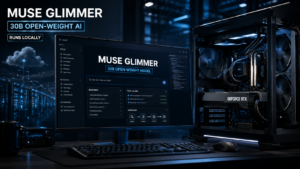
The company introduced Muse Glimmer, a 30-billion-parameter open-weight model developed by Meta Superintelligence Labs.
Unlike many frontier AI systems that depend on powerful cloud infrastructure, Muse Glimmer is specifically optimized to run on consumer hardware. Meta says it can run on a Mac or PC with a single consumer GPU, opening the door to local coding assistants, tool-using agents, research workflows and other always-on AI applications.
The release is also notable because Meta is making the model weights available under the permissive Apache 2.0 license.
That puts Muse Glimmer firmly in the growing open-weight AI race alongside models from companies such as Google, Alibaba and other AI labs.
But Muse Glimmer is not trying to win by simply being a gigantic model.
Its pitch is different:
A capable AI agent that you can actually run on your own machine.
What Is Meta Muse Glimmer?
Muse Glimmer is a 30-billion-parameter multimodal AI model designed specifically for local and agentic workflows.
The “agentic” part is important.
A conventional chatbot primarily responds to prompts.
An AI agent can go further. It can plan a task, call tools, inspect information, recover from errors and continue working through multiple steps.
Meta designed Muse Glimmer around these types of workflows.
The company says the model supports:
- Agentic task completion
- Tool calling
- Multi-step reasoning
- Coding
- Multimodal input
- Long-context workflows
- Failure recovery
- Different reasoning-effort levels
- More than 100 languages
Muse Glimmer is therefore not being positioned simply as another general-purpose chatbot.
It is intended to become a building block for local AI agents.
Meta Has Released Muse Glimmer as Open Weights
One of the biggest parts of the announcement is accessibility.
Meta has released Muse Glimmer’s weights under the Apache 2.0 license.
This means developers can download the model and work with it rather than accessing it only through a proprietary cloud API.
That distinction matters.
With a closed AI model, developers generally interact with an API or application controlled by the model provider.
With an open-weight model, developers can obtain the model parameters and deploy the model themselves, subject to the license terms.
For companies and developers, local deployment can provide several advantages:
- Greater control
- Lower dependence on cloud APIs
- Potentially lower operating costs
- Better privacy for sensitive workloads
- Offline operation
- Custom deployment options
- Ability to integrate the model into private systems
Meta is betting that these advantages will become increasingly valuable as AI agents become more capable.
How Big Is Muse Glimmer?
Muse Glimmer has 30 billion parameters.
That sounds enormous compared with consumer software, but it is relatively compact compared with the largest frontier models.
The reason Meta chose this scale is practical.
A much larger model might offer stronger general capabilities, but it would also require significantly more memory and compute.
Muse Glimmer is designed around a different goal:
Get as much useful agentic capability as possible into a model that people can actually run locally.
That makes its size an important part of the product strategy rather than a limitation that Meta is trying to hide.
Can Muse Glimmer Run on a Normal Computer?
Potentially, yes—with the right hardware configuration.
Meta says the full-precision 30-billion-parameter model would require more than 55 GB of memory.
That is too large for most consumer GPUs.
So Meta uses quantization to compress the model.
With approximately 4-bit quantization, the model can be reduced to under 20 GB, according to Meta.
That makes local deployment much more practical on systems with roughly 24 GB or 32 GB of available memory.
Meta specifically tested the model on consumer-class hardware including Apple’s newer Mac systems and Nvidia’s RTX 5090.
The important idea is that you do not necessarily need a massive cloud server to experiment with Muse Glimmer.
A sufficiently powerful personal computer can potentially run it.
What Is Quantization?
Quantization is a technique used to reduce the amount of memory required by an AI model.
Large language models store enormous numbers of numerical values called weights.
Those values can be represented using different levels of numerical precision.
Using fewer bits means the model requires less memory.
For example, moving toward 4-bit representations can dramatically reduce the amount of memory required to load a model.
The trade-off is that aggressive compression can sometimes reduce model quality.
Meta says it tested its quantized Muse Glimmer configuration and found minimal to no degradation on the agentic tasks it evaluated.
That claim comes from Meta’s own testing, so independent benchmarks will be important as more developers evaluate the model.
Muse Glimmer Uses Distillation
Another interesting part of the model’s development is distillation.
Meta trained Muse Glimmer using outputs from the much larger Muse Spark model.
The idea behind distillation is relatively straightforward:
A smaller model learns from a more capable teacher model.
Instead of requiring the smaller model to independently learn everything from scratch, training can transfer useful behaviors and reasoning patterns from the larger model.
Meta says Muse Glimmer’s training included several stages:
- Pre-training using Muse Spark outputs
- Mid-training with longer-context and agent-focused data
- Post-training combining supervised fine-tuning, on-policy distillation and reinforcement learning
This approach helps explain why Meta is emphasizing capability per unit of hardware rather than simply increasing parameter count.
What Can Muse Glimmer Do?
Meta designed Muse Glimmer around agentic workloads.
Coding
The model can be used for local coding agents that inspect files, reason through problems, generate code and work through development tasks.
This could make it useful for developers who want an AI coding assistant without sending their entire codebase to a cloud service.
Tool Use
Muse Glimmer is trained to make function calls using structured tool schemas.
That means an application can connect the model to external tools and allow it to perform actions.
For example, an agent could potentially:
- Read a task
- Inspect files
- Call a tool
- Analyze the result
- Decide what to do next
- Recover from an error
- Continue until the task is complete
That is considerably different from simply generating a text answer.
Local Agents
Muse Glimmer is particularly interesting for always-on local assistants.
An agent running on a personal machine could potentially work with local files, development environments and other applications without constantly communicating with a remote AI server.
Multimodal Tasks
Muse Glimmer is not limited to text.
Meta says the model can process interleaved text and images through a dedicated perception encoder.
That allows agents to work with things such as:
- Screenshots
- Documents
- Charts
- Visual interfaces
This could become increasingly important as computer-use agents become more common.
How Fast Is Muse Glimmer?
Meta has also focused heavily on inference speed.
A model can be small enough to run locally and still feel frustrating if every response takes too long.
To address this, Meta uses speculative decoding.
The system uses a smaller “drafter” model to propose groups of tokens, while the main model verifies those proposals.
Instead of generating every token sequentially in the traditional way, multiple proposed tokens can be checked together.
Meta reports that its setup increased decoding speed by:
- 3.1× on an RTX 5090
- 1.8× on an M5 Max
- 1.5× on an M4 Max
These are Meta’s measurements under its testing setup, not universal speed guarantees for every user’s hardware.
Still, the numbers illustrate what Meta is optimizing for.
Muse Glimmer is designed to feel responsive enough for real-time local agent interaction.
What Hardware Does Muse Glimmer Need?
There is no single hardware configuration that everyone needs.
Your requirements depend on the model precision, quantization level, context length and workload.
But Meta’s published testing provides a useful reference.
A quantized version around 17 GB can fit within a 24 GB or 32 GB memory envelope while leaving room for other components such as the KV cache and perception encoder.
Potential hardware categories include:
| Hardware | Suitability |
|---|---|
| High-end consumer GPU | Excellent for local deployment |
| RTX 5090-class GPU | Specifically tested by Meta |
| High-memory Apple Silicon Mac | Supported in Meta’s testing |
| 24–32 GB unified/system memory | Potentially suitable for quantized configurations |
| Typical office laptop | Generally not ideal |
| Low-memory GPU | Likely too constrained for practical use |
Actual performance will depend heavily on the specific implementation.
A model that technically fits into memory may still be too slow for comfortable agentic use.
Muse Glimmer vs Gemma and Qwen
One of the most interesting comparisons is with other models in the same general size category.
Meta evaluated Muse Glimmer against models including Gemma 4 31B and Qwen 3.6 27B.
The company says Muse Glimmer performs strongly across several agentic, coding, multimodal, safety and reasoning benchmarks.
However, benchmark comparisons need context.
There is no single benchmark that tells you which AI model is “best.”
A model might be better for coding but worse at creative writing.
Another might be stronger at reasoning while using more memory.
A third might have a better ecosystem for local deployment.
For developers, the more useful question is:
Which model performs best for my workload on my hardware?
Muse Glimmer’s real-world reputation will likely be determined by independent testing over the coming weeks.
Muse Glimmer vs Cloud AI Models
The biggest difference is not necessarily intelligence.
It is where the model runs.
Cloud-based AI services offer access to extremely large models without requiring users to purchase expensive hardware.
Local models reverse that equation.
You provide the hardware.
In return, you gain more control over the model and data.
Cloud AI
Advantages:
- Access to larger models
- No local hardware requirement
- Easy setup
- Managed infrastructure
- Rapid model upgrades
Disadvantages:
- Requires internet access
- API costs can accumulate
- Data may need to leave your device
- Less control over infrastructure
Local AI
Advantages:
- Greater privacy
- Offline operation
- No per-request API fee
- More customization
- Full control over deployment
Disadvantages:
- Requires capable hardware
- Initial hardware cost
- More technical setup
- Smaller models may have lower overall capability
Muse Glimmer is essentially Meta’s attempt to make the second category much more useful.
Why Local AI Agents Matter
Local AI becomes particularly interesting when agents start interacting with personal information.
Imagine an AI assistant that has access to:
- Your documents
- Your calendar
- Your code
- Your files
- Your photos
- Your notes
- Your local applications
If all of that information has to be sent to a cloud service, privacy becomes a major consideration.
A local agent can potentially keep that information on the device.
That does not automatically make every local deployment safe. Developers still need to secure the system, permissions and tools connected to the model.
But the architecture provides a fundamentally different privacy model.
Muse Glimmer Is Part of Meta’s Bigger AI Strategy
Muse Glimmer did not appear in isolation.
Meta launched Muse Spark in April 2026 as the first model from Meta Superintelligence Labs.
Muse Spark was positioned as a powerful multimodal reasoning model with tool use and multi-agent orchestration.
Meta then expanded the Muse family with media-generation models including Muse Image and Muse Video.
Now Muse Glimmer adds another direction:
small enough for local deployment, but designed for agentic workloads.
This gives Meta a broader model family rather than one single flagship model.
Meta Is Also Planning More Open Muse Models
The Glimmer release is especially interesting because Meta is also signaling another major move.
Mark Zuckerberg has said that Meta plans to release the weights for Muse Spark 1.2.
That would be a much more significant open-weight release because Spark represents a larger and more capable part of Meta’s current model strategy.
The timing suggests Meta is once again leaning heavily into open-weight AI.
That matters because Meta had previously made open models such as Llama one of the company’s defining AI strategies.
Muse Glimmer appears to extend that philosophy into the agentic-AI era.
Why Meta Wants Open-Weight AI
There is a strategic argument behind the approach.
If AI becomes dominated by a small number of closed companies, developers and businesses become dependent on those companies for access.
Open-weight models distribute more of that capability.
Developers can:
- Download models
- Fine-tune them
- Run them locally
- Build specialized applications
- Inspect model behavior
- Deploy without depending entirely on an API provider
For Meta, this strategy also creates a large developer ecosystem around its models.
The company can benefit from the broader adoption of its AI technology even when users are not directly using Meta AI.
Is Muse Glimmer Really “Open Source”?
This is where terminology matters.
Meta calls Muse Glimmer an open-weight model and says the weights are released under Apache 2.0.
Those terms are often used interchangeably in casual technology coverage, but they are not always identical.
“Open-weight” specifically describes the availability of the model’s learned parameters.
“Open source” can imply broader availability of source code, training data and other components depending on the context.
For accurate reporting, open-weight is the safer term for Muse Glimmer.
What Does Muse Glimmer Mean for Developers?
For developers, the release could be significant because it lowers the hardware barrier for experimenting with agentic AI.
A developer can potentially build an AI agent that runs directly on their own machine instead of paying for every interaction with a cloud API.
That opens up possibilities such as:
- Local coding assistants
- Private document agents
- Offline research tools
- Personal productivity agents
- Local automation
- AI-powered developer tools
- Enterprise agents running behind a firewall
The ability to customize the model also makes it more attractive for specialized applications.
What Does It Mean for Businesses?
Businesses have a different reason to pay attention.
AI inference can become expensive when thousands or millions of requests are processed through cloud APIs.
Running smaller models locally or on private infrastructure can potentially reduce recurring inference costs.
Privacy can also be important.
Companies working with confidential documents, proprietary code or sensitive internal information may prefer AI systems that can operate within their own infrastructure.
Muse Glimmer does not automatically solve every enterprise deployment problem, but it provides another option.
What Does Muse Glimmer Mean for Meta’s AI Competition?
Meta is competing in a crowded AI market.
OpenAI, Google, Anthropic, xAI, Alibaba and numerous open-model developers are all pushing AI capabilities forward.
But Meta has a distinctive position.
It can pursue both:
Closed consumer AI products
and
Open-weight models for developers.
Muse Glimmer strengthens the second side of that strategy.
If developers adopt the model widely, Meta can gain influence over the AI ecosystem even when the model is running outside Meta’s own infrastructure.
Could Muse Glimmer Challenge OpenAI or Google?
Not directly in every category.
Muse Glimmer is a 30B model designed around local agentic workloads.
The largest frontier models from companies such as OpenAI and Google are designed for broader and more demanding workloads and may operate at completely different scales.
The more interesting comparison is not:
“Is Muse Glimmer smarter than the biggest AI model?”
It is:
“Can a relatively compact local model perform enough useful work to replace cloud AI for certain tasks?”
If the answer is yes, that could be strategically important.
The Real Competition May Be Local AI
The AI industry has spent years moving toward larger models.
Muse Glimmer represents the other direction.
Instead of asking:
How large can we make the model?
Meta is asking:
How capable can we make a model that people can actually run themselves?
That is an important shift.
As computer hardware becomes more powerful and quantization techniques improve, more capable AI systems can move from data centers onto personal computers.
That could eventually lead to AI assistants that are always available without a cloud connection.
How to Run Muse Glimmer
Meta says the model is available now through Hugging Face, along with developer documentation.
Support is also coming through several local-AI ecosystems, including:
- llama.cpp
- MLX
- ExecuTorch
- Ollama
- LM Studio
- Unsloth
For larger-scale serving, Meta also lists platforms such as:
- vLLM
- SGLang
- Together AI
- Fireworks AI
- OpenRouter
This makes the model considerably easier to experiment with than a model that requires a proprietary API.
Developers should still check the latest hardware and software requirements before installing it because local inference performance depends heavily on the specific runtime and quantization format.
Should You Try Muse Glimmer?
If you already have a capable GPU or high-memory Apple Silicon machine and are interested in local AI, Muse Glimmer is worth experimenting with.
It is particularly interesting if you want:
- Local coding AI
- Agentic workflows
- Offline AI
- Privacy-focused AI
- Model customization
- Tool calling
- Local multimodal applications
For someone using a basic laptop primarily for casual AI chats, however, downloading a 30B model may not be the most practical option.
Cloud AI services will still be simpler.
What We Still Don’t Know
Despite the excitement around the release, there are several things that will become clearer only after independent testing.
These include:
- Real-world performance across different GPUs
- Long-running agent reliability
- Coding quality outside Meta’s benchmarks
- Memory behavior at large context lengths
- Performance of different quantization formats
- Tool-use reliability in complex environments
- Safety behavior during unrestricted local deployment
- How it compares with upcoming open-weight models
Meta’s benchmarks provide an initial picture, but the local-AI community will likely produce a much broader evaluation.
The Bigger Picture
Muse Glimmer is important because it represents a different philosophy for AI development.
The industry’s most powerful models increasingly require enormous data centers.
Muse Glimmer is trying to move some of that capability in the opposite direction.
Onto your laptop.
Onto your workstation.
Onto your private server.
And eventually, potentially onto smaller edge devices.
That could make AI more private, more accessible and less dependent on a handful of cloud providers.
But it also creates new challenges around security, model misuse, hardware requirements and responsible deployment.
The technology is becoming easier to distribute.
That means the responsibility for deploying it safely is also moving closer to developers and users.
Final Takeaway
Meta’s Muse Glimmer is more than another AI model release.
It is a statement about where Meta believes the next stage of AI could go.
The company has released a 30-billion-parameter open-weight agentic model designed specifically for local deployment. With quantization, Meta says the model can fit into under 20 GB of memory, while its optimized inference stack can deliver significant speed improvements on consumer hardware.
That makes Muse Glimmer especially interesting for developers who want capable AI agents without depending completely on cloud infrastructure.
The model is not necessarily going to replace the biggest frontier AI systems.
It doesn’t need to.
Its opportunity is different.
If Muse Glimmer can make local agents good enough for coding, automation, research and everyday computer tasks, it could help push AI toward a world where powerful assistants are not always sitting in a remote data center.
And Meta clearly wants to be one of the companies shaping that future.
Read More :- Microsoft Maia 300 AI Chip Could Challenge Nvidia’s Dominance
FAQ
What is Meta Muse Glimmer?
Muse Glimmer is a 30-billion-parameter open-weight AI model from Meta Superintelligence Labs designed for local agentic workflows, coding, tool use, multimodal tasks and reasoning.
Is Muse Glimmer open source?
Meta describes Muse Glimmer as an open-weight model and has released its weights under the Apache 2.0 license. For accuracy, “open-weight” is the preferred description.
Can Muse Glimmer run locally?
Yes. Meta specifically designed Muse Glimmer for local deployment and says it can run on a Mac or PC with a single consumer GPU when appropriately quantized.
How much RAM or VRAM does Muse Glimmer need?
Meta says the full-precision 30B model requires more than 55 GB of memory, while its approximately 4-bit quantized version can be compressed to under 20 GB. Actual requirements depend on the quantization format, context length and runtime.
What GPUs can run Muse Glimmer?
Meta tested the model on hardware including an Nvidia RTX 5090 and Apple Silicon Macs. Other GPUs may also run it depending on memory capacity and software support.
What can Muse Glimmer do?
It is designed for coding, tool calling, multi-step reasoning, agentic task completion, multimodal understanding and local AI workflows.
Is Muse Glimmer better than Qwen or Gemma?
There is no universal winner. Meta reports strong results against Gemma 4 31B and Qwen 3.6 27B on several benchmarks, but independent testing is needed to determine which model is better for specific workloads.
Can Muse Glimmer work without the internet?
Yes. Because the model can be deployed locally, it can operate without continuous cloud connectivity once the required model files and software are installed.
Where can I download Muse Glimmer?
Meta has released the model weights through Hugging Face along with developer documentation. Local-AI runtimes including llama.cpp, MLX, ExecuTorch, Ollama and LM Studio are also part of Meta’s deployment ecosystem.
What is the difference between Muse Glimmer and Muse Spark?
Muse Spark is Meta’s larger flagship Muse model, while Muse Glimmer is a smaller 30B model specifically optimized for local agentic workloads. Meta has also announced plans to release Muse Spark 1.2 weights.