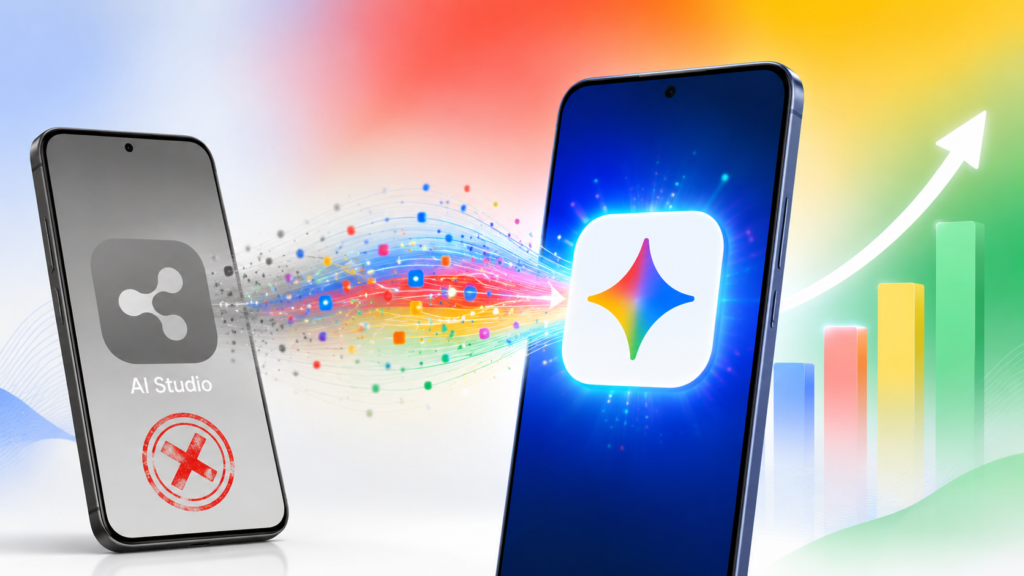
Few AI launches in 2026 have been quite as dramatic as this one. Google promised its next flagship model within a month, missed that deadline, missed the next one, and then missed a third — all while a room full of developers watched the promises pile up in real time. Now, after roughly three months of silence, delay reports, and mounting competitive pressure, Gemini 3.5 Pro appears to finally be reaching the finish line.
Here’s the complete story of what went wrong, why it took so long, and what’s actually different about the model arriving now compared to the one Google originally teased.

How the Delay Saga Began
The story starts on a stage in front of an eager crowd. On stage at Google I/O on May 19, 2026, Sundar Pichai told a room full of developers that Gemini 3.5 Pro, the flagship model many of them had shown up specifically to see, would arrive within a month. His exact words were “Give us until next month to get it to you” — a promise that reportedly drew an audible groan from the audience, since “next month” meant June.
June came and went with no launch. Google had only shipped Gemini 3.5 Flash at that I/O event, describing 3.5 Pro as “already being used internally” with plans to “roll it out next month.” That specific framing — internal use, imminent rollout — repeated itself for weeks without turning into an actual public release.
Why the Model Kept Slipping
The reasoning behind the delays eventually came out through reporting, not through Google itself. According to Bloomberg, Google was taking extra time to improve the model’s capabilities, particularly in coding, after early testing came back disappointing. In late June, Google reportedly updated the training data specifically to try improving coding skills, but the results still fell short of internal expectations.
The problems ran deeper than a simple tuning issue. Reports indicated Google DeepMind had scrapped its original base model entirely after engineers discovered structural failures in recursive tool-calling and SVG generation — essentially meaning the model broke down on certain multi-step coding and design tasks in ways that couldn’t be patched with minor adjustments. That finding pushed the team into a full rebuild rather than an incremental fix, which explains why the delays kept stacking up instead of resolving with a quick patch.
The Missed Deadlines, One by One
By the time a widely-reported July 17, 2026 target arrived, expectations were high enough that some observers treated it as close to a sure thing. Prediction markets had assigned around a 62% probability to a July 17 launch, with the model’s internal slug reportedly appearing on Google Cloud servers for weeks beforehand as a signal something was close.
That date passed too. Bloomberg reported the release was delayed again after the model fell short of Google’s internal quality goals, specifically around hallucination rates and real-world reliability — making this the third confirmed slip since the original June target.
Rather than let developers sit with nothing new, Google filled the gap with smaller releases. On July 21, 2026, Google released three new Gemini models — Gemini 3.6 Flash, 3.5 Flash-Lite, and 3.5 Flash Cyber — while continuing to say nothing new about 3.5 Pro’s actual release date. Gemini 3.6 Flash was positioned as Google’s workhorse model, promising better coding and multimodal performance while cutting token usage by up to 17% compared to its predecessor. The specialized 3.5 Flash Cyber model, fine-tuned specifically for finding and fixing cybersecurity vulnerabilities, was limited to a pilot program for governments and trusted partners rather than a broad public release.
Why the Timing Made the Delay Sting More
Google wasn’t just fighting its own internal deadlines — it was also losing ground in a market that wasn’t waiting around. The same week Gemini 3.5 Pro was originally rumored to arrive, competitors were shipping aggressively. OpenAI launched GPT-5.6 in Sol, Terra, and Luna variants on July 9, alongside a new ChatGPT Work product built for professional use. Grok 4.5 opened to the public that same day, and DeepSeek’s V4 family was separately targeting a stable release around the same window.
The pressure wasn’t limited to the big labs, either. Moonshot AI’s open-weight Kimi K3 model took the top spot on major coding benchmarks during this period, pulling in so much demand that the company had to pause new subscription signups entirely. Each of these moves chipped away at the “Google will have the best model when it finally ships” narrative that had carried the story through its first couple of delays.
What’s Actually New in Gemini 3.5 Pro
Even with official specs still not fully confirmed by Google at the time of the most recent reporting, a consistent picture has emerged from leaks, enterprise previews, and Google’s own framing of the 3.5 family. The model is expected to ship with a 2-million-token context window, double the 1-million-token window of Gemini 3.5 Flash and reportedly the largest of any production frontier model at the time it was first discussed.
Beyond raw context size, the model is built around a “Deep Think” reasoning layer designed for more careful, multi-step thinking on complex problems, along with stronger agentic capabilities for autonomous multi-file coding and tool-use workflows. Google has framed the entire 3.5 family around the idea of “frontier intelligence with action” — reasoning ability paired directly with the capacity to actually do things, not just answer questions.
Positioning-wise, Gemini 3.5 Pro is expected to go head-to-head with Anthropic’s Claude Fable 5 and OpenAI’s GPT-5.6 Sol, aiming to reclaim ground in reasoning depth and long-context tasks that Google had been steadily losing throughout the delay period.
Read More :- GPT-5.6 Luna Price Cut 80%: What It Means for AI Tool Users in 2026
What This Delay Says About the State of AI Development
There’s a broader lesson buried in this saga that goes beyond just one model’s release date. Google’s willingness to scrap a nearly finished base model rather than ship something with known structural weaknesses suggests frontier AI labs are increasingly running into real engineering ceilings, not just marketing timelines. Announcing a launch date on stage is easy; hitting it once your own internal testing reveals hallucination and reliability problems is a much harder commitment to keep.
It’s also a reminder of how quickly the ground shifts underneath any one company’s plans. A three-month delay that might have gone unnoticed a few years ago now plays out against a backdrop of multiple competing labs shipping major models in the same narrow window — meaning delays carry real competitive cost, not just reputational embarrassment.
Conclusion
Gemini 3.5 Pro’s path to release has been messier and slower than almost anyone at that I/O keynote expected, with three missed deadlines, a scrapped base model, and a string of stopgap releases along the way. But the underlying story isn’t really about Google being unable to build a good model — it’s about a company choosing to rebuild rather than ship something it didn’t trust, even as competitors moved fast around it. Whether that patience pays off in the model’s actual real-world performance is the next chapter still being written.
FAQs
Q1: Why was Gemini 3.5 Pro delayed multiple times?
Reports indicate Google DeepMind found structural issues in the original model, particularly around coding, recursive tool-calling, and SVG generation, along with concerns about hallucination rates. This led to a full rebuild of the base model rather than a quick fix, causing the release to slip from June to July and beyond.
Q2: What’s different about Gemini 3.5 Pro compared to Gemini 3.5 Flash?
Gemini 3.5 Pro is expected to offer a much larger 2-million-token context window, a “Deep Think” reasoning layer for complex multi-step problems, and stronger agentic coding capabilities, positioning it as the more powerful, reasoning-focused model in the family.
Q3: What models did Google release while Gemini 3.5 Pro was delayed?
Google released Gemini 3.5 Flash at I/O in May, followed later by Gemini 3.6 Flash, Gemini 3.5 Flash-Lite, and a specialized Gemini 3.5 Flash Cyber model for cybersecurity tasks, limited to a pilot program for governments and trusted partners.
Q4: Which AI models is Gemini 3.5 Pro expected to compete with?
Gemini 3.5 Pro is expected to compete directly with Anthropic’s Claude Fable 5 and OpenAI’s GPT-5.6 Sol, particularly in reasoning depth, long-context handling, and agentic coding performance.