The US government’s chip enforcement arm just opened a new front in the ongoing effort to limit China’s access to advanced AI hardware — and this time, the target isn’t smuggling. It’s something that isn’t actually illegal, at least not yet.
What’s Actually Being Reviewed
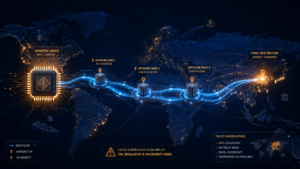
The Bureau of Industry and Security (BIS) — the Commerce Department division responsible for policing chip export controls — is reviewing how Chinese AI companies access Nvidia hardware by renting computing power located in other countries, rather than importing physical chips into China directly. According to reporting, the review is building two separate lists: one covering countries known for black markets that physically smuggle restricted chips into China (which falls squarely within existing enforcement), and a second, more unusual list covering countries where Chinese firms simply access chips remotely through cloud computing arrangements — a practice that isn’t currently illegal under existing rules.
Why This Distinction Matters
US export controls were built around a straightforward idea: control where physical chips get shipped. But that framework wasn’t designed for a world where a Chinese company can simply rent time on a cloud server sitting in Malaysia, Singapore, or Japan — with the actual Nvidia hardware never crossing into China at all. One estimate from the Institute for AI Policy and Strategy suggests these offshore compute-rental arrangements could be boosting China’s effective access to advanced US computing power by at least 60% beyond what chip export controls alone would otherwise allow.
What Triggered This Review
The immediate catalyst was a string of unexpectedly strong Chinese AI model releases. Moonshot AI’s Kimi K3 model scored nearly as high on benchmarks as the latest systems from Anthropic and OpenAI — a result that raised uncomfortable questions in Washington about exactly how Chinese labs are accessing enough advanced computing power to train models at that level, given existing export restrictions.
Part of a Longer-Running Pattern
This isn’t the first attempt to close a chip-access loophole this year. In late May 2026, BIS issued guidance closing a related loophole — Chinese companies had been using overseas subsidiaries, particularly in countries like Malaysia, to purchase advanced chips like Nvidia’s Blackwell processors that are otherwise banned for direct export to China. One industry estimate suggested hundreds of thousands of advanced chips may have reached Chinese buyers through that specific route before the guidance closed it.
A Genuinely Contradictory US Policy Picture
The broader chip policy landscape has been anything but consistent this year. In January 2026, BIS actually loosened restrictions on Nvidia’s H200 and AMD’s MI325X chips, shifting from an automatic denial policy to case-by-case review for exports to China — with a 25% tariff attached, revenue flowing to the US Treasury. Yet by mid-July, a Commerce Department official told Congress that despite roughly $10 billion in approved H200 export licenses, actual chip deliveries to China remained “trivial” in volume. In other words: the door was legally opened, but very few chips are actually walking through it — while the offshore rental channel, which was never technically closed, appears to be doing much of the real work.
What Happens to Data Centers Caught in the Middle
This creates a genuinely difficult position for cloud and data-center operators in countries like Malaysia, Singapore, and Japan — companies that built legitimate businesses renting out Nvidia computing capacity now face fresh compliance uncertainty as US regulators scrutinize arrangements that weren’t previously flagged as problematic.
What This Means Going Forward
This review doesn’t automatically mean new restrictions are coming — it’s explicitly a fact-finding review at this stage, not an announced policy change. But given the pattern of previous BIS actions this year, it’s a strong signal that offshore compute-rental arrangements are now squarely on regulators’ radar, and businesses relying on this model to serve Chinese AI customers should expect closer scrutiny, and possibly new rules, in the months ahead.
Read More :- Big Tech Stocks Are Roaring Back After AI Spending Fears Hit Hard
Frequently Asked Questions
Is renting Nvidia chip computing power from another country currently illegal for Chinese companies?
No — this is explicitly a legal gray area under current rules, which is exactly why the review is notable; existing export controls were designed around physical chip shipments, not remote cloud access.
What triggered this specific review?
A string of surprisingly strong Chinese AI model releases, particularly Moonshot AI’s Kimi K3, raised questions about how Chinese labs are accessing enough advanced computing power despite existing chip export restrictions.
Does this affect companies outside China directly?
Yes — cloud and data-center operators in countries like Malaysia, Singapore, and Japan that rent computing power to Chinese AI firms face new compliance uncertainty as this review proceeds.