The U.S. Army is taking a major step toward agentic artificial intelligence by training AI systems to perform real cybersecurity work alongside human personnel.
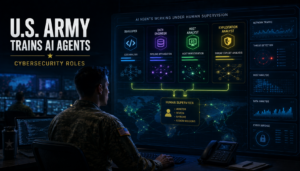
Through Army Cyber Command (ARCYBER) and its Task Force Lexington, the Army is developing AI agents for specialized cyber roles rather than treating them simply as chatbots or productivity assistants.
Army Cyber Command says these agents are being trained for roles including developers, data engineers, host analysts and exploitation analysts. The agents are trained to standards similar to human personnel, evaluated through Job Qualification Readiness processes and then placed on missions with human oversight.
The initiative reflects a broader shift in military cybersecurity: AI is moving from an experimental support technology toward systems capable of performing parts of operational cyber work at machine speed.
AI Agents Are Getting Actual Cyber Work Roles
One of the most significant aspects of the Army’s approach is the idea of giving AI agents defined work roles.
Instead of asking an AI system a one-off question, the Army can train an agent to perform a specific category of work.
According to Army Cyber Command leadership, agents are being developed for roles such as:
- Developers
- Data engineers
- Host analysts
- Exploitation analysts
- Other specialized cyber roles
The agents are then trained and evaluated before being assigned to missions.
Humans Still Watch the AI
The Army is not simply handing cyber operations over to autonomous software.
According to Lt. Gen. Christopher Eubank, commander of Army Cyber Command, agents are put on missions with a human watching their work.
That human-supervised approach is designed to combine the speed of AI with human judgment and accountability.
The distinction is important because cybersecurity operations can have consequences beyond a single computer or network.
AI Agents Are Being Trained Like Cyber Personnel
The Army says its AI agents are trained to the same standard that humans receive for their respective work roles.
They also undergo Job Qualification Readiness (JQR) processes before being considered ready for missions.
This represents a significant change from the way many organizations currently deploy generative AI.
Rather than simply providing access to a general-purpose chatbot, the Army is treating specialized AI agents more like members of a cyber workforce.
What Happens When an AI Agent Makes a Mistake?
AI systems can make mistakes.
The Army’s approach includes retraining agents when they make errors.
According to Eubank, when an agent makes a mistake, it is taught the correct approach and sent back through training.
That creates an iterative cycle:
Train → Test → Mission → Identify Errors → Retrain → Improve
The goal is to make the agents more reliable over time.
AI Agents Are Already Hunting for Cyber Threats
The Army says its AI agents are performing important cybersecurity tasks, including hunting across networks for cyber threats and intrusions.
Network threat hunting can involve searching large volumes of technical information for suspicious patterns that could indicate malicious activity.
This is a natural area for AI because machines can process large amounts of telemetry much faster than human analysts.
AI Is Also Being Used for Risk Management
Army Cyber Command is using AI tools for cybersecurity-related risk-management activities.
These include work associated with the Risk Management Framework and Enterprise Mission Assurance Support Service.
Such tasks can involve large amounts of documentation, analysis and compliance information.
AI agents can potentially reduce the amount of repetitive work human cybersecurity professionals need to perform.
The Army Has an Agentic Red Team
Army Cyber Command also has an agentic red team.
Red teams are used to simulate adversarial activity and identify weaknesses.
An AI-based red team could potentially help the Army test defenses at much greater speed and scale.
This creates an interesting dynamic:
AI defending networks
and
AI testing those defenses
at the same time.
Task Force Lexington Leads the Effort
The Army’s various AI efforts within Army Cyber Command are organized under Task Force Lexington.
The task force acts as a central organization for ARCYBER’s AI initiatives.
Its work covers multiple applications of AI within cyber operations rather than focusing on one single system.
Why Machine Speed Matters
Cybersecurity is increasingly a race between attackers and defenders.
Human analysts can only process a limited amount of information at a time.
AI systems can potentially analyze enormous quantities of network data much faster.
That speed could become especially important when adversaries use automation and AI themselves.
The Threat Is Also Becoming More Automated
The Army is not developing these capabilities in isolation.
Cybersecurity researchers and government analysts increasingly warn that AI agents can also be used by attackers.
Agentic systems can potentially automate activities such as analyzing targets, processing stolen information and assisting with cyber operations.
This creates a strategic incentive for defenders to develop comparable machine-speed capabilities.
AI Could Change Cyber Threat Hunting
Traditional threat hunting often requires analysts to:
- Collect network data
- Develop a hypothesis
- Write queries
- Search logs
- Investigate suspicious activity
- Correlate findings
- Build a timeline
- Decide whether an incident is real
AI agents can potentially automate several of these steps.
That could allow human analysts to focus on higher-level investigation and decision-making.
Army Researchers Are Testing Multi-Agent Cyber Defense
Army researchers have also explored coordinated teams of autonomous AI agents for defensive cyber operations.
A recent Army publication describes a controlled laboratory experiment in which a multi-agent system conducted a threat hunt against enterprise network data and reconstructed an attack timeline in under two minutes.
The experiment involved agents that could generate queries, write and execute code, and iteratively refine their analysis.
Multi-Agent Systems Could Act Like Cyber Teams
A single AI agent may be useful for a specific task.
A group of specialized agents could potentially work together.
For example:
Agent 1: Collect network data
Agent 2: Search for anomalies
Agent 3: Investigate suspicious activity
Agent 4: Correlate evidence
Agent 5: Generate a report
A human analyst could then review the combined result.
This resembles the structure of a human cybersecurity team.
The Army Is Exploring Agentic Cyber Defense
The Army Cyber Institute lists Agentic Cyber Infrastructure Defense (ACID) among its research projects.
The project explores auditable agentic defense workflows and the integration of autonomous and semi-autonomous agents into sensitive cyber environments.
This shows that the Army’s interest in agentic AI extends beyond a single experimental program.
Auditing Is a Major Requirement
Military AI systems need to be trustworthy and auditable.
An organization must be able to understand:
- What the agent did
- Why it acted
- What information it used
- What tools it accessed
- What decisions it made
- What happened afterward
This becomes increasingly important as agents gain more autonomy.
Human-in-the-Loop Remains Critical
Army cyber researchers have emphasized a human-in-the-loop framework for AI-enabled cybersecurity.
Routine and lower-risk activities can potentially be automated, while actions with operational or strategic consequences should remain subject to explicit human authorization.
That creates a division of labor.
AI Handles
- Alert prioritization
- Data processing
- Threat correlation
- Log analysis
- Threat-intelligence summaries
- Initial reporting
- Script generation
Humans Handle
- Operational judgment
- Risk assessment
- Mission prioritization
- Rules-of-engagement decisions
- Major network actions
- Final authorization
Why Humans Cannot Simply Be Removed
Cybersecurity decisions can have unpredictable consequences.
An AI agent might correctly identify a suspicious system but incorrectly determine how aggressively it should respond.
For example, isolating a network segment could stop an attack but potentially disrupt an important military mission.
That is why humans remain responsible for consequential decisions.
AI Is Being Used as a Cyber “Wingman”
Army researchers have described AI as a cyber defender’s wingman.
The concept is straightforward:
AI handles large-scale computational work.
Human operators provide judgment.
The combination can potentially outperform either approach alone.
AI Could Reduce Analyst Workloads
Cybersecurity teams face enormous volumes of alerts.
Human analysts can spend significant amounts of time sorting through information that ultimately turns out to be harmless.
AI agents can potentially prioritize the most important events.
That allows human experts to spend more time investigating genuine threats.
AI Can Work Around the Clock
Unlike human personnel, AI systems do not need sleep or shift changes.
They can continuously process network telemetry.
That could provide the Army with persistent cyber-defense capabilities.
AI Agents Could Increase Cyber Coverage
The Army has a finite number of highly trained cyber professionals.
AI agents could potentially expand the number of tasks the existing workforce can monitor.
Instead of replacing cyber personnel, the goal can be to give each analyst a larger machine-assisted team.
The Army Is Building an AI-Enabled Cyber Workforce
The idea of an AI workforce is broader than simply using AI tools.
Agents are increasingly being treated as specialized digital workers.
A future cyber team could include:
Human Cyber Commander
↓
Human Cyber Analysts
↓
AI Threat-Hunting Agents
AI Data Agents
AI Development Agents
AI Analysis Agents
Each could have a defined role and set of permissions.
Permissions Become Extremely Important
Giving an AI agent access to military networks creates serious security considerations.
The Army must determine:
- What systems the agent can access
- What data it can read
- What tools it can use
- What actions it can execute
- When human approval is required
- How activity is logged
An agent with excessive permissions could create a much larger security risk if compromised.
AI Agents Can Also Become Targets
The same technology that helps defenders can potentially become an attack surface.
An adversary could attempt to:
- Manipulate agent inputs
- Poison data
- Compromise connected tools
- Steal credentials
- Exploit agent permissions
- Cause an agent to take an incorrect action
That means agent security becomes part of cybersecurity itself.
The Army Is Researching AI Governance
The Army Cyber Institute has a dedicated research area focused on AI governance.
It examines challenges associated with deploying AI in mixed-trust and mission-critical environments.
This is important because military environments contain different levels of data sensitivity and operational authority.
Mixed-Trust Environments Are Difficult
An AI agent may encounter information from different sources with different levels of trust.
The system needs to distinguish between:
Trusted instructions
and
Potentially malicious or untrusted information.
This becomes particularly challenging when an AI agent can read external data and then take actions.
The Army Is Also Working on Zero Trust
AI is being incorporated into the Army’s broader cybersecurity modernization efforts.
Army innovators have developed AI tools designed to accelerate the transition toward a Zero Trust cybersecurity framework.
Zero Trust is based on the principle that users and systems should not automatically be trusted simply because they are inside a network.
AI Could Accelerate Zero Trust
AI can potentially help automate:
- Risk assessment
- Identity analysis
- Configuration checks
- Security monitoring
- Compliance documentation
- Anomaly detection
This could help organizations manage the enormous complexity associated with Zero Trust environments.
AI Is Becoming Part of Army Modernization
The Army’s AI strategy extends beyond cybersecurity.
In March 2026, the Army announced Project ARIA, or Army Rapid Implementation of Artificial Intelligence.
The initiative focuses on rapidly developing and deploying practical AI capabilities for Army operations.
Cybersecurity is one important part of this larger AI transformation.
The Army Is Building Secure AI Infrastructure
The Army says its enterprise LLM workspace operates in a secure Impact Level 5 environment.
The goal is to provide trusted AI capabilities while maintaining the security requirements associated with military operations.
AI Is Also Being Used Outside Cybersecurity
The Army has begun deploying AI agents for administrative functions as well.
Army Human Resources Command recently selected Salesforce’s Agentforce technology to provide AI-powered support to Soldiers, veterans and military families.
Those agents can answer routine questions, summarize case histories and surface information, while sensitive decisions can still be routed to human specialists.
This demonstrates that the Army’s interest in AI agents extends across multiple mission areas.
Cybersecurity Is a Particularly Important Test
Cybersecurity may be one of the most challenging environments for AI agents.
The systems must operate quickly while dealing with adversarial inputs.
That makes cyber defense an important proving ground for military AI.
The AI Must Understand Its Role
Giving an AI agent a defined work role can help establish boundaries.
A host analyst agent should perform host-analysis tasks.
A data-engineering agent should focus on data workflows.
A developer agent should work within its authorized development environment.
Clear role definitions can make AI systems easier to evaluate and govern.
Qualification Could Become a Standard for Military AI
The Army’s use of JQR-style qualification for agents suggests a possible future model for AI deployment.
Instead of asking only:
“Is this AI model capable?”
military organizations may increasingly ask:
“Is this specific agent qualified for this specific mission?”
That is a much more operational approach.
AI Agents May Need Continuous Evaluation
AI systems can change as models, tools and environments change.
A capability that performs well today may behave differently after an update.
Continuous evaluation could therefore become necessary.
Retraining Is Part of the Feedback Loop
The Army’s reported approach of retraining agents after mistakes creates a feedback loop.
The agent performs a task.
Its output is evaluated.
Errors are identified.
The system is corrected.
The agent is retrained.
It can then be tested again.
Machine Speed Could Become a Strategic Advantage
Military cyber operations increasingly happen at digital speed.
An attacker can scan systems and launch automated activities far faster than a human team can manually respond.
AI defenders could potentially narrow that speed gap.
But Speed Alone Is Not Enough
Faster decisions are not automatically better decisions.
An AI system could respond quickly and still make the wrong choice.
That is why Army researchers emphasize human judgment and mission assurance alongside automation.
Trust Is Another Challenge
Humans need to know when they can trust an AI system.
If an AI agent constantly produces incorrect alerts, analysts may stop using it.
If the system is overly trusted, analysts may fail to catch its mistakes.
Finding the right balance is critical.
Army Researchers Are Studying AI Trust
Army Research Laboratory researchers are specifically studying trust, workload, cohesion and team adaptation in human-AI teams.
Their work examines how advanced AI systems affect the way humans and intelligent agents work together.
The Future May Be Human-AI Cyber Teams
The likely outcome is not a cyber force made entirely of humans or entirely of AI.
Instead, military cybersecurity could increasingly involve hybrid teams.
Humans would provide:
Judgment + Authority + Accountability
AI agents would provide:
Speed + Scale + Continuous Analysis
What Could AI Cyber Agents Do Next?
Future agents could potentially become capable of:
- Continuous threat hunting
- Automated incident triage
- Malware analysis
- Vulnerability analysis
- Security-control validation
- Threat intelligence correlation
- Automated report generation
- Defensive code generation
The level of autonomy will depend on testing, security and authorization.
Could AI Agents Automatically Respond to Attacks?
Potentially, but this is one of the most sensitive areas.
Army cyber research emphasizes keeping consequential actions under human authorization.
Automated response may be appropriate for carefully defined low-risk activities, but major operational actions require much stronger controls.
The Biggest Challenge Is Accountability
When an AI agent makes a mistake, organizations need to know who is responsible.
A human-supervised model makes the accountability structure clearer.
The human remains responsible for significant decisions.
This Is Not a Replacement for Soldiers
The Army’s current approach is better described as augmentation than replacement.
AI agents are being developed to extend the capabilities of human cyber personnel.
Humans remain responsible for decisions with significant consequences.
The Workforce Could Become More Productive
Instead of replacing analysts, AI could allow each analyst to supervise multiple specialized AI systems.
That could effectively increase the capacity of the existing cyber workforce.
AI Agents Could Become Standard Cyber Tools
If the Army’s experiments prove successful, specialized AI agents could eventually become a normal part of military cybersecurity operations.
They could be treated similarly to other operational tools, but with additional requirements for AI-specific evaluation and governance.
The Broader Defense Industry Is Moving in the Same Direction
The Army is not alone in exploring agentic AI.
Defense organizations are increasingly investigating AI for:
- Cyber defense
- Intelligence analysis
- Logistics
- Command and control
- Software development
- Decision support
The broader trend is toward integrating AI into operational workflows rather than keeping it isolated as an experimental technology.
The Cyber Arms Race Is Becoming an AI Arms Race
As attackers adopt AI for automation, defenders will need comparable capabilities.
This could create a new competition:
Human cyber teams vs. AI-assisted attackers
and increasingly:
AI-assisted defenders vs. AI-assisted attackers
The side that can safely combine speed, intelligence and human judgment could gain an advantage.
Final Verdict
The U.S. Army is moving AI agents into increasingly realistic cybersecurity roles.
Through Army Cyber Command and Task Force Lexington, AI agents are being trained as specialized cyber workers, including developers, data engineers, host analysts and exploitation analysts. They are trained to defined standards, evaluated through qualification processes and assigned to missions under human supervision.
The Army is already exploring AI for network threat hunting, cybersecurity risk management and agentic red-team activities.
At the same time, Army researchers are developing systems such as Agentic Cyber Infrastructure Defense and studying how multi-agent teams can perform defensive cyber operations.
The most important part of the strategy is that the Army is not treating AI autonomy as a replacement for human judgment.
Instead, the emerging model is:
AI provides speed and scale.
Humans provide judgment and authority.
That balance could become increasingly important as cyber threats themselves become faster and more automated.
If the Army can reliably train, qualify, monitor and govern these AI agents, they could become a major force multiplier for cybersecurity.
The future cyber team may therefore look very different from today’s.
It may not be humans versus machines.
It may be humans working with teams of specialized AI agents at machine speed.
Read More:- NVIDIA Eyes $30 Billion Perplexity Investment as AI Agent Revenue Surges
FAQ
Is the U.S. Army using AI agents for cybersecurity?
Yes. Army Cyber Command is developing and using AI agents for cybersecurity-related work, including network threat hunting and cyber protection activities.
What is Task Force Lexington?
Task Force Lexington is an Army Cyber Command initiative established in April 2026 to develop and integrate AI capabilities across cyber operations.
What cybersecurity roles are AI agents being trained for?
The Army says it has created AI agents for roles including developers, data engineers, host analysts and exploitation analysts.
Are these AI agents replacing human cyber personnel?
No. The current approach is designed to have AI agents work alongside humans rather than replace them.
Do humans supervise the AI agents?
Yes. Agents are assigned missions with humans watching their work and reviewing their results.
Can Army AI agents make decisions on their own?
The Army’s cyber chief said that humans currently remain responsible for risk and that agents have not been allowed to assume risk independently.
Do the AI agents receive training?
Yes. Army Cyber Command says agents are trained for specific cyber work roles and trained to the same standard used for human personnel in those roles.
Do AI agents have to qualify before missions?
Yes. The Army says the agents receive Job Qualification Readiness (JQR) approval before being used for mission work.
What happens when an AI agent makes a mistake?
According to Army Cyber Command, the agent is taught the correct approach and goes back through training.
Can AI agents hunt for cyber threats?
Yes. Army Cyber Command says its agentic systems are being used to hunt for threats and intrusions across the Department of Defense information network.
How many agentic elements does the Army currently have?
Army Cyber Command has reported 17 agentic mission elements and cyber protection mission elements operating across the Department of Defense information network.
What is an AI agent?
An AI agent is a software system that can use an AI model together with tools and external systems to perform tasks toward a defined goal.
How is an AI agent different from ChatGPT?
A normal chatbot primarily responds to prompts. An AI agent can use tools, interact with external systems and perform multi-step tasks with less continuous human input.
Why is the Army interested in AI agents?
AI agents can process information and perform technical tasks at machine speed, potentially allowing cyber teams to detect and investigate threats faster.
Why is machine speed important in cybersecurity?
Cyberattacks can develop extremely quickly. AI systems can process large amounts of network data faster than human analysts can manually review it.
What is threat hunting?
Threat hunting is the proactive search for suspicious activity, indicators of compromise and potential intrusions inside a network.
Can AI automate threat hunting?
AI can automate parts of threat hunting, including data analysis, query generation, correlation and investigation workflows.
Is the Army using multiple AI agents together?
Yes. Army researchers have explored multi-agent cyber-defense systems in which specialized agents plan, investigate and coordinate threat-hunting tasks.
What can multi-agent cyber systems do?
A multi-agent system can divide a complex investigation into smaller tasks, allow specialized agents to work in parallel and combine their findings into a larger analysis.
Has the Army tested multi-agent cyber defense?
Yes. Army researchers have published work describing a multi-agent threat-hunting architecture that uses planning, leadership and analyst agents to investigate network data.
What is an AI red team?
An AI red team uses AI systems to simulate adversarial behavior or test defensive systems for weaknesses.
Does Army Cyber Command have an AI red team?
Yes. Task Force Lexington includes AI red-team capabilities as part of Army Cyber Command’s broader AI efforts.
Can Army AI agents attack other systems?
The Army has discussed offensive and defensive cyber work, but the reported current approach emphasizes human responsibility for operational risk. The available reporting does not establish that autonomous agents are independently authorized to conduct unrestricted cyberattacks.
What safeguards does the Army use?
Army Cyber Command says it evaluates guardrails for its agents and asks whether a particular risk should be handled by a human or can safely be handled by an agent.
Can an AI agent assume operational risk?
Not currently, according to Lt. Gen. Christopher Eubank. Humans remain responsible for risk decisions.
Why is human oversight important?
AI agents can make mistakes, misunderstand information or behave unexpectedly. Human oversight provides an additional layer of judgment and accountability.
What happens if an AI agent produces the wrong result?
The Army’s reported training process allows the agent to be corrected and retrained before it continues operating.
Could AI agents eventually operate with more autonomy?
Potentially, but any increase in autonomy would depend on testing, reliability, security controls and Army authorization.
Is the Army building its own AI agents?
Army Cyber Command’s Task Force Lexington is developing agents and the supporting harnesses and training processes internally, according to its commander.
Does the Army rely only on commercial AI models?
Reporting on the program indicates the Army has emphasized developing capabilities internally rather than relying exclusively on commercial frontier models.
What is an AI harness?
An AI harness is the surrounding software infrastructure that connects an AI model to tools, data, permissions, workflows and other agents.
Why does an AI agent need a harness?
The harness determines what the agent can access, what tools it can use and how it interacts with other systems.
What is agentic cybersecurity?
Agentic cybersecurity uses AI systems that can perform multi-step security tasks, rather than simply generating text or recommendations.
Can AI agents analyze network logs?
Yes. Army research has demonstrated multi-agent systems that analyze network log data using queries and other technical tools.
Can AI agents write code?
Yes. Army research into agentic cyber operations has included agents capable of generating and executing code for investigative tasks.
Can AI agents analyze packets?
Army research has explored agents using packet-analysis utilities as part of defensive cyber investigations.
Why does the Army need AI for cybersecurity?
The amount and speed of cyber data can exceed what human teams can efficiently process manually. AI can potentially increase the scale and speed of analysis.
Will AI reduce the need for cybersecurity experts?
The current Army approach suggests augmentation rather than simple replacement. Human personnel remain responsible for risk and mission decisions.
Could AI create new cybersecurity risks?
Yes. AI agents introduce additional risks involving permissions, data access, model behavior, tool use and potential compromise.
Why are AI agents themselves a security concern?
An agent with access to sensitive systems could potentially become an attack path if its credentials, tools or decision process were compromised.
What is the Army researching about agentic AI?
The Army Cyber Institute is researching AI for cyber operations, agentic AI and AI-enabled decision support, including auditable agentic workflows for sensitive environments.
Does the Army research responsible AI?
Yes. Responsible AI governance is included among the Army Cyber Institute’s AI research areas.
Could AI agents work 24/7?
AI systems can operate continuously, which is one reason they can potentially provide persistent monitoring and threat-hunting capabilities.
What is the advantage of AI over human cyber analysts?
AI can process large volumes of data and perform repetitive analytical tasks rapidly, while humans provide context, judgment and accountability.
What is the advantage of humans over AI?
Humans can apply contextual judgment, understand mission consequences and take responsibility for decisions involving significant operational risk.
Is the Army trying to create an AI cyber workforce?
Yes. The concept is moving toward specialized AI agents performing defined cyber work roles alongside human personnel.
Could an AI agent have a specific job description?
Yes. Army Cyber Command says agents are assigned specific work roles such as developer, data engineer, host analyst and exploitation analyst.
Why give AI agents specific work roles?
Defined roles can make an agent easier to train, evaluate, supervise and restrict to appropriate tasks.
What does JQR mean?
JQR stands for Job Qualification Readiness. It is the qualification process Army Cyber Command says its agents undergo before mission use.
Are AI agents trained exactly like humans?
Army Cyber Command says the agents are trained to the same standard humans receive for their respective cyber work roles.
Can AI agents learn from their mistakes?
Army Cyber Command says agents that make mistakes are taught the correct approach and retrained.
Is this the first time the military has used AI?
No. The U.S. military has used AI and machine learning for years. What is new is the increasing use of agentic systems capable of performing multi-step work.
What makes this Army announcement different?
The important change is that AI is being treated as a specialized digital workforce with defined cyber roles, qualification processes and supervised mission assignments.
Could this change military cybersecurity?
Potentially. If AI agents prove reliable, they could allow military cyber teams to monitor and analyze networks at a much larger scale.
Could other militaries adopt similar systems?
Yes. The development of agentic cyber capabilities is likely to become an important area of competition among technologically advanced militaries.
What is the biggest challenge for Army AI agents?
Balancing speed and autonomy with security, reliability, human oversight and operational risk is one of the biggest challenges.
What is the biggest advantage?
The biggest potential advantage is the ability to combine human judgment with AI’s speed and scale.
What is the biggest takeaway?
The U.S. Army is moving beyond experimenting with AI chatbots and is developing specialized AI agents for real cyber work roles, including data engineering, development and cyber analysis. These agents can operate at machine speed, but humans currently remain responsible for operational risk and supervise their mission activity.