NVIDIA and MediaTek are significantly expanding their long-running semiconductor partnership, bringing the two companies closer together across AI data centers, custom AI chips, local AI computing and automobiles.
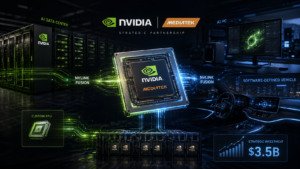
The deal includes a major financial commitment: NVIDIA is investing $3.5 billion in convertible bonds issued by MediaTek.
At the same time, MediaTek is adopting NVIDIA’s NVLink Fusion platform, giving hyperscalers, cloud providers and AI developers a prevalidated route for building custom processors that can connect into NVIDIA’s rack-scale AI infrastructure.
The announcement shows that NVIDIA’s strategy is expanding beyond selling GPUs. The company increasingly wants its technology to remain at the center of AI systems even when customers use custom silicon alongside NVIDIA hardware.
NVIDIA Is Investing $3.5 Billion in MediaTek
The financial part of the announcement is one of its biggest developments.
NVIDIA is investing $3.5 billion through convertible bonds issued by MediaTek. Reuters described the move as another example of NVIDIA deepening its financial and technological relationships throughout the AI ecosystem.
The investment is part of a much larger MediaTek overseas convertible-bond offering worth approximately $3.9 billion.
Alphabet also participated in the offering, although its investment amount was not disclosed in the announcement.
For NVIDIA, the investment gives it a deeper relationship with one of the world’s major fabless chip designers.
For MediaTek, the partnership provides additional access to NVIDIA’s AI ecosystem while allowing it to expand beyond its traditional strength in smartphone and connectivity chips.
MediaTek Will Adopt NVIDIA NVLink Fusion
The technical centerpiece of the announcement is NVLink Fusion.
NVLink is NVIDIA’s high-speed interconnect technology used to connect processors and other components inside large AI systems.
NVLink Fusion extends that ecosystem to custom chips.
Under the new collaboration, MediaTek will help customers develop custom XPUs that can integrate with NVIDIA NVLink-connected, rack-scale AI factories.
An XPU is a broad term for a specialized processor designed for a particular workload.
That could include custom AI accelerators designed by cloud companies, hyperscalers or AI labs.
Instead of requiring every customer to rely entirely on NVIDIA GPUs, the new model allows customers to build specialized processors while still connecting them to NVIDIA’s infrastructure.
That is a significant strategic shift.
Why Custom AI Chips Matter
The biggest cloud companies are increasingly designing their own silicon.
Custom processors can be optimized for particular AI workloads, potentially improving performance, power efficiency or cost.
Companies building large AI infrastructure therefore have an incentive to develop chips that complement or partially replace general-purpose accelerators.
NVIDIA’s challenge is that custom silicon could eventually reduce the amount of NVIDIA hardware some customers need.
NVLink Fusion provides a way around that problem.
If a customer develops a custom accelerator that can connect directly into an NVIDIA-based AI factory, NVIDIA can remain an important part of the infrastructure even when its GPU is not doing every piece of computation.
That allows NVIDIA to compete on the system level, rather than only at the individual chip level.
NVIDIA Wants Its AI Ecosystem to Become the Standard Layer
The partnership is important because it reinforces NVIDIA’s broader strategy.
Rather than requiring every AI system to be built entirely from NVIDIA components, the company is opening parts of its infrastructure to other processors.
MediaTek can design custom silicon.
Customers can create specialized XPUs.
But the resulting hardware can still connect into NVIDIA’s rack-scale architecture.
That creates an ecosystem in which NVIDIA’s interconnect, networking, software and accelerated-computing technologies remain central.
In practical terms:
Custom chip + NVIDIA connectivity + NVIDIA infrastructure + NVIDIA software
could become an increasingly common architecture for large AI deployments.
The Partnership Extends Beyond Data Centers
The announcement is not limited to AI factories.
NVIDIA and MediaTek said they will continue collaborating across three major areas:
- AI infrastructure
- Local AI computing
- Automotive computing
That makes the partnership much broader than a conventional chip supply agreement.
RTX Spark Brings the Partnership to PCs
The companies are also working on multiple generations of NVIDIA RTX Spark and DGX Spark PC chips.
These systems combine NVIDIA’s accelerated computing and graphics technologies with MediaTek’s system-on-chip expertise, connectivity and power efficiency.
The first major result of this collaboration is RTX Spark, a new class of Windows PCs designed around local AI and personal agents.
The idea is to bring more powerful AI processing directly to consumer PCs instead of requiring every AI workload to be sent to the cloud.
That becomes increasingly important as AI agents begin handling more complex tasks.
Local AI Is Becoming a Major Battleground
Running AI locally has several advantages.
A device can potentially respond faster because it does not need to send every request to a remote server.
It can also reduce cloud dependency and keep certain information on the user’s device.
However, local AI requires powerful and efficient processors.
That is where the NVIDIA-MediaTek combination becomes interesting.
NVIDIA contributes GPU acceleration, AI software and graphics technology.
MediaTek contributes expertise in power-efficient SoCs, CPUs, connectivity and system integration.
Together, the companies can build chips designed specifically for AI-powered PCs.
The Partnership Is Also Moving Into Cars
The third major area is automotive computing.
NVIDIA and MediaTek are continuing their work on AI-powered, software-defined vehicles.
MediaTek’s Dimensity Auto platforms integrate NVIDIA technology to provide AI acceleration, RTX graphics and advanced in-car computing capabilities.
The companies are targeting vehicles in which software becomes a much more important part of the driving and passenger experience.
Future cars could use AI for:
- Intelligent voice assistants
- Driver monitoring
- Personalized cabin experiences
- Multimodal AI
- Advanced infotainment
- Gaming and graphics
- Automated vehicle functions
NVIDIA’s technology can provide the accelerated computing layer, while MediaTek brings its experience designing integrated automotive SoCs.
This Partnership Has Been Building for Years
The August 2026 announcement is not the beginning of the NVIDIA-MediaTek relationship.
The companies have already worked together on several major projects.
One example is NVIDIA’s GB10 Grace Blackwell Superchip, which powers DGX Spark.
MediaTek collaborated with NVIDIA on the chip, which combines a Grace CPU with a Blackwell GPU and uses NVLink-C2C to connect the processors.
The companies also expanded their collaboration earlier in 2026 with RTX Spark for Windows PCs.
The new agreement therefore represents an expansion of an existing technology relationship rather than an entirely new partnership.
What NVIDIA Gets From the Deal
NVIDIA’s $3.5 billion investment may look like a straightforward strategic investment, but the technology relationship is arguably more important.
NVIDIA gains a stronger connection to MediaTek’s expertise in:
- Custom silicon
- System-on-chip design
- Connectivity
- Power efficiency
- Advanced packaging
- Automotive computing
That gives NVIDIA another way to extend its architecture into markets where a traditional discrete GPU may not be the ideal solution.
It also creates a potential bridge between NVIDIA’s AI infrastructure and the custom-chip ambitions of major technology companies.
What MediaTek Gets From the Deal
For MediaTek, the partnership offers an opportunity to move further into high-value AI computing.
The company already has a major position in smartphone processors and connectivity.
Its collaboration with NVIDIA allows it to participate more deeply in:
- AI data centers
- Custom AI accelerators
- AI PCs
- Developer systems
- Enterprise workstations
- Automotive AI
The $3.5 billion NVIDIA investment also represents a major vote of confidence in MediaTek’s role in the AI hardware market.
The Bigger Competition Is Against Custom Silicon
The most important competitive dynamic may not be NVIDIA versus MediaTek.
It is NVIDIA versus the growing wave of custom AI silicon.
Google has its TPUs.
Amazon has Trainium and Inferentia.
Microsoft has developed its own Maia accelerators.
Meta has also been investing heavily in custom AI chips.
Other cloud providers and AI companies are increasingly exploring specialized processors.
NVIDIA cannot necessarily prevent customers from developing their own chips.
Instead, NVLink Fusion gives NVIDIA a way to make those custom chips part of its broader ecosystem.
That could be one of the most important strategic purposes behind the partnership.
Could This Reduce NVIDIA’s GPU Dominance?
Potentially, but that is not necessarily the immediate goal.
If customers eventually use more custom accelerators, NVIDIA could sell fewer GPUs for certain workloads.
However, if those custom processors still depend on NVIDIA’s interconnect, networking, software or rack-scale architecture, NVIDIA can retain an important position in the system.
The company’s business could therefore evolve from:
“Buy NVIDIA GPUs”
to:
“Build your AI infrastructure around NVIDIA.”
That is a much broader strategy.
There Are Also Questions Around NVIDIA’s Investment Strategy
NVIDIA’s growing financial involvement across the AI ecosystem has attracted scrutiny.
The company has invested in or financially supported several companies that are also major users of AI infrastructure.
Some investors have questioned whether such arrangements can create circular relationships in which NVIDIA helps finance customers who then purchase NVIDIA hardware.
Reuters and other financial coverage have highlighted this broader debate around NVIDIA’s investments and AI infrastructure financing.
NVIDIA has argued that these investments are strategic and designed to expand its ecosystem rather than simply manufacture demand.
The MediaTek deal should therefore be viewed in the context of NVIDIA’s broader push to shape the AI infrastructure market.
Affitronix Analysis: NVIDIA Is Building an AI Hardware Ecosystem, Not Just Selling GPUs
The most interesting part of this announcement is not the $3.5 billion investment.
It is the architecture NVIDIA is building around its technology.
AI computing is becoming more heterogeneous.
Some workloads are best handled by GPUs.
Others can benefit from specialized accelerators.
Edge devices need low-power SoCs.
Cars need integrated compute, connectivity and graphics.
AI PCs need efficient local inference.
NVIDIA appears increasingly willing to let other companies design parts of that hardware ecosystem—as long as NVIDIA’s technology remains an important connection point.
MediaTek is particularly useful for that strategy because it has expertise across several of these markets.
The partnership could therefore help NVIDIA maintain influence even as the AI industry becomes less dependent on a single type of accelerator.
Read More:- OpenAI Reveals How ChatGPT Ads Could Actually Work
What Happens Next?
The companies say they will continue developing their collaboration across AI infrastructure, local computing and automotive platforms.
For data centers, the next major development to watch is how quickly customers begin using NVLink Fusion to create custom XPUs that connect into NVIDIA’s rack-scale systems.
For PCs, future RTX Spark generations could determine whether NVIDIA and MediaTek can establish a meaningful position in the rapidly growing local-AI market.
And in automotive, the partnership could become increasingly important as software-defined vehicles demand more powerful onboard AI.
The semiconductor industry is moving toward a future where AI workloads are distributed across many types of processors.
NVIDIA’s partnership with MediaTek shows that the company is preparing for that future—not by abandoning its GPU business, but by making its AI architecture broad enough to include custom chips, local computers and intelligent vehicles.
The real story is not NVIDIA and MediaTek building one new chip. It is NVIDIA trying to make its AI ecosystem the infrastructure layer connecting the next generation of custom silicon.
Frequently Asked Questions
What did NVIDIA and MediaTek announce?
NVIDIA and MediaTek announced an expanded partnership covering AI infrastructure, local AI computing and automotive technology. MediaTek will adopt NVIDIA’s NVLink Fusion platform for custom AI processors, while both companies continue developing AI computing platforms for PCs and vehicles.
How much is NVIDIA investing in MediaTek?
NVIDIA is investing $3.5 billion in convertible bonds issued by MediaTek.
What is NVIDIA NVLink Fusion?
NVLink Fusion is NVIDIA’s platform for connecting custom processors, including XPUs, into NVIDIA’s NVLink-connected rack-scale AI infrastructure. It gives customers a way to use custom silicon while remaining connected to NVIDIA’s broader AI architecture.
Will NVIDIA and MediaTek build AI chips for PCs?
Yes. The companies are continuing to collaborate on multiple generations of RTX Spark and DGX Spark PC chips that combine NVIDIA’s accelerated computing and graphics technology with MediaTek’s SoC expertise.
Are NVIDIA and MediaTek working on automotive chips?
Yes. Their automotive collaboration focuses on AI-powered, software-defined vehicles, including MediaTek Dimensity Auto platforms integrated with NVIDIA technologies.
Why is NVIDIA partnering with MediaTek?
The partnership allows NVIDIA to combine its AI acceleration, graphics and software technologies with MediaTek’s expertise in custom silicon, SoCs, connectivity, power efficiency and advanced packaging. It also helps NVIDIA extend its ecosystem into custom AI infrastructure, PCs and vehicles.
Could NVLink Fusion compete with custom AI chips from Google, Amazon and Microsoft?
NVLink Fusion is designed to make custom chips compatible with NVIDIA’s broader AI infrastructure rather than eliminate custom silicon. That could allow NVIDIA to remain an important part of AI systems even when customers use their own specialized processors.