
NASA and IBM have released a new open-source artificial intelligence model designed specifically for studying the Moon, giving scientists a new way to analyze decades of lunar observations and identify important features such as potential ice deposits, craters and volcanic formations.
Called the NASA-IBM Lunar Foundation Model, the system combines more than 30 layers of lunar data collected from nine instruments across four missions. The organizations say it can help researchers analyze the Moon at a scale that would be difficult to achieve by manually studying individual maps and images.
The model is part of IBM and NASA’s broader Prithvi family of open foundation models, extending the collaboration from Earth and space-weather applications into lunar exploration.
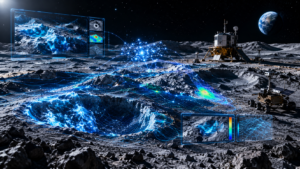
NASA and IBM Build an AI Foundation Model for the Moon
The Moon has been observed for decades by spacecraft carrying instruments that measure different aspects of its surface and subsurface.
The problem is that these datasets are not always easy to analyze together.
Different instruments capture different types of information, at different resolutions and from different viewing conditions. Scientists have traditionally had to combine these observations manually or develop task-specific machine-learning systems.
The NASA-IBM Lunar Foundation Model is designed to create a common representation of these observations.
The model integrates multimodal and multi-resolution information so researchers can adapt it to different lunar-science tasks instead of building a separate AI system for every problem.
The Model Combines Data From Multiple Lunar Missions
The foundation model was trained using more than 30 spatially aligned data layers from nine instruments across four missions.
The dataset includes observations from NASA’s Lunar Reconnaissance Orbiter (LRO) and GRAIL, along with complementary observations from Japan’s SELENE/Kaguya mission.
IBM and NASA describe the accompanying dataset as an open, machine-learning-ready lunar dataset that brings tens of thousands of images and maps into a unified framework.
This matters because AI systems can potentially discover relationships between different measurements that may be difficult to identify when each dataset is examined separately.
AI Could Help Find Hidden Lunar Ice
One of the most important applications is the search for water ice.
Scientists are particularly interested in permanently shadowed regions near the lunar poles. Because sunlight does not reach some of these areas directly, they can remain extremely cold and preserve volatile materials.
The NASA-IBM model can analyze combinations of temperature and topographic information to estimate areas where lunar ice may be present.
IBM and NASA report that the model reduced error in an ice-prospecting task by approximately 22% compared with the SwinV2-B model used as a benchmark.
Finding ice is important because water could eventually become a valuable resource for sustained lunar operations.
Water could potentially provide drinking water for astronauts and, after processing, oxygen and hydrogen for life-support and propellant applications.
Crater Mapping Could Help Identify Safer Landing Areas
The AI model can also help identify and classify lunar craters.
Craters are scientifically important because they provide clues about the Moon’s geological history, but detailed crater mapping can also have practical implications for exploration.
A detailed understanding of terrain can help scientists and mission planners identify areas that are less hazardous for landing and infrastructure.
NASA says crater mapping can help with landing-site selection by revealing terrain hazards such as steep slopes and boulders.
However, the Lunar Foundation Model should not be confused with an autonomous spacecraft landing system.
NASA separately develops technologies such as SPLICE, which combines lidar, navigation, terrain-relative navigation and hazard-detection algorithms to help spacecraft identify and avoid dangerous terrain during descent.
The Moon Is Surprisingly Difficult for AI to Map
Mapping the Moon is not simply a matter of analyzing high-resolution photographs.
The lunar surface experiences extreme lighting conditions.
The Moon has roughly two weeks of daylight followed by roughly two weeks of darkness, while the lack of a substantial atmosphere produces extremely sharp contrasts between illuminated and shadowed terrain.
The problem becomes particularly challenging near the lunar poles.
Low-angle sunlight can create enormous shadows that hide rocks, crater edges and other surface features.
This makes it difficult for conventional image-based systems to interpret the terrain consistently.
IBM researchers say the new foundation model is designed to combine multiple observations so scientists can overcome some of these limitations.
AI Could Also Help Study the Moon’s Volcanic History
Ice is not the only scientific target.
NASA and IBM are also using the model to investigate lunar volcanic features.
The Moon contains unusual formations known as Irregular Mare Patches, which can provide information about the Moon’s volcanic and thermal history.
The model can help researchers locate and analyze these features across large datasets.
According to IBM and NASA, the system performed better than the benchmark model on identifying the extent of certain volcanic features while requiring less fine-tuning.
That could help scientists study regions that would otherwise require extensive manual analysis.
Why Open-Source Matters
Perhaps the most important part of the announcement is that the model is open source.
Instead of restricting the system to NASA and IBM researchers, the organizations are making the model and dataset available to the wider scientific community.
Researchers can potentially adapt the model to their own lunar-science questions, test new applications and improve it for specific missions.
The model is being added to the broader Prithvi family of open foundation models, which already covers areas including geospatial analysis, weather and heliophysics.
This approach could accelerate scientific research because researchers do not necessarily have to start from scratch for every new lunar dataset.
AI Could Become Part of the Artemis Data Pipeline
The timing is closely connected to NASA’s plans for a sustained return to the Moon.
NASA’s Artemis program is focused on returning humans to the lunar surface and developing technologies needed for longer-duration exploration.
Future missions will generate enormous quantities of scientific and operational data.
AI systems that can organize, interpret and prioritize that information could become increasingly valuable.
NASA’s broader Moon Base efforts already include work on technologies for long-term exploration around the lunar South Pole.
A foundation model capable of understanding multiple types of lunar observations could eventually become one component of that larger ecosystem.
From Mapping the Moon to Preparing for Mars
The potential impact extends beyond lunar exploration.
NASA and IBM say resources such as lunar water ice could eventually support technologies needed for future missions farther into space.
Water can potentially be separated into hydrogen and oxygen, making it relevant to both life support and rocket propellant.
That means identifying accessible lunar resources could become strategically important if the Moon is used as a staging point for deeper-space exploration.
The Lunar Foundation Model therefore represents more than an image-analysis project. It is an example of how AI could help convert enormous scientific datasets into practical information for future exploration.
The Bigger AI and Space Technology Story
The NASA-IBM project highlights a broader trend in artificial intelligence: foundation models are moving beyond language and consumer applications into specialized scientific domains.
Instead of asking an AI model to write text or generate images, researchers are increasingly using foundation models to understand Earth observations, weather systems, biological data and now the Moon.
The advantage is scale.
A scientist can inspect only a limited number of images manually. An AI system can process much larger datasets and identify patterns that researchers can then investigate more closely.
That does not eliminate the need for scientists. Instead, it can help researchers decide where to focus their attention.
The Bottom Line
NASA and IBM’s Lunar Foundation Model represents an important step toward AI-assisted lunar science.
By combining decades of observations from multiple missions, the open-source model can help researchers map potential ice deposits, identify craters, study volcanic features and support the search for promising exploration areas.
The most important development may be its open nature.
If researchers around the world build on the same foundation model and dataset, AI could accelerate lunar research far beyond what any single organization could accomplish alone.
As NASA prepares for a sustained human presence on the Moon, systems like this could become an increasingly important part of how humanity understands—and eventually navigates—the lunar surface.
Frequently Asked Questions
What is the NASA-IBM Lunar Foundation Model?
The NASA-IBM Lunar Foundation Model is an open-source AI model designed to analyze lunar observations and help researchers study features such as ice deposits, craters and volcanic formations.
What data was used to train the lunar AI model?
The model was trained using more than 30 spatially aligned data layers from nine instruments across four lunar missions, including NASA’s Lunar Reconnaissance Orbiter and GRAIL missions and Japan’s SELENE/Kaguya mission.
Can the AI find water ice on the Moon?
The model can identify areas with characteristics associated with potential lunar ice deposits, particularly in permanently shadowed regions. It does not directly confirm the presence of ice; scientific observations and follow-up analysis are still required.
How accurate is NASA and IBM’s lunar AI?
NASA and IBM report that the model can outperform widely used methods by up to 23% on certain lunar-feature identification tasks. For an ice-prospecting task, IBM reported an approximately 22% reduction in error compared with a benchmark model.
Can this AI choose where astronauts should land?
The model can support lunar landing-site research by helping identify and characterize terrain features such as craters and potential hazards. It is not itself a spacecraft landing-control system.
Is the NASA-IBM Lunar Foundation Model open source?
Yes. NASA and IBM have released the model and an accompanying machine-learning-ready lunar dataset for the research community.
Why is lunar ice important?
Lunar ice could potentially provide water for astronauts and may eventually be processed into oxygen and hydrogen for life support and rocket propellant.
Is the model part of NASA’s Artemis program?
The model supports the broader scientific and technological goals associated with sustained lunar exploration and can potentially contribute to future Artemis-era research and lunar-surface planning.