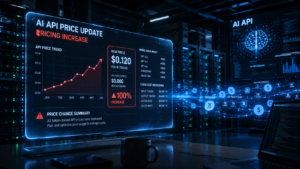
DeepSeek is changing the economics of its AI API.
The company is moving its V4 models to a new peak and off-peak pricing system, with the biggest increases affecting DeepSeek V4 Pro.
For developers who built applications around DeepSeek’s reputation for extremely low API costs, the change is significant.
V4 Pro’s output price will rise from $0.87 to as much as $3.96 per million tokens during peak hours. Its cache-hit input price will also increase substantially.
The new structure is designed around demand. Developers will pay less during off-peak periods and more during designated peak windows.
That means the cost of using DeepSeek will no longer depend only on which model a developer selects.
When the API is used will also matter.
What Is Changing in DeepSeek V4 Pricing?
DeepSeek is introducing separate rates for peak and off-peak usage across its V4 Pro and V4 Flash models.
The change takes effect at 16:00 UTC on August 16, 2026, which corresponds to midnight on August 17 in Beijing.
Under the new system, peak-hour pricing is twice the off-peak rate.
For developers, that creates a new optimization opportunity.
Workloads that do not need immediate responses can potentially be scheduled during cheaper off-peak periods.
Real-time applications, however, may have little choice but to operate during peak hours.
DeepSeek V4 Pro’s New Price
The biggest change is visible in the V4 Pro output price.
Previously, DeepSeek V4 Pro cost $0.87 per million output tokens.
Under the new pricing structure:
- Off-peak output: $1.98 per million tokens
- Peak output: $3.96 per million tokens
That means the peak price is more than four times the previous $0.87 rate.
The increase is significant, especially for applications that generate large amounts of text or use AI agents that repeatedly call the model.
DeepSeek V4 Pro Input Pricing Also Changes
Input tokens are divided into two categories: cache hits and cache misses.
A cache hit occurs when previously processed information can be reused.
A cache miss occurs when the input does not benefit from the existing cache.
Under the new V4 Pro pricing:
| V4 Pro API Usage | Previous Price | New Off-Peak | New Peak |
|---|---|---|---|
| Cache-hit input | $0.003625 / 1M | $0.022 / 1M | $0.044 / 1M |
| Cache-miss input | $0.435 / 1M | $0.66 / 1M | $1.32 / 1M |
| Output | $0.87 / 1M | $1.98 / 1M | $3.96 / 1M |
The most dramatic percentage increase is actually on cache-hit input pricing.
The old $0.003625 rate rises to $0.022 during off-peak hours and $0.044 during peak hours.
That makes cached input considerably more expensive than it was previously.
DeepSeek V4 Flash Is Also Getting More Expensive
The price increase is not limited to V4 Pro.
DeepSeek V4 Flash is also moving to the new peak/off-peak structure.
Its new pricing is:
| V4 Flash API Usage | Previous Price | New Off-Peak | New Peak |
|---|---|---|---|
| Cache-hit input | $0.0028 / 1M | $0.007 / 1M | $0.014 / 1M |
| Cache-miss input | $0.14 / 1M | $0.22 / 1M | $0.44 / 1M |
| Output | $0.28 / 1M | $0.66 / 1M | $1.32 / 1M |
V4 Flash remains cheaper than V4 Pro.
But the changes still represent substantial increases compared with the previous pricing structure.
When Are DeepSeek’s Peak Hours?
DeepSeek’s peak pricing is based on specific UTC time windows.
The designated peak periods are:
01:00–04:00 UTC
and
06:00–10:00 UTC
Outside those windows, the off-peak rates apply.
For users in India, the peak windows correspond approximately to:
- 6:30 AM–9:30 AM IST
- 11:30 AM–3:30 PM IST
That means developers running workloads in India may want to schedule non-urgent jobs outside those periods when possible.
Why Is DeepSeek Introducing Peak Pricing?
The most obvious reason is demand.
AI inference requires significant computing resources.
When a large number of customers use a model simultaneously, the provider has to operate enough infrastructure to handle that demand.
Peak pricing gives DeepSeek a way to reflect those differences in usage patterns.
It also creates an incentive for customers to move flexible workloads to quieter periods.
This is a familiar approach in other infrastructure businesses.
Electricity providers, cloud platforms and data-center services can all use different pricing structures depending on demand.
DeepSeek is applying a similar concept to AI inference.
Why Is the Price Increase So Large?
DeepSeek became famous partly because of its extremely low API prices.
That pricing strategy helped developers experiment with AI without spending large amounts of money.
It also made DeepSeek attractive for high-volume applications.
But the economics change as models become more capable.
The official V4 Pro is significantly more capable than earlier DeepSeek releases in areas such as coding, tool use and agentic tasks.
More capable models can require more compute per request.
At the same time, demand for AI inference continues to grow.
The new pricing structure appears to reflect those pressures.
V4 Pro Is Still Relatively Cheap
The price increase sounds dramatic when compared with DeepSeek’s old rates.
But the bigger question is how V4 Pro compares with competing AI models.
Even after the increase, DeepSeek remains relatively inexpensive by frontier-model standards.
That is important.
A model moving from $0.87 to $3.96 per million output tokens during peak hours is a major percentage increase.
But developers are not evaluating the model only against its old price.
They are also comparing:
Price + capability + reliability + context + tool use + output quality
On that broader comparison, DeepSeek V4 Pro can still remain attractive.
The Biggest Impact May Be on AI Agents
Traditional chatbot applications may not notice the change as dramatically.
AI agents could be different.
An agent can make many model calls while completing a single task.
For example, an AI coding agent might:
- Read a codebase.
- Analyze the problem.
- Create a plan.
- Write code.
- Run tests.
- Inspect errors.
- Modify the code.
- Run tests again.
- Review the final result.
Each step can consume tokens.
A complex task may therefore involve dozens of model calls.
When the price of each call increases, the total cost can rise quickly.
That makes pricing particularly important for developers building autonomous agents.
Coding Applications Could Feel the Difference
DeepSeek V4 Pro has been positioned strongly around coding and agentic workloads.
That makes the pricing change especially relevant for software-development tools.
An AI coding platform might make thousands or millions of API calls across its user base.
Even a small increase in the cost per request can become significant at scale.
Developers may therefore start optimizing their systems more aggressively.
That could mean:
- Using V4 Flash for simpler tasks
- Reserving V4 Pro for complex reasoning
- Scheduling background jobs during off-peak hours
- Improving prompt caching
- Reducing unnecessary context
- Limiting agent loops
- Routing requests between different models
Model Routing Could Become More Important
One of the easiest ways to control AI costs is to stop using the most expensive model for every task.
A developer could use V4 Flash for straightforward requests.
Then the application could route difficult problems to V4 Pro.
For example:
Simple classification → V4 Flash
Basic summarization → V4 Flash
Complex coding → V4 Pro
Difficult reasoning → V4 Pro
This kind of model routing can reduce costs without eliminating access to the stronger model.
The new DeepSeek pricing makes that strategy more attractive.
Caching Becomes More Important
DeepSeek’s pricing change also puts more attention on caching.
AI applications frequently send repeated information to models.
For example, a coding agent may repeatedly include:
- System instructions
- Repository context
- Documentation
- Previous conversation history
- Project configuration
If the API can reuse cached information, developers can potentially avoid repeatedly processing the same data from scratch.
But the new cache-hit pricing is considerably higher than DeepSeek’s previous rates.
That means developers may need to rethink how they structure long-running conversations and agent workflows.
What Does This Mean for High-Volume Users?
High-volume API customers will probably notice the change first.
Consider an application processing hundreds of millions of tokens each month.
At that scale, even a small difference in price can translate into a large change in operating expenses.
Companies may therefore start monitoring:
- Token consumption
- Peak-hour usage
- Cache-hit ratios
- Average output length
- Model selection
- Agent iteration counts
Cost optimization is likely to become a bigger part of AI application development.
Developers Can Schedule Flexible Workloads
The new peak/off-peak structure also creates an opportunity.
Not every AI task needs an immediate response.
Examples include:
- Batch document processing
- Dataset analysis
- Offline summarization
- Report generation
- Code indexing
- Embedding preparation
- Automated testing
- Background research
These workloads can potentially be scheduled during off-peak hours.
Real-time chat applications do not have the same flexibility.
But companies running large background workloads may be able to reduce their costs by moving processing away from peak periods.
What Does This Mean for AI Startups?
For startups, API pricing can directly affect product economics.
A startup may have a business model where customers pay a fixed monthly fee while the company pays AI providers based on usage.
If API prices increase significantly, margins can shrink.
That can force startups to make difficult decisions.
They may need to:
- Increase customer prices
- Reduce model usage
- Switch models
- Add usage limits
- Optimize prompts
- Introduce cheaper model tiers
- Build more efficient agent architectures
DeepSeek’s new pricing therefore matters beyond developers.
It can influence the economics of entire AI products.
DeepSeek V4 Pro Still Has an Important Advantage
Despite the price increase, DeepSeek has not suddenly become one of the most expensive AI API providers.
Its pricing remains competitive.
That is important because DeepSeek’s strategy has always been based partly on offering strong AI capabilities at lower costs.
The company is now moving toward a more nuanced model.
Instead of simply offering one extremely low rate, it is charging more when infrastructure demand is high and less when demand is lower.
That could allow DeepSeek to manage capacity while retaining a cost advantage.
What Happened to DeepSeek’s Low-Cost Reputation?
The price increase will undoubtedly change how developers think about DeepSeek.
For a long time, low cost was one of the company’s defining advantages.
Its earlier V4 Flash pricing was particularly aggressive.
The new rates reduce that advantage.
But the company is not abandoning the low-cost strategy completely.
Instead, it is increasing prices while keeping V4 Pro and V4 Flash below many competing frontier models.
The competitive question is therefore changing from:
“Is DeepSeek cheap?”
to:
“Is DeepSeek cheap enough for the capabilities it provides?”
That is a much more important question for businesses.
The V4 Pro Upgrade Matters Too
The pricing change is happening alongside the general availability release of DeepSeek V4 Pro 0813.
The updated model brings stronger agent capabilities and improvements in areas such as coding and tool use.
That means developers are not simply paying more for exactly the same system.
They are also getting access to a newer and more capable model.
The value proposition therefore needs to be evaluated based on both sides of the equation.
Higher price matters.
But so does higher capability.
How Should Developers Respond?
Developers using DeepSeek V4 should not automatically abandon the platform.
Instead, they should first analyze their workloads.
Start by identifying which applications use the most tokens.
Then separate workloads into categories.
For example:
High-value complex tasks → V4 Pro
Simple high-volume tasks → V4 Flash
Non-urgent jobs → Off-peak processing
Repeated context → Optimize caching
Unnecessary long outputs → Reduce output limits
This approach can help control costs without completely changing the underlying AI stack.
Should Developers Switch to Another AI API?
Not necessarily.
A price increase is only one factor.
Developers should compare the total cost of completing a task rather than looking only at the token price.
A more expensive model may actually be cheaper for a particular workflow if it completes the task with fewer calls or produces better results.
Similarly, a cheaper model may become expensive if it requires multiple retries or extensive agent loops.
The right comparison is:
Cost per successful task, not simply cost per million tokens.
What Happens Next for DeepSeek?
The pricing change could be an important test for DeepSeek.
The company needs to balance three competing objectives:
Keep AI affordable.
Manage growing demand.
Maintain enough revenue to support massive computing requirements.
The new peak/off-peak system gives DeepSeek more flexibility.
It can charge more when demand is high while still offering discounted pricing during quieter periods.
If developers adapt their workloads accordingly, the model could become a sustainable pricing structure.
The Bigger Picture
DeepSeek’s pricing change is part of a larger shift happening across the AI industry.
The early phase of the AI boom was dominated by extremely aggressive pricing.
Companies competed to make powerful models accessible to as many developers as possible.
Now AI providers are dealing with a different reality.
Models are becoming more capable.
AI agents are generating more tokens.
Enterprise workloads are growing.
Inference infrastructure is expensive.
As a result, API pricing is becoming more sophisticated.
Peak pricing, caching, model routing and workload scheduling are likely to become increasingly important.
Bottom Line
DeepSeek is making a major change to its V4 API pricing, with V4 Pro and V4 Flash moving to peak and off-peak rates.
For V4 Pro, the output price rises from $0.87 to $1.98 per million tokens during off-peak hours and $3.96 during peak hours.
V4 Pro cache-hit input also rises substantially, while cache-miss input increases from $0.435 to $0.66 off-peak and $1.32 during peak periods.
V4 Flash is also becoming more expensive, although it remains the cheaper option within the V4 family.
The new system means developers now have another variable to consider: time of day.
For companies running large AI workloads, scheduling background tasks outside peak periods could reduce costs.
For AI-agent developers, the impact could be larger because agents can generate huge numbers of model calls.
Even after the increase, DeepSeek V4 Pro remains competitively priced compared with many frontier AI APIs.
The real question is no longer whether DeepSeek is the cheapest option.
It is whether V4 Pro’s improved capabilities justify the higher cost.
For developers, the answer will depend on the workload — and increasingly, on how intelligently they manage tokens, caching, model routing and peak-hour usage.
Read More :- Anthropic Delays Powerful Model 2 AI Over Rising Cybersecurity Risks
FAQ
How much does DeepSeek V4 Pro cost under the new pricing?
DeepSeek V4 Pro costs $1.98 per million output tokens during off-peak hours and $3.96 per million during peak hours. Cache-miss input costs $0.66 off-peak and $1.32 peak, while cache-hit input costs $0.022 and $0.044 respectively.
When does the new DeepSeek pricing take effect?
The pricing transition begins at 16:00 UTC on August 16, 2026. In Beijing Time, this corresponds to 00:00 on August 17.
What are DeepSeek V4 Pro peak hours?
The peak pricing windows are 01:00–04:00 UTC and 06:00–10:00 UTC. All other times use off-peak pricing.
How much did DeepSeek V4 Pro’s output price increase?
The old output price was $0.87 per million tokens. The new off-peak price is $1.98, while the peak price is $3.96. That means the peak rate is more than four times the previous price.
Is DeepSeek V4 Pro still cheap?
Yes. Although its prices have increased substantially, V4 Pro remains relatively inexpensive compared with many competing frontier AI APIs. Its competitiveness now depends more heavily on the value delivered per successful task.
Is DeepSeek V4 Flash also getting more expensive?
Yes. V4 Flash is also moving to peak and off-peak pricing. Its output price changes from $0.28 per million tokens to $0.66 off-peak and $1.32 during peak periods.
Why did DeepSeek raise its API prices?
DeepSeek has not publicly provided a detailed explanation for every pricing change, but the new structure comes as the company scales its flagship V4 models and faces growing demand for AI inference. The peak/off-peak structure also allows it to differentiate pricing based on usage periods.
What is the biggest price increase?
The largest percentage increase is on V4 Pro cache-hit input, which rises from $0.003625 to $0.022 off-peak and $0.044 peak per million tokens.
Will AI agents become more expensive to run on DeepSeek?
Potentially. AI agents can make many API calls during a single task, so higher token prices can significantly increase the cost of long-running or high-volume agents.
Can developers reduce DeepSeek API costs?
Yes. Developers can use V4 Flash for simpler workloads, reserve V4 Pro for difficult tasks, optimize prompts and caching, reduce unnecessary output and schedule flexible workloads during off-peak periods.