D-Robotics is putting the computing hardware behind the next generation of robots in the spotlight at IFA 2026, showcasing its Sunrise AI chip family and the growing robotics ecosystem built around the platform.
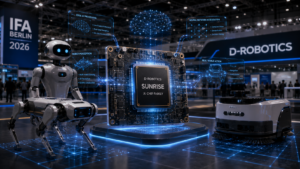
Rather than presenting a single consumer gadget, D-Robotics is using IFA to demonstrate how its chips and developer infrastructure are powering different types of intelligent machines, from family companion robots and quadrupeds to autonomous floor-cleaning systems.
The company says its Sunrise portfolio spans 5 to 560 TOPS of INT8 AI performance, covering applications ranging from home-service robots to humanoids and logistics autonomous mobile robots.
What Is D-Robotics Showcasing at IFA 2026?
D-Robotics’ IFA presence is centered on the idea that increasingly capable robots need dedicated edge AI computing.
The company provides more than just processors. Its ecosystem combines Sunrise intelligent computing chips, RDK robotics developer kits, operating systems and application software.
At IFA, that technology is being demonstrated through several partner products.
The highlighted robots include:
- TCL hey AiMe family companion robot
- Vbot SuperDog household quadruped
- xLean TR1 floor-washing robot
All three demonstrate different ways edge AI can be integrated into consumer and home robotics.
Sunrise AI Chips Power Different Types of Robots
The most interesting part of D-Robotics’ IFA showcase is the diversity of machines using its technology.
A companion robot needs perception, navigation and interaction capabilities.
A quadruped requires real-time sensing and movement control.
A cleaning robot needs to understand its environment and translate user instructions into physical actions.
The Sunrise platform is designed to provide the computing foundation for these different workloads.
D-Robotics says its portfolio covers 5–560 TOPS, allowing manufacturers to choose different levels of AI computing depending on the complexity of their robot.
Sunrise X5 Brings 10 TOPS to Smaller Robots
One of the more accessible members of the family is the Sunrise X5.
D-Robotics’ RDK X5 developer platform uses the Sunrise 5 intelligent computing chip and provides up to 10 TOPS of AI performance.
The platform is designed for robotics and edge-intelligence applications, giving developers a compact computing platform for deploying AI algorithms closer to the robot itself.
That approach can be particularly useful for robots that need fast responses without sending every perception or control task to a remote cloud server.
xLean TR1 Uses Sunrise X5 for AI-Agent Features
One of the clearest IFA demonstrations of the Sunrise X5 is the xLean TR1 floor-washing robot.
The TR1 uses a Sunrise X5 chip with 10 TOPS of computing power to support its EvoMate OS experience.
At IFA, xLean is demonstrating an AI-agent approach in which users can give the robot a natural-language instruction in a single sentence.
The system is designed to interpret the request, determine what needs to be cleaned, select an appropriate cleaning strategy and complete the task before reporting the result.
That is a notable shift from traditional robotic cleaners that depend heavily on predefined modes, maps and manually selected commands.
TCL’s hey AiMe Shows Another Side of the Platform
TCL is also showcasing its hey AiMe family companion-education robot at IFA.
The robot combines guided-play learning with autonomous navigation, expressive movement and more than 20 sensors.
It is designed around interaction with family members rather than simply performing a single household task.
D-Robotics identifies hey AiMe as one of the products demonstrating how its Sunrise computing technology can support a new generation of home companion robots.
Vbot SuperDog Brings Sunrise to Quadruped Robots
Another IFA example is Vbot’s SuperDog, a consumer quadruped robot.
The robot represents a different category of embodied AI from the companion and cleaning machines.
Quadruped robots need to combine perception, navigation and physical movement while responding to changing environments.
D-Robotics says SuperDog has entered mass production and reached thousands of households since May 2026, with European pre-orders opening around its IFA appearance.
Why Edge AI Matters for Robots
The importance of chips such as Sunrise goes beyond raw TOPS numbers.
Robots operate in physical environments.
They need to recognize objects, understand their surroundings and respond to changes quickly.
That can create problems if every decision depends on a remote cloud connection.
Local or edge AI allows more computation to happen directly on the robot.
This can potentially reduce latency, improve responsiveness and allow certain functions to continue operating even when connectivity is limited.
The exact division between local and cloud processing varies by product, however, and D-Robotics’ IFA announcement does not establish that every function of every partner robot operates entirely offline.
D-Robotics Is Building a Full Robotics Stack
The company’s strategy is broader than selling AI chips.
D-Robotics describes its platform as a full-stack robotics infrastructure that includes:
- Sunrise intelligent computing chips
- RDK development kits
- Robotics operating systems
- Application software
- AI acceleration capabilities
- Developer tools and ecosystem support
That approach allows robot manufacturers and developers to build products around a common hardware and software foundation.
The RDK Ecosystem Goes Beyond Home Robots
D-Robotics’ developer portfolio also extends into more powerful robotics platforms.
Its RDK S100 series offers 80/128 TOPS of on-device AI inference and uses a six-core ARM Cortex-A78AE processor.
The company also lists the RDK S600 series, which reaches up to 560 TOPS of on-device AI inference and uses an 18-core ARM Cortex-A78AE processor.
That gives D-Robotics a much broader range than the 10-TOPS Sunrise X5 platform used in products such as the xLean TR1.
More Than 100,000 Developers Are Part of the Ecosystem
D-Robotics says more than 100,000 developers across 20-plus countries are using its platforms.
The company also says developers from more than 500 universities and more than 500 startups and maker teams have created hundreds of robot products using D-Robotics technology.
Its ecosystem includes companies and robotics organizations such as TCL, Midea, Positec, Mammotion, UBTech, Fourier Intelligence, LimX Dynamics, Booster Robotics, Astribot and others.
If accurate, that ecosystem scale could become just as important as the performance of individual chips.
Why IFA 2026 Matters for D-Robotics
IFA is primarily known as a major consumer-electronics event.
That makes it an important venue for demonstrating that AI robotics is moving beyond research laboratories and industrial environments.
The products showcased around D-Robotics’ platform are aimed at everyday scenarios:
- Family interaction
- Home cleaning
- Household companionship
- Personal assistance
- Consumer quadruped robots
The message is clear: embodied AI is increasingly becoming a consumer-electronics story.
D-Robotics Is Betting on Embodied AI
The company’s broader strategy fits into a growing industry trend toward embodied AI.
Unlike traditional software AI, embodied AI connects intelligence to machines that can physically perceive and act in the world.
A robot therefore needs more than a powerful language model.
It needs:
- Cameras and sensors
- Real-time perception
- AI inference
- Navigation
- Motion control
- Hardware acceleration
- Software frameworks
- Power-efficient computing
D-Robotics is positioning Sunrise and RDK as the infrastructure layer connecting many of those pieces.
The Bigger Competition Is Moving to Robot Computing
NVIDIA, Qualcomm, AMD and several specialized chip companies are also competing to provide computing platforms for robotics.
That makes D-Robotics’ strategy particularly interesting.
Instead of competing only for traditional PC or smartphone workloads, these companies are increasingly targeting machines that need AI inference at the edge.
Robotics could become one of the next major markets for specialized AI processors.
What Makes Sunrise Different?
The strongest argument for Sunrise is not simply its headline TOPS number.
It is the combination of AI acceleration, developer hardware and a robotics software ecosystem.
For manufacturers, having access to development kits and existing software can reduce the amount of work required to bring an intelligent robot from prototype to production.
D-Robotics’ RDK X5, for example, is explicitly designed as an all-in-one development platform for robotics and intelligent-computing applications.
The Challenge: Turning Compute Into Useful Robots
High AI performance alone does not guarantee a successful robot.
The real test is whether manufacturers can turn computing power into machines that are:
- Reliable
- Safe
- Affordable
- Energy efficient
- Easy to use
- Useful in everyday environments
IFA’s demonstrations provide an early look at that process.
The xLean TR1, TCL hey AiMe and Vbot SuperDog represent different approaches to turning edge AI computing into physical products.
What Comes Next for Sunrise AI Chips?
D-Robotics’ IFA 2026 showcase suggests that the company is trying to establish Sunrise as a broad robotics computing platform rather than a single-chip product line.
With performance ranging from 5 to 560 TOPS and products spanning home robots, humanoids, quadrupeds and logistics AMRs, the company is targeting multiple levels of the robotics market.
The next challenge will be expanding that ecosystem while proving that developers and manufacturers can turn the hardware into commercially successful robots.
Final Takeaway
D-Robotics is using IFA 2026 to showcase its Sunrise AI computing platform and the growing ecosystem of robots built around it.
The company’s technology currently spans 5 to 560 TOPS, while the Sunrise X5 provides 10 TOPS for platforms such as the RDK X5 and products including the xLean TR1.
The bigger story is not simply another AI chip.
It is the growing push to put AI directly inside physical machines.
From TCL’s companion robot and Vbot’s quadruped to xLean’s AI-agent floor cleaner, D-Robotics is betting that the next generation of consumer robots will need dedicated computing infrastructure to see, reason and act in the real world.
IFA 2026 is showing what that future could look like.
Frequently Asked Questions
What did D-Robotics showcase at IFA 2026?
D-Robotics showcased its Sunrise AI chip platform and robotics computing ecosystem through multiple robots, including TCL’s hey AiMe, Vbot SuperDog and the xLean TR1.
What is the Sunrise AI chip family?
Sunrise is D-Robotics’ family of intelligent computing chips designed for AI inference and robotics applications.
How powerful are D-Robotics Sunrise chips?
D-Robotics says its broader portfolio spans from 5 to 560 TOPS of INT8 AI performance.
How much AI performance does Sunrise X5 provide?
The Sunrise X5 used in the RDK X5 provides up to 10 TOPS of AI performance.
Which robots use D-Robotics chips at IFA 2026?
Highlighted products include TCL hey AiMe, Vbot SuperDog and xLean TR1.
What is xLean TR1?
xLean TR1 is a transformable floor-washing robot that uses D-Robotics’ Sunrise X5 chip and an AI-agent experience called EvoMate OS.
What is embodied AI?
Embodied AI refers to artificial intelligence integrated into physical machines such as robots, allowing them to perceive environments and take actions in the real world.
Does D-Robotics only make AI chips?
No. The company provides chips, robotics developer kits, operating systems and application software as part of a broader robotics infrastructure platform.