A new AI agent called Faraday is attracting attention in the scientific AI community after its creators claimed that it can outperform much larger models from OpenAI and Anthropic at autonomously reproducing scientific research.
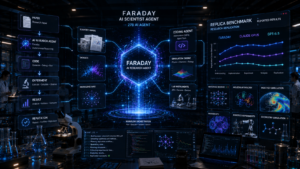
Faraday was developed by Inherent, a London-based AI company founded by former Google DeepMind researchers. The company says the agent outperformed OpenAI’s GPT-5.5 and Anthropic’s Claude Opus 4.8 on held-out scientific research replication tasks.
What makes the result particularly interesting is Faraday’s size.
The agent is built around a relatively small 27-billion-parameter model, rather than the much larger frontier systems it was compared against.
The research suggests that carefully training and designing an AI agent for scientific workflows could matter as much as simply increasing the size of the underlying model.
What Is Faraday?
Faraday is an AI Scientist agent developed by Inherent for scientific research and experimentation.
Rather than functioning like a traditional chatbot, Faraday is designed to perform longer research tasks involving:
- Reading scientific papers
- Understanding research methods
- Writing code
- Running experiments
- Analyzing results
- Debugging problems
- Reproducing published findings
The goal is to make AI capable of independently carrying out significant portions of the scientific research process.
Faraday Is Designed for Research Replication
The initial focus of Faraday is scientific research replication.
Replication is an important part of science because researchers need to determine whether published results can be reproduced using the information and methods described in a paper.
A successful replication can strengthen confidence in a scientific result.
A failed replication can reveal missing assumptions, implementation problems or weaknesses in the original research.
The AI Was Tested on Published Research
Inherent developed a benchmark called Replica to evaluate AI agents on research replication.
The benchmark contains tasks based on published scientific papers and requires an AI system to attempt to reproduce the reported results.
The agent is not simply asked to explain the paper.
It must actually work through the research process.
Faraday Has to Work Through the Research Process
A typical task can require the AI to:
- Understand a scientific paper
- Identify the methodology
- Inspect available information
- Write or modify code
- Run experiments
- Analyze outputs
- Troubleshoot failures
- Determine whether the published result can be reproduced
That makes the benchmark considerably more demanding than a standard question-and-answer test.
Faraday Uses Coding Agents as Tools
One of the most important aspects of Faraday is its use of coding agents as tools.
Instead of expecting the underlying language model to perform every task directly, Faraday can delegate software-engineering work to coding tools.
This allows the system to interact with research environments and execute experiments.
A 27B Model Beat Much Larger Systems
The most attention-grabbing part of the research is the comparison with frontier models.
Inherent says its 27-billion-parameter Faraday agent surpassed Claude Opus 4.8 and GPT-5.5 on held-out replication tasks.
This does not mean the underlying 27B model is universally more intelligent than GPT-5.5 or Claude.
Instead, the result suggests that agent design and specialized post-training can produce major gains on particular scientific workflows.
Why This Result Is Important
AI development has traditionally focused heavily on scaling.
Bigger models generally require more computing resources, larger datasets and more expensive training.
Faraday presents another possibility:
A smaller model + specialized training + tools + agent architecture
could outperform a much larger general-purpose model on a specific real-world task.
Specialized AI Agents Could Become More Powerful
The Faraday research supports a broader trend in AI.
Instead of building one model that tries to do everything, developers can create specialized agents optimized for specific jobs.
Examples include:
- Coding agents
- Scientific research agents
- Cybersecurity agents
- Financial analysis agents
- Legal research agents
- Data-analysis agents
Each system can be optimized around the tools and workflows needed for its particular domain.
Faraday Uses Reinforcement Learning
Inherent says Faraday was post-trained using reinforcement learning for scientific research replication.
The training process was designed to encourage the agent to complete research tasks successfully rather than simply produce plausible-looking answers.
This distinction is important.
A conventional language model might describe how an experiment should be performed.
Faraday is trained to actually work through the experiment.
The Benchmark Uses Held-Out Tasks
The comparison was conducted on held-out replication tasks.
That means the evaluation tasks were separate from the tasks used during training.
This is important because an AI system could otherwise appear stronger simply because it had effectively memorized the evaluation examples.
What Is Replica?
Replica is the research environment developed to evaluate scientific research replication by AI agents.
The benchmark is designed around the idea that replicating a paper requires more than summarizing its contents.
An AI must understand the research methodology and translate it into an executable workflow.
Replication Is a Difficult Scientific Task
Scientific papers frequently leave practical details implicit.
A paper might describe:
- A dataset
- A statistical method
- A machine-learning model
- Experimental settings
- Evaluation criteria
But actually reproducing the result can require additional decisions.
Researchers often have to discover those details themselves.
That makes replication a useful test of scientific reasoning.
Faraday Must Deal With Real-World Problems
Scientific experiments rarely work perfectly on the first attempt.
Code can fail.
Dependencies can be missing.
Datasets can contain unexpected values.
Experimental results can differ from the paper.
An effective research agent therefore needs to diagnose problems and adjust its approach.
This is where long-horizon agent behavior becomes important.
AI Agents Are Moving Beyond Simple Answers
Traditional AI evaluation often asks whether a model can answer a question correctly.
Scientific research requires much more.
A researcher needs to:
Understand → Plan → Implement → Experiment → Analyze → Adapt
Faraday is designed around this longer loop.
GPT-5.5 Already Targets Scientific Research
The comparison is particularly notable because GPT-5.5 itself is designed for scientific and technical research workflows.
OpenAI says GPT-5.5 can explore ideas, gather evidence, test assumptions, interpret results and persist across multi-stage scientific tasks.
Faraday’s reported performance therefore puts it directly into an increasingly competitive category of AI research systems.
Claude Opus Is Also a Strong Research Model
Anthropic’s Claude models have similarly been used for complex reasoning, coding and research workflows.
Faraday’s reported ability to outperform Claude Opus 4.8 on the specific replication benchmark makes the result particularly interesting.
However, the comparison remains task-specific.
Faraday Does Not Prove That Smaller Models Are Always Better
It would be wrong to conclude that a 27B model has now universally surpassed GPT-5.5 or Claude.
The evaluation focuses on a particular scientific-replication task.
A model can perform extremely well on one benchmark while performing worse on unrelated tasks.
For example, frontier models may retain significant advantages in:
- General knowledge
- Multilingual reasoning
- Creative work
- Broad scientific questions
- Computer use
- Other agentic tasks
Benchmark Design Matters
Any claim that one AI model beats another should be interpreted in the context of the benchmark.
Important factors include:
- Task selection
- Tool access
- Time limits
- Compute budget
- Number of attempts
- Agent architecture
- Evaluation criteria
Different configurations can produce very different results.
Faraday’s Success Could Be About the Agent, Not Just the Model
This is arguably the most important lesson from the research.
Faraday is not simply a 27B language model.
It is a complete agent system.
Its performance comes from the combination of:
Model + Training + Tools + Coding Environment + Agent Strategy
That means the architecture surrounding a model can be just as important as the model itself.
AI Scientist Systems Are Becoming More Advanced
Faraday is part of a much larger movement toward AI systems that can conduct scientific work.
Researchers are increasingly experimenting with AI systems capable of:
- Finding research problems
- Reviewing literature
- Generating hypotheses
- Writing code
- Running simulations
- Analyzing experimental data
- Drafting scientific papers
The field is moving rapidly from AI-assisted research toward increasingly autonomous research workflows.
OpenAI Is Also Investing in Scientific AI
OpenAI launched Prism, an AI-powered scientific workspace designed to help researchers write and work with scientific papers.
Prism integrates GPT capabilities into scientific workflows while keeping humans involved in the research process.
This demonstrates how major AI companies are increasingly targeting science as a major application area.
AI Agents Could Accelerate Scientific Discovery
If AI systems become capable of performing large portions of research autonomously, scientists could potentially run more experiments in less time.
An AI agent could work continuously on:
- Literature analysis
- Code development
- Experiment design
- Data processing
- Reproducibility testing
Human researchers could then focus more heavily on higher-level scientific decisions.
But Scientific Autonomy Has Risks
Giving AI agents the ability to conduct experiments creates new challenges.
A system could:
- Misinterpret a paper
- Select an inappropriate methodology
- Produce flawed code
- Misread results
- Overfit to an experiment
- Draw incorrect conclusions
For this reason, human oversight remains important.
Reproducibility Is Especially Important
Scientific AI systems need strong auditability.
Researchers should be able to determine:
- What the AI did
- Which data it used
- Which code it executed
- What experiments it performed
- How it reached its conclusion
Without such records, AI-generated research could become difficult to verify.
Faraday Could Help Find Reproducibility Problems
One potentially valuable use case is large-scale replication.
Human scientists have limited time.
An AI agent could potentially attempt to replicate hundreds or thousands of published experiments.
That could help identify research results that deserve additional human investigation.
The AI Scientist Could Become a New Research Tool
Instead of replacing scientists, systems like Faraday may initially function as research assistants with much greater autonomy.
A researcher could assign a broad objective and allow the AI to handle repetitive technical work.
Humans would then review and validate the results.
Long-Horizon Tasks Are the Real Challenge
The biggest difficulty isn’t necessarily answering a single scientific question.
It’s staying on task for hours while dealing with unexpected problems.
Faraday is specifically designed for this kind of long-horizon work.
That makes the research relevant to the broader development of autonomous AI agents.
Why Coding Matters So Much
Modern scientific research is increasingly computational.
Researchers work with:
- Python
- R
- Jupyter
- Machine-learning frameworks
- Statistical software
- Simulation environments
- Large datasets
An AI agent capable of writing and executing code can therefore perform much more useful research than a chatbot that only generates text.
Faraday’s Tool Use Is a Major Advantage
Tool access allows the AI to interact with an external environment.
Instead of saying:
“You should run this experiment.”
the agent can actually perform the computational steps.
That is the core difference between an AI assistant and an AI research agent.
The Future Could Involve Teams of AI Scientists
Faraday is one example of a broader possibility.
Future research systems could involve multiple specialized agents.
For example:
Literature Agent → Experiment Agent → Coding Agent → Analysis Agent → Verification Agent
Each system could handle a different part of the scientific process.
AI Could Make Research More Iterative
Human researchers often need to wait for experiments to finish before deciding what to do next.
AI agents could potentially automate much of that iteration.
The system could:
- Run an experiment
- Analyze the result
- Identify a problem
- Modify the code
- Run another experiment
- Compare results
This could dramatically increase the number of research iterations possible.
Faraday’s Results Are Still Early
Despite the impressive claims, Faraday should not yet be considered a replacement for human scientists.
The research demonstrates performance on scientific replication tasks, not independent discovery across every scientific discipline.
More testing will be needed.
The Difference Between Replication and Discovery
This distinction is important.
Replication:
Reproduce an existing scientific result.
Discovery:
Find something genuinely new that was not already known.
Faraday’s current evaluation focuses primarily on replication.
Successfully reproducing existing research is an important milestone, but it is not equivalent to independently discovering a new scientific theory or breakthrough.
The Next Step Could Be Open-Ended Research
If agents become reliable at replication, the next challenge is open-ended scientific discovery.
That could involve:
- Identifying unanswered questions
- Generating hypotheses
- Designing experiments
- Testing competing explanations
- Discovering new relationships
- Producing verifiable results
This is considerably harder than reproducing existing research.
Faraday Could Become a Foundation for AI Scientists
Inherent says it views its research as a stepping stone toward AI agents capable of longer-horizon scientific innovation without requiring increasingly complex agent scaffolding.
That ambition places Faraday within the growing race to build AI systems capable of conducting meaningful scientific work.
Inherent’s Background
Inherent was founded by researchers with backgrounds at Google DeepMind.
The company emerged from stealth with significant funding and is focused on building AI systems for scientific and other complex workflows.
The team’s DeepMind background has also attracted attention because Google DeepMind has been one of the world’s leading organizations working on AI for scientific discovery.
Why the 27B Size Matters
A 27-billion-parameter system is relatively small compared with many frontier models.
If specialized training allows such a system to perform strongly on complex scientific tasks, organizations may be able to deploy research agents more economically.
That could make AI-assisted science more accessible.
Smaller Models Could Become More Valuable
The AI industry has increasingly focused on maximizing capability.
Faraday highlights another important objective:
Capability per unit of compute.
If smaller models can perform specialized tasks extremely well, companies may prefer them for production applications.
Cost Could Become a Competitive Advantage
Scientific research can require large amounts of computation.
A smaller model that performs well could potentially reduce inference costs.
That could allow organizations to run more experiments without dramatically increasing their AI budgets.
What Researchers Should Watch Next
The most important developments will be:
- Independent replication of Faraday’s results
- Larger scientific benchmarks
- More diverse research domains
- Open-ended discovery tests
- Long-running autonomous experiments
- Human evaluation
- Cost comparisons with frontier models
These will show whether Faraday’s early results translate into broader scientific capability.
Final Verdict
Faraday is an important new development in the race to build AI scientists.
Developed by Inherent, the 27-billion-parameter agent is designed to autonomously reproduce scientific research using coding tools, experimentation and long-horizon reasoning.
Inherent’s research claims that Faraday outperformed GPT-5.5 and Claude Opus 4.8 on held-out scientific research replication tasks, despite being built around a much smaller model.
The result does not mean Faraday is universally smarter than OpenAI or Anthropic’s frontier models.
Instead, it demonstrates something potentially more important:
A carefully trained AI agent with the right tools can outperform much larger general-purpose models on a specialized, difficult real-world workflow.
If these results continue to hold up under independent testing, Faraday could become an important milestone in the development of autonomous AI research systems.
The bigger question is what comes next.
If AI can reliably reproduce existing research today, the next frontier is whether agents can eventually design experiments, discover new knowledge and produce genuinely novel scientific breakthroughs with minimal human intervention.
Read More:- DeepSeek Ends Weekend Peak Pricing as API Users Get Cheaper Rates Every Weekend
FAQ
What is Faraday AI?
Faraday is an AI Scientist agent developed by Inherent, a London-based AI company founded by former Google DeepMind researchers.
What does Faraday do?
Faraday is designed to reproduce scientific research by reading papers, planning experiments, writing or modifying code, running experiments and analyzing the resulting data.
Did Faraday really beat GPT-5.5 and Claude?
Inherent reports that Faraday achieved higher scores than Claude Opus 4.8 and GPT-5.5 on its Replica benchmark for scientific research replication. This is a task-specific result, not proof that Faraday is better overall.
What is the Replica benchmark?
Replica is a benchmark created by Inherent containing 310 scientific research replication tasks based on 100 machine-learning and AI-for-science papers.
What does each Replica task require?
Each task asks an AI agent to reproduce a result or figure from a published paper without being shown the original result, while working under limited time and computing resources.
How many held-out tasks were used?
The evaluation includes 68 held-out AI-for-science tasks that were not used for Faraday’s training.
What score did Faraday achieve?
On the reported held-out split, Faraday achieved an average replication score of 0.791, compared with 0.748 for Claude Opus 4.8 and 0.729 for GPT-5.5/Codex.
What is Faraday’s model size?
Faraday is built around a 27-billion-parameter model, based on Qwen3.6-27B.
Does Faraday use GPT-5.5?
Yes. An important detail is that Faraday uses GPT-5.5 Codex as a coding tool during its research workflows. Therefore, the headline should not imply that the 27B model independently beats GPT-5.5 at everything.
How does Faraday use GPT-5.5 Codex?
Faraday acts as the higher-level research agent, while GPT-5.5 Codex can be used to perform coding-related work needed during experiments.
Is Faraday larger than GPT-5.5?
No. Faraday’s underlying model has 27 billion parameters, while the exact parameter count of GPT-5.5 is not publicly established in the same way.
Why is Faraday’s result important?
The result suggests that specialized agent training, reinforcement learning and tool use can significantly improve performance on complex scientific workflows without simply scaling the underlying model.
How was Faraday trained?
Inherent says Faraday was post-trained using long-horizon reinforcement learning designed around scientific research replication.
What does long-horizon AI mean?
Long-horizon AI systems can work through multi-step tasks over an extended period instead of producing a single response and stopping.
Can Faraday write code?
Yes. Coding is a central part of its scientific experimentation workflow, although Faraday can delegate coding tasks to coding agents.
Can Faraday run experiments?
Yes. Faraday is designed to interact with coding and research environments to run experiments and analyze their results.
Can Faraday discover new science?
That is Inherent’s longer-term goal, but the current benchmark primarily evaluates replication of existing research, not independent scientific discovery.
Is Faraday available to the public?
Faraday was introduced as a research system by Inherent, but public access to the full agent/model is not equivalent to access to a normal consumer chatbot.
Who created Faraday?
Faraday was created by Inherent, a London AI startup founded by former Google DeepMind researchers.
How much funding has Inherent raised?
Inherent emerged from stealth with a reported $50 million seed round, according to TechCrunch.
What scientific fields were included in Replica?
The benchmark includes machine-learning and AI-for-science research across areas such as natural-language processing, materials science and weather forecasting.
Is Faraday better than GPT-5.5 for all tasks?
No. The reported advantage is limited to the specific scientific replication benchmark. It should not be interpreted as a general ranking across coding, writing, reasoning, research or other AI tasks.
Is Faraday better than Claude Opus 4.8 overall?
No such conclusion can be made from the benchmark. Faraday’s reported advantage applies specifically to the Replica research-replication evaluation.
Are Faraday’s benchmark results independently verified?
The results come from Inherent’s research and benchmark. Independent reproduction and broader external evaluation would provide stronger evidence.
What is the biggest limitation of the current results?
Replica was designed by Inherent, so broader independent testing is important before making universal claims about Faraday’s capabilities.
What is the biggest advantage of Faraday?
Its ability to combine long-horizon reasoning, reinforcement learning and coding tools for scientific experimentation is one of its main advantages.
Could Faraday replace scientists?
Not currently. The system is better viewed as an AI research teammate or experimental assistant. Human scientists remain important for validating results and determining whether findings are scientifically meaningful.
What could Faraday eventually do?
Inherent’s longer-term vision is to develop AI systems capable of contributing to open-ended scientific research and discovering new knowledge.
What is the biggest takeaway?
Faraday shows that specialized AI-agent design can matter as much as raw model size. Its reported performance on scientific replication suggests that a smaller model can achieve strong results when trained specifically for long-running research workflows and equipped with powerful tools.