AI agents are becoming increasingly capable of performing complex tasks, but one major problem remains: how do you train an AI agent to become better at tasks it repeatedly struggles with?
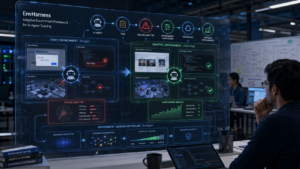
A new research project called EnvHarness proposes a different approach.
The framework, developed by researchers including members of Google’s research organization, introduces a programmable layer that can modify an existing task environment to specifically target an AI agent’s weaknesses.
The research paper, titled “EnvHarness: Awakening Static Worlds for Agent Learning,” was published on August 20, 2026.
Rather than rebuilding an entire environment every time an AI agent improves, EnvHarness is designed to dynamically reshape existing environments and make them more useful for agent training.
What Is EnvHarness?
EnvHarness stands for Environment Harness.
The basic idea is relatively simple.
AI agents learn by interacting with environments. These environments could be websites, software tools, games, coding platforms or other simulated worlds.
But traditional environments are usually static.
If an agent repeatedly fails in a particular situation, the environment itself does not automatically adapt to create more targeted training opportunities.
EnvHarness attempts to change that.
How EnvHarness Works
EnvHarness acts as a programmable layer between the AI agent and the underlying environment.
Instead of modifying the original environment’s core logic, the framework can add components that reshape how the environment behaves.
The original environment’s verifier is preserved.
This means the system can create more challenging or targeted scenarios without completely rebuilding the environment from scratch.
The Problem With Static AI Training Environments
Many AI-agent training environments are designed manually.
Researchers create tasks, define rules and establish a way to determine whether the agent succeeded.
The problem is that AI agents change over time.
An environment that is useful for training an agent today may become too easy tomorrow.
At the same time, a particular agent may develop very specific weaknesses that the original environment was never designed to test.
This creates a mismatch between the agent’s capabilities and its training environment.
EnvHarness Attempts to Close That Gap
EnvHarness is designed to make environments more responsive to the agent being trained.
If the system identifies a weakness, it can modify the environment to create additional situations that expose that weakness.
The result is a more targeted training loop.
Instead of repeatedly presenting the same type of task, the framework can generate variations designed around what the agent needs to improve.
Introducing EnvRigger
The researchers also introduce EnvRigger, an automated system that works alongside EnvHarness.
EnvRigger treats the target AI policy as a black box.
It observes the agent’s execution trajectories and analyzes where the agent is struggling.
It then synthesizes EnvHarness components designed to target those weaknesses.
The newly modified environment is subsequently tested using fresh agent rollouts.
AI Agents Can Learn From Their Own Weaknesses
This creates an interesting feedback loop.
The basic process looks like this:
Agent performs task → system observes failure → weakness is identified → environment is modified → agent trains again → new performance is evaluated.
The environment therefore becomes part of the optimization process.
Instead of only improving the AI model, researchers can also improve the environment in which that model learns.
Why This Matters for AI Agents
Modern AI agents are expected to perform increasingly complex tasks.
They may need to:
- Browse websites
- Use software tools
- Write code
- Manage files
- Navigate interfaces
- Plan multiple steps
- Recover from errors
- Complete long-running workflows
A static benchmark may not adequately test all of these capabilities.
EnvHarness attempts to make training environments more adaptive.
The Research Tested Five Benchmarks
The researchers evaluated EnvHarness across five benchmarks spanning four domains.
According to the paper, EnvHarness outperformed both the original environments and domain-specific environment-generation approaches.
The researchers report improvements of up to 9.0 percentage points on held-out instances.
The framework also achieved 9.8% fewer execution steps in the reported experiments.
The “7%” Claim Needs Context
Some summaries of this research may describe the improvement as approximately 7%.
However, the research paper itself reports up to a 9.0-point improvement, rather than presenting a universal 7% improvement.
That distinction matters.
The results vary depending on the benchmark and task.
EnvHarness should therefore not be interpreted as guaranteeing that every AI agent will become 7% better.
EnvHarness Is Not a New AI Model
One of the most important aspects of the project is that EnvHarness is not another large language model.
It is an environment-level framework.
The system changes how an agent interacts with its training environment rather than simply increasing the number of parameters in the underlying AI model.
This represents a different direction for improving agent performance.
Why Environment Design Matters
AI research often focuses heavily on models.
Researchers ask:
- How large should the model be?
- How much data should it receive?
- How much computing power should be used?
- Which architecture performs best?
But agents also depend heavily on their environments.
If an environment does not expose the right challenges, even a powerful model may fail to learn useful behaviors.
EnvHarness Treats the Environment as Part of Training
The framework effectively turns the environment into another component of the learning system.
This is significant because it allows researchers to target specific weaknesses without manually redesigning the entire benchmark.
The environment becomes more dynamic and responsive.
Traditional Environment Generation Has Limitations
Researchers have previously explored methods for automatically generating new environments.
However, those approaches can require domain-specific pipelines.
They may also depend on expensive or unreliable verification systems.
EnvHarness attempts to reduce that engineering burden by modifying existing environments through standardized components.
Existing Environments Can Be Reused
Instead of throwing away an existing benchmark when an AI agent becomes stronger, researchers can potentially use EnvHarness to extend it.
This could make benchmarks more useful over longer periods.
As agents improve, the environment can evolve alongside them.
The Framework Preserves Original Verification
Another important design feature is that EnvHarness aims to preserve the original environment’s verifier.
That means the system can alter the difficulty or behavior of the environment while maintaining the underlying mechanism used to determine whether an agent completed the task correctly.
This helps maintain consistency in evaluation.
Why Held-Out Performance Matters
The researchers did not only evaluate agents on the scenarios used to create the environment modifications.
They also tested performance on held-out instances.
This is important because an AI agent could theoretically memorize patterns from training.
Performance on new instances provides stronger evidence that the training process actually improved generalization.
The reported results show that EnvHarness can improve performance beyond the exact scenarios used to diagnose weaknesses.
EnvHarness Could Support Reinforcement Learning
The researchers also report that EnvHarness provides a stronger optimization signal for reinforcement learning.
This is important because reinforcement learning requires useful feedback.
If the environment does not provide enough meaningful variation, the learning process can become inefficient.
By creating targeted challenges, EnvHarness can potentially provide more useful feedback to the agent.
Continuous Co-Evolution
One of the most interesting ideas in the research is continuous co-evolution.
The agent improves.
The environment observes the agent’s new weaknesses.
The environment then adapts.
The agent trains again.
This creates a continuous cycle in which both the agent and its training environment evolve together.
A New Way to Think About AI Training
Traditional AI development often follows a relatively linear process:
Build model → train model → evaluate model → improve model.
EnvHarness suggests a more dynamic approach:
Train agent → identify weaknesses → adapt environment → retrain agent → adapt environment again.
This could become increasingly important as AI systems become more capable.
AI Agents Are Outgrowing Simple Benchmarks
Many early AI benchmarks were designed around relatively straightforward tasks.
Modern agents are increasingly expected to complete long, multi-step workflows.
That makes static benchmarks less useful.
An agent might solve a task once but fail when the environment changes slightly.
Adaptive environments could help researchers test whether an agent has actually learned a robust strategy.
Coding Agents Could Benefit
AI coding agents are an obvious potential application.
A coding agent may successfully solve one programming problem but fail when:
- The codebase becomes larger
- Requirements change
- Dependencies break
- Tests behave differently
- The task requires multiple iterations
An adaptive environment could deliberately expose these weaknesses.
Web Agents Could Also Benefit
Web-based AI agents face similar challenges.
Websites change layouts.
Buttons move.
Information appears in different locations.
Authentication requirements change.
A static benchmark may not adequately represent those real-world variations.
An adaptive environment could create more realistic challenges.
Long-Running Agents Need Better Training
Long-running AI agents are particularly difficult to train.
An agent may need to work for minutes or hours while maintaining context and recovering from mistakes.
A single failure can derail the entire workflow.
Frameworks that can systematically target those failure modes could become increasingly valuable.
EnvHarness Could Reduce Manual Engineering
Creating specialized training environments is expensive.
Researchers often need to understand the domain, build the environment, create tasks and design verification systems.
EnvHarness attempts to automate some of this process.
That could allow research teams to spend less time rebuilding environments and more time improving AI agents.
The Framework Is Model-Agnostic in Concept
The core idea does not depend on creating an entirely new AI model.
The environment can be modified around the target policy.
That means the approach could potentially be applied to different types of agents.
The research focuses on the framework rather than tying the concept to a single commercial AI model.
Google Is Investing Heavily in Agent Development
The EnvHarness research arrives as Google continues to expand its broader AI-agent ecosystem.
Google Cloud’s Gemini Enterprise Agent Ready (GEAR) program provides developers with training and tools for building enterprise AI agents.
Google’s Agent Development Kit is also designed to help developers create agents that can reason, plan and take action.
Google Is Also Building Agent Evaluation Tools
Google has been working on systems for measuring agent quality.
Its Agent and Model Evaluations platform provides more than 20 pre-built metrics covering areas such as quality, safety, grounding and agent tool use.
This is important because agent development requires both training and evaluation.
Training and Evaluation Are Becoming Connected
The AI industry is increasingly recognizing that model performance cannot be measured only through static tests.
Agents need to be evaluated in realistic workflows.
Google’s recent work on agent-quality evaluation and EnvHarness research point toward a future where AI systems are continuously tested against increasingly difficult environments.
AI Agents Need More Than Better Models
A more capable model does not automatically produce a reliable agent.
Agents also need:
- Good tools
- Good environments
- Strong memory
- Reliable verification
- Security controls
- Effective evaluation
- Feedback loops
EnvHarness focuses on one of these pieces: the environment.
Security Is Another Major Challenge
As AI agents become capable of performing actions, security becomes increasingly important.
Google DeepMind has separately described its AI Control Roadmap for managing risks from increasingly capable agents, including treating potentially misaligned agents as possible insider threats.
This demonstrates how agent development increasingly involves both capability and safety research.
The Future Could Be Self-Improving Agent Training
The long-term implication of EnvHarness is potentially much bigger than a benchmark improvement.
If environments can automatically identify and target weaknesses, AI development could become increasingly automated.
Researchers could create systems where:
- Agents attempt tasks
- Failures are analyzed automatically
- New challenges are generated
- Agents train against those challenges
- Performance is measured
- The cycle repeats
That could accelerate AI-agent development.
But EnvHarness Does Not Solve Everything
The research does not mean AI agents are suddenly reliable at all tasks.
The reported results are benchmark-specific.
Real-world environments can be much more unpredictable than research environments.
Agents can also fail for reasons that are difficult to reproduce or diagnose.
Generalization Remains Important
A training framework is useful only if improvements transfer to new situations.
This is why the paper’s held-out evaluation is important.
However, broader real-world generalization still requires additional research.
Cost Is Another Consideration
Adaptive environment generation can itself require computing resources.
If the system repeatedly observes agents, generates environment modifications and validates them through new rollouts, the process can become computationally expensive.
Future research will need to examine the cost-benefit tradeoff.
Could EnvHarness Change AI Benchmarks?
Potentially.
If adaptive benchmarks become more common, researchers may increasingly move away from fixed test sets.
Instead, benchmarks could dynamically evolve as AI systems improve.
That could make it harder for models to simply optimize for known benchmark patterns.
The Bigger AI Research Trend
The research reflects a broader shift in AI.
The industry is moving from:
AI that generates answers
toward:
AI that takes actions and completes tasks.
As that transition happens, training environments become increasingly important.
Why This Matters for Businesses
Businesses are beginning to deploy AI agents for real workflows.
These systems may interact with:
- Customer databases
- Internal documents
- Software
- Websites
- Enterprise applications
- Financial systems
Reliability therefore becomes critical.
Better agent training could eventually translate into fewer failures in production environments.
What Could Happen Next?
Future versions of environment-harness approaches could become more automated and more sophisticated.
They could potentially:
- Detect failures automatically
- Generate targeted tasks
- Adjust difficulty dynamically
- Test edge cases
- Simulate adversarial conditions
- Evaluate long-running workflows
This could create a more continuous development loop for AI agents.
Final Verdict
Google-affiliated researchers have introduced EnvHarness, a framework designed to make AI-agent training environments more adaptive.
Instead of rebuilding environments from scratch, EnvHarness adds programmable components that can reshape existing environments while preserving their original verification systems.
The accompanying EnvRigger system observes an agent’s behavior, identifies weaknesses and automatically creates environment modifications designed to target those weaknesses.
Across five benchmarks in four domains, the researchers reported up to a 9.0-point improvement on held-out instances along with 9.8% fewer execution steps.
The most important idea may not be the specific benchmark improvement.
It is the concept of allowing AI agents and their training environments to continuously evolve together.
As AI agents move toward longer, more autonomous and more complex workflows, static training environments may become increasingly inadequate.
EnvHarness offers one possible path toward a future where AI agents are not simply trained once and tested afterward, but continuously challenged by environments that adapt to their weaknesses.
Read More:- Google Gemini Hits 1 Billion Monthly Users, Closing the Gap With ChatGPT
FAQ
What is Google’s EnvHarness framework?
EnvHarness is a research framework designed to make AI-agent training environments more adaptive by allowing researchers to modify existing environments according to an agent’s weaknesses.
What problem does EnvHarness solve?
Traditional AI-agent training environments are often static. EnvHarness attempts to make them more targeted by creating new challenges based on the specific failures and weaknesses observed in an AI agent.
What is EnvRigger?
EnvRigger is an automated system introduced alongside EnvHarness. It analyzes an AI agent’s execution trajectories and generates environment modifications designed to target the agent’s weaknesses.
How does EnvHarness improve AI-agent training?
The framework creates a feedback loop in which an agent’s failures can be used to modify its training environment, giving the agent more targeted opportunities to improve.
Does EnvHarness create a new AI model?
No. EnvHarness is an environment-level framework rather than a new large language model. It focuses on modifying the environment in which an AI agent learns.
How does EnvHarness work?
The basic process is:
Agent performs a task → failures are analyzed → weaknesses are identified → environment is modified → agent trains again → performance is evaluated.
How was EnvHarness tested?
The researchers evaluated the framework across five benchmarks spanning four domains.
How much improvement did EnvHarness achieve?
The research paper reports up to a 9.0 percentage-point improvement on held-out instances and 9.8% fewer execution steps in the reported experiments.
Does EnvHarness always improve AI agents by 7%?
No. A universal 7% improvement should not be claimed. The reported results vary by benchmark, with the paper reporting improvements of up to 9.0 percentage points on held-out instances.
What are held-out instances?
Held-out instances are new evaluation scenarios that were not directly used during the process of modifying the training environment. They help researchers determine whether an agent’s improvement generalizes beyond the examples it encountered.
Can EnvHarness be used for coding agents?
The framework could potentially be useful for coding agents because it can target specific failure modes and create more challenging software-development environments.
Could EnvHarness help web agents?
Potentially. Web agents often struggle with changing layouts, multi-step workflows and unexpected interface conditions. Adaptive environments could be used to create more targeted training scenarios.
Why are adaptive environments important for AI agents?
As AI agents become more capable, static environments can become too easy or fail to expose the agent’s weaknesses. Adaptive environments can evolve alongside the agent.
What is continuous co-evolution in AI training?
It is the idea that an AI agent and its training environment can continuously improve together. The agent develops new capabilities, the environment identifies new weaknesses and creates new challenges, and the agent trains again.
Is EnvHarness an AI agent?
No. EnvHarness is a framework for modifying and improving environments used to train and evaluate AI agents.
Does EnvHarness replace reinforcement learning?
No. EnvHarness can provide more targeted environments and potentially stronger optimization signals for reinforcement-learning workflows, but it is not itself a replacement for reinforcement learning.
Could EnvHarness make AI agents more reliable?
Potentially. By exposing agents to targeted weaknesses and more challenging scenarios, adaptive training environments could help improve robustness. However, the research does not establish that EnvHarness guarantees real-world reliability.
What are the limitations of EnvHarness?
The reported results are benchmark-specific. Adaptive environment generation can also require additional computing resources, and improvements in research environments may not automatically transfer to every real-world workflow.
Why is EnvHarness important for the future of AI?
As AI agents move from simple chatbot interactions toward autonomous multi-step tasks, researchers need better ways to train and evaluate them. EnvHarness represents one approach to making those training environments more dynamic.
Who developed EnvHarness?
The EnvHarness research was authored by researchers affiliated with Google and collaborating institutions. The research paper is titled “EnvHarness: Awakening Static Worlds for Agent Learning.”