NVIDIA is rapidly expanding its role in the physical infrastructure behind artificial intelligence, moving beyond supplying AI chips to helping secure the land, power and facilities needed to build massive data centers across the United States.
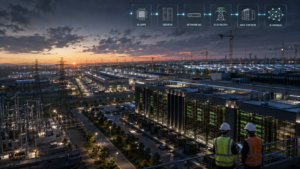
The latest moves include NVIDIA’s backing of a huge AI data-center campus in Ohio, a $1.5 billion investment in SB Energy, and a new minority investment in Cloverleaf Infrastructure, a company developing sites for AI data centers across the U.S.
The strategy reflects a major change in the AI industry.
As AI models become more powerful, the biggest constraint is no longer simply access to GPUs. Companies also need enormous amounts of electricity, land, cooling capacity, networking infrastructure and purpose-built data-center facilities.
NVIDIA increasingly wants to help solve those problems.
NVIDIA Is Moving Deeper Into AI Infrastructure
NVIDIA has traditionally been known as the world’s leading supplier of GPUs and AI accelerators.
But the company is now positioning itself as a much broader AI infrastructure provider.
Its strategy increasingly covers:
- AI chips
- Networking
- Memory
- Software
- AI systems
- Data centers
- Power infrastructure
- Cooling
- Financing
- AI factory design
NVIDIA CEO Jensen Huang has described AI data centers as “AI factories” that transform electricity and data into intelligence.
The company now argues that securing land, power and shell capacity is becoming just as important as securing chips.
The Massive Ohio AI Data Center
One of NVIDIA’s biggest infrastructure moves is the PORTS-Pike Technology Campus in Ohio.
NVIDIA announced that it has secured land, power and shell capacity through a partnership with SB Energy to host NVIDIA computing infrastructure.
OpenAI will be the customer for an 8-IT-gigawatt buildout at the site.
The project is expected to become one of the world’s largest dedicated AI computing campuses.
NVIDIA Could Provide Up to $105 Billion in Credit Support
The Ohio project has attracted enormous attention because NVIDIA is providing substantial financial support.
The company has committed credit support covering land, power and shell construction requirements for the initial phase.
The reported support can reach approximately $105 billion for the initial buildout under the project’s financing structure.
NVIDIA’s role is designed to help SB Energy secure financing for the massive infrastructure project.
OpenAI Will Lease the Facility
OpenAI is expected to lease the Ohio data-center campus for 20 years.
The facility will provide OpenAI with a huge amount of dedicated computing capacity for AI research, model training and inference.
The initial phase is expected to provide approximately 800 megawatts of computing power by 2028, with the broader campus potentially scaling to around 8 gigawatts.
That would make the project one of the largest AI infrastructure developments ever announced.
NVIDIA Is Also Investing $1.5 Billion in SB Energy
NVIDIA is not simply providing financing support.
The company is also investing $1.5 billion in SB Energy, the data-center developer behind the Ohio project.
SB Energy is a SoftBank-backed company that has increasingly shifted toward large-scale AI data-center infrastructure.
The investment gives NVIDIA a stronger relationship with the company developing the physical facilities required to deploy its computing systems.
NVIDIA Wants to Secure Future GPU Demand
There is also a strategic business reason behind NVIDIA’s infrastructure investments.
Building a data center requires enormous amounts of capital.
If customers cannot finance or construct facilities, they cannot deploy NVIDIA’s GPUs.
By helping customers solve infrastructure and financing problems, NVIDIA can potentially accelerate deployment of its own computing systems.
That could create a powerful feedback loop:
More infrastructure → more AI compute → more NVIDIA systems → more AI applications.
NVIDIA Is Investing in Cloverleaf Infrastructure
The company has also made a minority investment in Cloverleaf Infrastructure, a privately held company focused on developing data-center sites.
Financial terms of the investment were not disclosed.
Cloverleaf works with utilities, energy providers and investors to secure the power and infrastructure required for large AI data-center developments.
The partnership is designed to accelerate AI infrastructure projects across the United States.
Why Cloverleaf Matters
Finding a suitable location for an AI data center is becoming increasingly difficult.
Developers need:
- Large amounts of land
- Reliable electricity
- Transmission capacity
- Cooling resources
- Fiber connectivity
- Local permitting
- Construction capacity
- Access to capital
Cloverleaf specializes in assembling these resources.
NVIDIA can then provide the computing infrastructure that ultimately occupies those facilities.
NVIDIA Is Building an Infrastructure Ecosystem
The Cloverleaf investment demonstrates that NVIDIA is increasingly interested in the entire development pipeline.
Instead of waiting for data-center developers to build facilities and then selling them GPUs, NVIDIA can become involved much earlier.
That gives the company visibility into future AI computing demand.
It also potentially helps reduce bottlenecks that could otherwise delay GPU deployments.
The U.S. AI Data-Center Race Is Accelerating
Demand for AI computing has exploded.
Companies including OpenAI, Microsoft, Google, Meta and Amazon are investing enormous sums into AI infrastructure.
The competition is no longer limited to developing better models.
Companies are also competing to secure:
- Power
- Data-center space
- GPUs
- Networking
- Cooling
- Semiconductor supply
The physical infrastructure race is becoming just as important as the AI model race.
Power Is Becoming a Major AI Bottleneck
AI data centers consume enormous amounts of electricity.
Traditional data centers were already large power consumers, but modern AI facilities can require dramatically more energy because of high-density GPU deployments.
This is why NVIDIA increasingly talks about power alongside computing.
Without enough electricity, even the world’s most advanced GPUs cannot be deployed at scale.
AI Data Centers Are Becoming Gigawatt-Scale Projects
The scale of modern AI infrastructure is changing rapidly.
Traditional data centers were often measured in tens or hundreds of megawatts.
The newest AI campuses are increasingly being designed at gigawatt scale.
The Ohio project is a major example, with an eventual target of approximately 8 gigawatts of IT capacity.
Why 8 Gigawatts Is Extraordinary
An 8-gigawatt AI campus represents an enormous concentration of computing power.
For comparison, a large power plant can generate several gigawatts of electricity.
An AI campus operating at this scale requires a completely different approach to energy planning.
Developers need dedicated power generation, transmission infrastructure and sophisticated cooling systems.
NVIDIA Is Becoming Part of the Financing System
NVIDIA’s recent moves show that the company is increasingly participating in the financing of AI infrastructure.
On August 10, NVIDIA announced partnerships with major financial firms including Apollo, BlackRock, Blackstone, Brookfield, Goldman Sachs and KKR.
The financing platforms are designed to mobilize more than $500 billion of third-party capital for AI infrastructure over time.
Turning AI Infrastructure Into an Investment Asset
NVIDIA’s financial strategy is designed to make AI infrastructure more attractive to institutional investors.
Data centers are long-lived assets.
They require huge upfront investment but can generate revenue over many years.
That makes them potentially attractive to pension funds, insurers and other investors seeking long-duration assets.
NVIDIA wants to connect this capital with the growing demand for AI computing.
Why NVIDIA Needs Wall Street
The scale of AI infrastructure is becoming too large for many individual technology companies to finance alone.
A single AI campus can require tens of billions of dollars.
As projects grow into hundreds of billions of dollars, institutional capital becomes increasingly important.
NVIDIA’s partnerships with financial institutions are designed to help bridge that gap.
NVIDIA’s Strategy Goes Beyond Selling GPUs
NVIDIA’s traditional business model was relatively straightforward:
Build GPUs → Sell GPUs → Customers build data centers.
The new strategy is more complicated:
Secure land → secure power → arrange financing → build data centers → deploy NVIDIA systems → provide software → support AI workloads.
This gives NVIDIA a much larger role in the AI ecosystem.
AI Factories Are the New Infrastructure Model
NVIDIA increasingly uses the term AI factory to describe next-generation computing facilities.
An AI factory is designed specifically to convert massive amounts of electricity and data into AI outputs.
These facilities need specialized:
- GPUs
- CPUs
- Networking
- Memory
- Storage
- Cooling
- Power systems
- Software
The concept is different from a traditional cloud data center.
NVIDIA Is Designing the Full Stack
NVIDIA’s DSX platform is designed to help customers plan and optimize AI data-center infrastructure.
The platform can integrate decisions around computing, power, cooling and facility design.
NVIDIA is also deploying DSX technology with partners such as Cloverleaf and in international AI factory projects.
AI Infrastructure Is Becoming a Competitive Advantage
The ability to secure physical infrastructure could become a major competitive advantage for AI companies.
A company may have an excellent AI model, but if it cannot obtain enough GPUs or electricity, it cannot scale that model.
NVIDIA’s strategy directly addresses this problem.
OpenAI Benefits From the Strategy
OpenAI is one of the biggest beneficiaries of NVIDIA’s infrastructure push.
The company needs enormous amounts of computing power to train and operate increasingly advanced AI models.
The Ohio facility could provide a major source of dedicated capacity.
OpenAI’s 20-year lease also gives the project a long-term anchor customer.
NVIDIA Benefits From OpenAI’s Demand
The relationship is also beneficial for NVIDIA.
OpenAI requires large amounts of AI computing hardware.
NVIDIA can supply those systems while also helping finance and develop the infrastructure required to deploy them.
This creates a much deeper commercial relationship than a normal chip-supplier agreement.
The Strategy Could Generate Huge Chip Sales
NVIDIA expects the Ohio project to require enormous quantities of its computing systems.
According to reports, each generation of AI infrastructure at the site could represent tens of billions of dollars in NVIDIA hardware revenue.
The company has suggested that the long-term opportunity could reach hundreds of billions of dollars as the site expands and computing generations are refreshed.
NVIDIA Is Also Expanding U.S. Manufacturing
The infrastructure push is happening alongside NVIDIA’s efforts to expand domestic manufacturing.
The company has been working with partners including TSMC, Foxconn, Wistron, Amkor and others to establish more AI infrastructure production in the United States.
NVIDIA says its U.S. ecosystem is now spread across dozens of states.
Blackwell and Future NVIDIA Systems
The U.S. manufacturing expansion is intended to support current and future generations of NVIDIA AI systems.
As AI clusters become larger, the company needs reliable access to:
- Advanced chips
- Packaging
- Memory
- Networking equipment
- Servers
- Racks
The supply chain therefore becomes part of the infrastructure strategy.
Advanced Networking Is Also Critical
AI clusters cannot function efficiently if GPUs cannot communicate rapidly.
That makes networking technology increasingly important.
NVIDIA has invested heavily in high-speed interconnects and networking systems designed specifically for AI factories.
The company’s broader infrastructure strategy therefore includes more than processors.
Memory Is Another Bottleneck
AI workloads require huge amounts of high-bandwidth memory.
NVIDIA systems rely heavily on HBM and advanced packaging technologies.
The company has therefore been strengthening relationships across the semiconductor supply chain to ensure adequate access to these components.
Energy Infrastructure Could Become the Biggest Challenge
The biggest challenge facing the AI data-center industry may ultimately be electricity.
Developers are increasingly exploring:
- Natural gas
- Nuclear power
- Renewable energy
- Battery storage
- Dedicated power plants
- Grid upgrades
The Ohio project itself involves major energy infrastructure planning, demonstrating how closely AI and power markets are becoming connected.
AI Could Reshape U.S. Energy Demand
The growth of AI data centers could dramatically increase electricity demand in the United States.
Large AI campuses can consume as much power as major industrial facilities.
That means utilities and governments need to plan for new generation and transmission infrastructure.
NVIDIA’s infrastructure strategy is therefore becoming part of a much broader energy transition.
Jobs Are Another Major Impact
Large AI infrastructure projects can create significant employment.
The Ohio campus is expected to create tens of thousands of construction jobs and thousands of permanent jobs.
NVIDIA says its broader American manufacturing ecosystem is also supporting jobs across the semiconductor and technology supply chain.
The U.S. Wants Domestic AI Infrastructure
The infrastructure push also aligns with U.S. efforts to strengthen domestic AI capabilities.
Building AI computing capacity inside the country can reduce dependence on overseas infrastructure and strengthen national technological competitiveness.
NVIDIA has increasingly positioned its U.S. manufacturing and infrastructure strategy as part of that effort.
NVIDIA’s Global AI Strategy Continues
Although the U.S. is a major focus, NVIDIA is also supporting AI infrastructure projects internationally.
For example, NVIDIA and partners are working with NAVER and Brookfield to expand sovereign AI infrastructure in South Korea.
The initial 55-megawatt AI factory deployment at GAK Sejong is planned to expand to 200 megawatts by 2028.
This shows that NVIDIA’s infrastructure strategy is global.
AI Infrastructure Is Becoming Geopolitical
Countries increasingly view AI computing as strategic infrastructure.
The ability to train large AI models requires access to advanced chips, data centers and electricity.
That means AI infrastructure is becoming closely connected to national security and economic policy.
NVIDIA sits at the center of this competition.
The Risks Are Also Growing
NVIDIA’s infrastructure strategy carries significant risks.
Building enormous data centers requires massive capital.
If AI demand slows, some facilities could become underutilized.
Interest rates can also increase financing costs.
Power shortages can delay construction.
Regulators may also examine relationships between chip suppliers, AI companies and infrastructure developers.
Investors Are Watching the Financial Exposure
NVIDIA’s growing role in financing AI infrastructure has attracted investor attention.
The company is taking on more exposure to projects that ultimately depend on continued AI demand.
That does not mean NVIDIA is directly funding every project at full cost, but its guarantees and investments can create financial commitments.
Investors will be watching these arrangements closely.
NVIDIA’s Upcoming Earnings Matter
The timing is particularly important because NVIDIA is scheduled to report its fiscal second-quarter results on August 26, 2026.
Investors will be watching the company’s AI infrastructure demand, margins, supply constraints and financial commitments closely.
The Bigger AI Infrastructure Race
NVIDIA’s moves are part of a much larger industry trend.
OpenAI, Microsoft, Google, Meta, Amazon and other technology companies are all investing enormous sums in computing infrastructure.
The companies that secure enough power, chips and data-center capacity could have a major advantage in the next stage of AI development.
What Happens Next?
The next phase will involve turning announced plans into operational AI factories.
NVIDIA will need to coordinate:
- Land acquisition
- Power availability
- Data-center construction
- GPU deployment
- Networking
- Cooling
- Financing
- Customer demand
The success of this model could determine how quickly AI infrastructure scales over the next decade.
Final Verdict
NVIDIA is rapidly transforming itself from an AI-chip supplier into a much broader AI infrastructure company.
Its latest U.S. moves include the massive Ohio AI campus for OpenAI, a $1.5 billion investment in SB Energy and a strategic investment in Cloverleaf Infrastructure to accelerate AI data-center development across the country.
At the same time, NVIDIA is working with major financial institutions to mobilize more than $500 billion in third-party capital for AI infrastructure projects.
The strategy reflects a fundamental change in the AI industry.
The future of AI will not depend only on who builds the smartest model or fastest GPU.
It will also depend on who can secure the electricity, land, data centers, financing and computing capacity required to run those systems at enormous scale.
NVIDIA increasingly wants to be involved in every part of that equation.
Read More:- NVIDIA Pays $7 Billion for Poolside AI Technology in Massive Coding Agent Deal
FAQ
Why is NVIDIA expanding U.S. AI data-center infrastructure?
NVIDIA is expanding its role beyond AI chips by helping secure the land, power, financing and facilities required to deploy large-scale AI computing infrastructure in the United States.
What is NVIDIA’s AI infrastructure strategy?
NVIDIA’s strategy increasingly covers AI chips, networking, software, data centers, power infrastructure, financing and complete AI factory systems.
What is the NVIDIA and SB Energy Ohio project?
NVIDIA and SB Energy are developing the PORTS-Pike Technology Campus in Ohio, which is planned to host large-scale NVIDIA AI computing infrastructure for OpenAI.
How large will the Ohio AI data center be?
The broader Ohio campus is planned to scale to approximately 8 gigawatts of IT capacity, making it one of the largest AI computing projects announced.
Who will use the Ohio AI data center?
OpenAI is expected to be the major customer for the Ohio project under a long-term lease arrangement.
How much is NVIDIA investing in SB Energy?
NVIDIA has announced a $1.5 billion investment in SB Energy, the company developing the Ohio AI infrastructure project.
What is Cloverleaf Infrastructure?
Cloverleaf Infrastructure is a company focused on developing sites and infrastructure for large-scale data centers, including AI computing facilities.
Why is NVIDIA investing in Cloverleaf?
NVIDIA’s investment can help accelerate the development of U.S. AI data-center sites by improving access to land, electricity, utilities and other infrastructure.
Why is electricity so important for AI data centers?
Modern AI data centers can require enormous amounts of electricity because they operate thousands of high-performance AI processors and advanced cooling systems.
What is an AI factory?
An AI factory is a purpose-built computing facility designed to transform electricity, data and computing resources into AI model training, inference and other AI workloads.
Why is NVIDIA getting involved in data-center financing?
Large AI data centers can require tens of billions of dollars in capital. NVIDIA is working with financial institutions and infrastructure companies to help accelerate investment in new AI computing capacity.
How much third-party capital is NVIDIA trying to mobilize?
NVIDIA has announced partnerships designed to mobilize more than $500 billion of third-party capital for AI infrastructure over time.
Why does NVIDIA want to secure data-center capacity?
Securing infrastructure helps NVIDIA ensure that customers can actually deploy its AI chips and computing systems at large scale.
Is NVIDIA becoming a data-center company?
NVIDIA remains primarily an AI computing and semiconductor company, but it is increasingly expanding into the broader AI infrastructure ecosystem.
What other companies are competing to build AI data centers?
Companies including Microsoft, OpenAI, Google, Meta and Amazon are investing heavily in large-scale AI computing infrastructure.
Why are AI data centers becoming larger?
AI models require increasing amounts of computing power for training and inference. This is driving companies toward increasingly dense and larger computing campuses.
What is the biggest challenge for new AI data centers?
Power availability is one of the biggest challenges. Developers also need land, cooling, transmission infrastructure, networking, construction capacity and financing.
Is NVIDIA expanding AI infrastructure outside the U.S.?
Yes. NVIDIA is also supporting AI infrastructure projects in other countries, including large AI factory initiatives in South Korea and other markets.
Could NVIDIA’s infrastructure strategy increase GPU sales?
Potentially. By helping customers develop and finance AI facilities, NVIDIA can accelerate the deployment of its computing systems and create additional demand for future generations of AI hardware.
What does NVIDIA’s infrastructure expansion mean for the U.S.?
The expansion could increase domestic AI computing capacity, support semiconductor and technology jobs and strengthen the United States’ position in the global AI infrastructure race.