Uber is expanding its autonomous ride-hailing network in the Middle East with the launch of Baidu’s fully driverless Apollo Go robotaxis in Dubai.
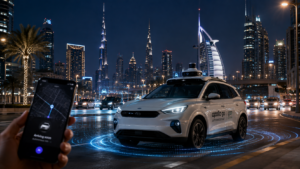
Starting August 20, 2026, riders in Dubai can be matched with an Apollo Go autonomous vehicle directly through the Uber app.
The launch marks an important milestone for both companies because Dubai is the first market where Baidu’s Apollo Go service is being offered through Uber as part of their global autonomous-vehicle partnership.
The service is being introduced in collaboration with Dubai’s Roads and Transport Authority (RTA), with New Horizon Luxury Transport managing the Apollo Go fleet.
Baidu Apollo Go Robotaxis Are Now Available on Uber
Users in Dubai can access Apollo Go vehicles through the Uber platform.
When booking an eligible Uber trip, riders may be matched with an Apollo Go vehicle.
Uber says users can access the autonomous service through eligible UberX or Uber Comfort bookings, while the Uber app also provides an “Autonomous” option where available.
The vehicles operate without a human safety driver behind the wheel.
That makes the Dubai launch significantly different from earlier supervised autonomous-vehicle trials.
What Is Baidu Apollo Go?
Apollo Go is Baidu’s autonomous ride-hailing platform.
The service uses artificial intelligence, cameras, radar, LiDAR and other sensors to allow vehicles to understand their surroundings and navigate city roads.
Baidu has already operated Apollo Go robotaxis at large scale in China and has been expanding the service internationally.
According to Baidu and Uber, Apollo Go had accumulated hundreds of millions of autonomous kilometers globally by 2026, including a large number of kilometers completed in fully driverless mode.
Fully Driverless Means No Safety Driver
One of the most important aspects of the Dubai launch is that the Apollo Go vehicles operate in fully driverless mode.
There is no human safety operator sitting behind the steering wheel.
Dubai Taxi Company also describes its Apollo Go service as operating without a safety driver and says the service is being conducted in accordance with local regulatory and safety requirements.
This represents a major step from testing autonomous technology to offering it as an actual commercial ride-hailing service.
How Can Passengers Book an Apollo Go Robotaxi?
Passengers can access the service through the Uber app.
Depending on availability and location, an eligible Uber booking can be fulfilled by an Apollo Go autonomous vehicle.
Passengers can also access Apollo Go directly through the company’s own app.
Dubai therefore becomes Apollo Go’s first international market where its autonomous service operates through both its own application and a third-party ride-hailing platform.
Where Are the Robotaxis Available?
The Apollo Go service is being rolled out within Dubai’s designated autonomous-vehicle operating areas.
Earlier commercial operations focused on districts including Jumeirah and Umm Suqeim, two major coastal areas of Dubai.
Dubai’s RTA has been gradually expanding autonomous-vehicle operations following extensive testing on designated roads.
The initial rollout is expected to expand as operational data is collected and additional regulatory approvals are obtained.
Dubai Is Becoming a Major Robotaxi Test Market
The launch is part of Dubai’s broader strategy to become one of the world’s leading autonomous-transport cities.
Dubai has set a target of making 25% of all transportation trips autonomous by 2030.
The emirate has therefore been working with multiple autonomous-driving companies rather than relying on a single technology provider.
Companies involved in Dubai’s autonomous-mobility ecosystem include:
- Baidu Apollo Go
- WeRide
- Pony.ai
The strategy is designed to gradually integrate autonomous vehicles into Dubai’s existing public transportation network.
Uber Already Has Another Robotaxi Partner in Dubai
Baidu is not Uber’s only autonomous-driving partner operating in Dubai.
WeRide began fully driverless commercial robotaxi operations through Uber in Dubai in March 2026.
Those vehicles operate in areas including Jumeirah and Umm Suqeim and can be booked through Uber’s “Autonomous” option.
The arrival of Apollo Go therefore gives Uber another autonomous-vehicle partner in the same city.
This is important because Uber’s strategy is not to build a single proprietary robotaxi fleet.
Instead, the company is creating a platform where multiple autonomous-vehicle companies can provide rides through Uber.
Why Uber Is Working With Multiple Robotaxi Companies
Uber has increasingly positioned itself as a marketplace for autonomous vehicles.
Rather than developing all autonomous-driving technology internally, the company partners with companies that specialize in self-driving systems.
Uber can then provide:
- A large customer base
- Ride-hailing infrastructure
- Payment systems
- Driverless-ride distribution
- Fleet-management partnerships
- Customer support
- Global market access
Autonomous-driving companies can focus more heavily on vehicle technology while Uber provides the marketplace.
The Baidu partnership is an example of this strategy in action.
Baidu’s Autonomous Driving Technology
Apollo Go vehicles use a combination of sensors and AI systems to understand the road.
Dubai’s RTA says Baidu’s RT6 autonomous taxis use more than 40 sensors, including high-precision LiDAR, multi-band radar and advanced cameras.
These systems allow the vehicle to detect and respond to:
- Cars
- Pedestrians
- Cyclists
- Traffic signals
- Road markings
- Intersections
- Obstacles
- Other road users
The AI system then uses the collected information to determine how the vehicle should navigate through the environment.
Why Dubai Is Attractive for Autonomous Vehicles
Dubai provides several advantages for autonomous-driving companies.
The city has invested heavily in:
- Smart-city infrastructure
- Digital government services
- Connected transportation
- High-quality roads
- Traffic-management technology
- Autonomous mobility
The RTA has also established regulatory and operational frameworks for testing and deploying autonomous vehicles.
That makes Dubai an attractive international market for companies that want to demonstrate autonomous driving outside their home countries.
Dubai’s Robotaxi Program Is Already Expanding
The Baidu-Uber launch is not the beginning of Dubai’s autonomous taxi program.
Dubai had already begun commercial autonomous taxi operations earlier in 2026.
The RTA announced commercial operations involving Apollo Go and WeRide, with an initial deployment of around 100 autonomous taxis in the city’s transportation network.
The fleet is expected to expand gradually as demand increases and regulatory requirements are met.
Dubai’s Robotaxis Have Already Driven Millions of Kilometers
The autonomous program is moving beyond small-scale demonstrations.
According to Dubai’s government media office, the city’s Robotaxi program had accumulated more than 4 million kilometers by August 2026.
The program also reported a 97% customer satisfaction rate.
Dubai says the accumulated driving data is being used to evaluate autonomous-driving performance and prepare the technology for wider deployment.
These figures suggest that the emirate is increasingly treating autonomous taxis as part of its transportation infrastructure rather than simply an experimental technology.
The Service Is Designed for Everyday Riders
One of the biggest differences between a technology demonstration and a commercial robotaxi service is accessibility.
Passengers do not need to be engineers or autonomous-driving testers.
They can simply request a ride through a familiar ride-hailing application.
This is exactly where Uber’s role becomes important.
By placing autonomous vehicles inside an existing ride-hailing ecosystem, Uber can make the technology available to ordinary consumers.
What Does the Robotaxi Experience Look Like?
A passenger’s journey is designed to feel similar to a normal Uber ride.
The customer requests a trip through the app.
If an autonomous vehicle is available for the route, the system can match the passenger with a robotaxi.
The passenger then enters the vehicle and travels to the destination while the autonomous-driving system handles the journey.
The major difference is that there is no human driver controlling the vehicle.
Safety Remains the Biggest Priority
Fully autonomous driving requires a high level of reliability.
The vehicle must be able to deal with unpredictable situations such as:
- Sudden lane changes
- Pedestrians crossing roads
- Emergency vehicles
- Construction zones
- Heavy traffic
- Poor visibility
- Unusual road behavior
Dubai’s autonomous-vehicle program has therefore gone through extensive testing before commercial deployment.
The RTA says autonomous vehicles were tested on designated roads to evaluate their performance and readiness for Dubai’s traffic environment.
What Happens If Something Goes Wrong?
Autonomous vehicles are designed to detect unusual situations and respond safely.
The vehicles are supported by remote operational and fleet-management systems.
Fleet operators can monitor the vehicles and intervene when necessary according to the operating framework.
This means “fully driverless” does not mean the vehicle exists completely outside a wider human-operated transportation system.
Instead, the driving task is automated while fleet management and operational oversight remain part of the broader infrastructure.
How Much Will a Baidu Robotaxi Cost?
Pricing can depend on the specific service, promotion and booking channel.
Dubai Taxi Company’s Apollo Go service is currently listed as complimentary until further notice, after which standard commercial taxi fares are expected to apply.
Uber pricing for an Apollo Go ride can depend on the booking category, availability and applicable promotional terms.
Passengers should therefore check the fare displayed in the Uber app before confirming a trip.
What Does This Mean for Uber Drivers?
The expansion of robotaxis raises questions about the future of human drivers.
Uber’s strategy is currently focused on combining autonomous vehicles with its existing ride-hailing marketplace.
The company has continued to work with large numbers of human drivers while expanding autonomous partnerships.
This means robotaxis are being added to the platform rather than immediately replacing every conventional Uber vehicle.
The long-term balance between human drivers and autonomous vehicles remains uncertain.
Baidu’s Global Autonomous Expansion
Dubai is an important international milestone for Baidu.
Apollo Go has already operated extensively in China and is now expanding into international markets.
Baidu and Uber’s broader partnership aims to deploy thousands of autonomous vehicles across markets outside mainland China and the United States.
The companies have identified markets in Asia and the Middle East as important areas for expansion.
Dubai is therefore not simply a standalone launch.
It is part of a much larger global autonomous-driving strategy.
Uber Wants Autonomous Rides Around the World
Uber has partnered with more than one autonomous-vehicle company as it expands its robotaxi network.
The company says its autonomous partners have already completed millions of autonomous trips globally.
The platform approach allows Uber to work with different vehicle and autonomous-driving technologies in different cities.
This could eventually create a global network where the type of robotaxi available to a rider depends on the local autonomous-vehicle partners operating in that market.
What About Dubai’s 2030 Autonomous Goal?
Dubai’s government wants 25% of all transportation trips to be autonomous by 2030.
Robotaxis are expected to play a major role in reaching that target.
The emirate is developing an ecosystem involving autonomous taxis, public transportation and smart-city infrastructure.
The goal is not simply to introduce driverless cars.
It is to create a transportation system where autonomous mobility becomes a normal part of everyday urban travel.
Could Robotaxis Become More Common in Dubai?
The current trajectory suggests that autonomous ride-hailing will continue expanding.
Dubai has already moved from testing to commercial operations.
The next stage will involve increasing the number of vehicles, expanding operating areas and improving the technology’s ability to handle increasingly complex road conditions.
Read More:- ChatGPT Down: OpenAI Confirms Major Login and Signup Outage
Dubai Taxi Company says its autonomous fleet is expected to grow to more than 1,000 driverless vehicles by 2030.
The Bigger Picture
Uber’s launch of Baidu Apollo Go robotaxis in Dubai represents a significant step in the global development of autonomous transportation.
For the first time in this partnership, Baidu’s fully driverless vehicles are available through Uber’s ride-hailing marketplace in Dubai.
The launch combines three major pieces of technology and infrastructure:
Baidu’s autonomous-driving technology + Uber’s global ride-hailing platform + Dubai’s smart-mobility infrastructure.
The result is a service where passengers can request a ride and potentially be transported entirely without a human driver.
Dubai’s ambition to make 25% of transportation trips autonomous by 2030 gives the project an even bigger strategic significance.
If the service continues to expand successfully, Dubai could become one of the world’s most important real-world testing grounds for autonomous ride-hailing.
The era of ordering a taxi without a driver may no longer be a futuristic concept — in Dubai, it is already becoming part of everyday transportation.
FAQ
Are Baidu’s robotaxis fully driverless in Dubai?
Yes. Baidu’s Apollo Go robotaxis launched in Dubai with fully driverless operations, meaning there is no human safety driver behind the wheel during eligible rides.
Can I book a Baidu robotaxi through Uber?
Yes. Eligible riders in Dubai can be matched with Baidu Apollo Go autonomous vehicles through the Uber app, depending on availability and operating area.
When did Baidu Apollo Go launch on Uber in Dubai?
The Apollo Go service became available through Uber in Dubai on August 20, 2026.
What is Baidu Apollo Go?
Apollo Go is Baidu’s autonomous ride-hailing platform. It uses AI, cameras, LiDAR, radar and other sensors to navigate roads and transport passengers without a conventional human driver.
Where are Baidu robotaxis available in Dubai?
The service is initially operating within designated autonomous-driving areas of Dubai. Early autonomous taxi operations have focused on areas including Jumeirah and Umm Suqeim, with expansion expected over time.
How do I get a Baidu robotaxi in Dubai?
Users can request eligible Uber rides through the Uber app. If an Apollo Go vehicle is available for the selected route, the ride may be fulfilled by an autonomous vehicle.
Are Uber robotaxis available in Dubai from other companies?
Yes. Uber has also partnered with WeRide, which launched fully driverless commercial robotaxi operations through Uber in Dubai earlier in 2026.
Is there a human driver inside the Baidu robotaxi?
No. Apollo Go’s Dubai service is designed to operate fully driverlessly. However, the vehicles remain supported by broader fleet-management and operational systems.
How safe are Baidu’s robotaxis?
The vehicles use multiple sensors and AI systems to detect road users, obstacles, traffic signals and other environmental conditions. Dubai authorities have conducted extensive testing before allowing commercial operations.
How much does a Baidu robotaxi cost in Dubai?
Pricing depends on the service and booking platform. Dubai Taxi Company’s Apollo Go service has been offered on a complimentary basis during its initial phase, while Uber fares can depend on the applicable booking category and availability.
Can robotaxis replace Uber drivers?
Robotaxis could eventually reduce demand for some human-driven rides, but Uber currently operates a mixed ecosystem that includes both autonomous vehicles and human drivers.
Why is Dubai important for autonomous driving?
Dubai has an ambitious goal of making 25% of transportation trips autonomous by 2030. The city has invested heavily in smart transportation infrastructure and autonomous-mobility regulations.
How many autonomous vehicles does Dubai plan to have?
Dubai Taxi Company has said its autonomous fleet is expected to grow to more than 1,000 driverless vehicles by 2030.
Will Baidu expand its robotaxi service to other countries?
Baidu and Uber have a broader partnership aimed at expanding autonomous ride-hailing internationally. Dubai is an important milestone in that global expansion strategy.