China’s push to build a domestic alternative to NVIDIA is gaining another major player — and investors are showing enormous interest.
Tencent-backed AI chipmaker Shanghai Enflame Technology is moving ahead with a roughly 6.1 billion yuan ($908 million) initial public offering on Shanghai’s STAR Market, giving the eight-year-old company fresh capital to develop its next generations of AI processors and supporting software.
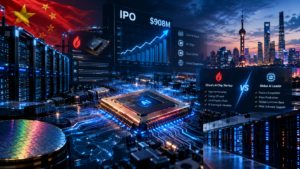
The IPO has already attracted extraordinary investor demand. Enflame’s online offering was reportedly 6,109 times oversubscribed, with more than 7 million online investor accounts placing orders. The final winning rate for online investors was only 0.025%.
The response highlights how China’s semiconductor self-reliance campaign is turning domestic AI-chip companies into major investment stories — particularly as restrictions on advanced U.S. chips continue to complicate China’s access to NVIDIA’s most capable hardware.
Enflame’s $908 Million IPO
Enflame has set its IPO price at 142.18 yuan per share and plans to sell about 43 million shares on Shanghai’s technology-focused STAR Market.
At that price, the company is being valued at roughly 61 billion yuan ($9.1 billion). Reuters reported that this represents approximately 61.8 times Enflame’s projected 2025 sales, even though the company has not yet become profitable.
The money raised is intended to support the development and production of Enflame’s fifth- and sixth-generation AI chips, along with related hardware and software projects.
That makes the IPO more than a fundraising event.
It is effectively a bet on China’s ability to build a complete domestic AI-computing ecosystem.
Why Enflame Is Being Compared With NVIDIA
Enflame develops AI accelerators designed for high-performance computing and artificial intelligence workloads.
Its technology is particularly relevant to AI inference — the stage where trained AI models generate responses, predictions or other outputs for users.
That is strategically important because the AI industry is moving beyond model training toward massive inference demand. Every chatbot query, AI-generated image, coding task and agent workflow requires computing resources somewhere.
Reuters Breakingviews described Enflame as one of the Chinese companies increasingly challenging NVIDIA’s long-standing position in AI chips, while noting that Chinese AI-chip startups are making progress in both hardware and software.
However, Enflame is not currently a direct equivalent to NVIDIA at global scale.
NVIDIA has a much larger product ecosystem, software stack, developer base and global customer footprint. The more accurate description is that Enflame is part of China’s effort to build competitive domestic alternatives and reduce dependence on foreign accelerators.
China’s “Four Little GPU Dragons”
Enflame is often grouped with three other major Chinese AI-chip startups:
- Moore Threads
- MetaX Integrated Circuits
- Shanghai Biren Technology
- Enflame Technology
Chinese financial circles have referred to these companies as the country’s “four little GPU dragons.”
Enflame is the latest of the group to move into the public markets, following its domestic competitors.
Their emergence is significant because China has increasingly treated advanced computing hardware as a strategic technology rather than simply another commercial semiconductor category.
The U.S. Export-Control Factor
The competition between Enflame and NVIDIA cannot be separated from U.S.-China technology restrictions.
Washington has imposed restrictions on exports of advanced AI chips and semiconductor technology to China, with rules aimed at limiting Beijing’s access to cutting-edge computing capabilities.
That has created a difficult environment for Chinese technology companies that depend on imported accelerators.
At the same time, the restrictions have created an incentive for domestic companies to develop alternatives.
Enflame’s IPO therefore arrives at an unusual intersection of business opportunity, national technology policy and geopolitical competition.
Tencent Is a Major Part of the Story
One of Enflame’s biggest advantages is its relationship with Tencent.
Tencent is both a major shareholder and Enflame’s largest customer, giving the chipmaker a powerful domestic technology partner and a large potential deployment environment.
That relationship matters because developing a competitive AI accelerator is only half the challenge.
Chip companies also need real workloads, customers, software compatibility and large-scale deployments to improve their products.
Tencent can provide an important environment for Enflame to test and deploy its technology.
But the relationship also creates concentration risk.
A large dependence on one major customer can be beneficial while that customer continues expanding AI infrastructure, but it can become a vulnerability if demand changes or if the company struggles to diversify its customer base.
Enflame Is Growing Rapidly — But Profitability Remains a Question
Enflame’s growth is one reason investors are paying attention.
Reuters reported on September 7 that the company’s quarterly revenue had increased by roughly 1,400%, illustrating the extremely rapid expansion taking place among some Chinese AI-chip companies.
But rapid revenue growth does not automatically translate into a sustainable semiconductor business.
AI-chip companies face enormous research, development, manufacturing and software costs.
Enflame is still not profitable, and its IPO valuation reflects significant expectations about future growth. Reuters reported that the company’s IPO valuation corresponds to 61.8 times its projected 2025 sales.
That means investors are effectively betting that today’s relatively small business can become much larger as China’s AI infrastructure expands.
The IPO Demand Is the Real Signal
The most striking development may not actually be the $908 million fundraising target.
It is the level of investor demand.
Enflame’s online IPO portion was oversubscribed by 6,109 times, forcing the company to shift 3.4 million shares from the offline portion to the online offering.
Even after the reallocation, the online allocation rate was just 0.025%.
That kind of demand suggests investors see China’s AI-chip sector as one of the country’s most promising technology opportunities.
It also reflects the performance of earlier Chinese AI-chip listings, which have attracted substantial market enthusiasm.
But Enflame Faces a Huge NVIDIA Gap
Despite the excitement, replacing NVIDIA is not simply a matter of building a faster chip.
NVIDIA’s advantage comes from an entire ecosystem.
Its CUDA software platform, libraries, developer tools, networking products, GPUs, CPUs and AI systems allow customers to build large-scale infrastructure around NVIDIA hardware.
For Chinese competitors, the challenge is therefore to build not just competitive silicon but an ecosystem that developers and cloud providers can actually use.
Enflame has been working on its own software and hardware ecosystem, and Reuters noted that Chinese AI-chip companies are attempting to simplify the transition away from NVIDIA’s platforms.
That could become increasingly important if Chinese companies face continued restrictions on access to advanced NVIDIA hardware.
China’s AI Chip Market Is Becoming More Competitive
Enflame’s IPO is part of a much larger transformation in China’s semiconductor industry.
Companies such as Huawei and Cambricon are also developing domestic AI-computing solutions, while several specialist GPU and accelerator companies are entering public markets.
The result is a growing domestic ecosystem rather than a single NVIDIA replacement.
That distinction is important.
China does not necessarily need one company to completely replicate NVIDIA.
Instead, it could develop multiple companies specializing in different parts of the AI-computing stack — inference, training, networking, software and specialized accelerators.
NVIDIA Still Has a Major Advantage
The rise of Enflame does not mean NVIDIA’s dominance is suddenly disappearing.
NVIDIA remains one of the most powerful companies in the global AI infrastructure market, with massive revenue, a mature software ecosystem and deep relationships with cloud providers and AI developers.
The company also expects strong continued demand for AI infrastructure. NVIDIA recently forecast roughly 70% revenue growth for its next fiscal year, underscoring how strong the broader AI-computing market remains.
The more immediate threat from Enflame is therefore regional.
China has strong incentives to reduce its dependence on NVIDIA, while companies like Enflame have a large domestic market in which to develop and improve their products.
Why This IPO Matters Beyond China
The Enflame IPO is important because AI-chip competition is becoming increasingly global.
The first phase of the generative AI boom was dominated by a relatively small group of U.S. semiconductor and cloud companies.
The next phase could look very different.
China is investing heavily in domestic AI hardware, the U.S. is using export controls as a strategic tool, and other countries are attempting to develop their own semiconductor capabilities.
That means AI chips are becoming part of the broader competition over technological independence.
Enflame’s IPO is one visible example of that shift.
What Enflame Plans to Do With the Money
The company plans to direct the IPO proceeds toward its next-generation AI chips and supporting technology.
Specifically, the funds are intended to support fifth- and sixth-generation AI-chip development and production, alongside software and hardware innovation.
The success of those projects will ultimately determine whether Enflame can justify its current valuation.
If its future chips deliver competitive performance while maintaining compatibility with China’s growing AI ecosystem, Enflame could become a much more significant player.
If development costs rise faster than revenue, the current valuation could become harder to defend.
The Bigger AI Hardware Race
The Enflame story illustrates an important change in the AI industry.
The competition is no longer simply:
OpenAI vs Google vs Anthropic.
Increasingly, it is also:
NVIDIA vs AMD vs Huawei vs Chinese AI-chip startups vs custom silicon developed by major technology companies.
Every major AI model requires enormous amounts of compute.
Whoever controls that compute infrastructure will have significant influence over the economics and availability of AI.
That is why Enflame’s $908 million IPO is attracting attention far beyond China’s stock market.
What Happens Next?
Enflame now has access to substantial new capital and a public-market valuation that gives it room to expand its research and manufacturing ambitions.
The immediate questions will be whether the company can:
- Deliver competitive fifth- and sixth-generation chips
- Expand beyond Tencent as a major customer
- Improve profitability
- Build a stronger software ecosystem
- Increase production capacity
- Compete effectively with other Chinese AI-chip companies
- Reduce the performance and ecosystem gap with NVIDIA
The IPO gives Enflame resources to pursue those goals.
It does not guarantee that it will achieve them.
Conclusion
China’s Enflame is becoming one of the clearest examples of how the country’s AI-chip industry is attempting to challenge NVIDIA’s long-standing dominance.
The company’s $908 million Shanghai IPO, combined with extraordinary investor demand and plans for fifth- and sixth-generation AI chips, demonstrates how strongly the market is betting on China’s domestic AI hardware sector.
But Enflame still faces significant challenges.
It is not yet profitable, its valuation already assumes substantial future growth, and NVIDIA’s software and hardware ecosystem remains extremely difficult to replicate.
The real significance of the IPO is therefore not that Enflame is about to replace NVIDIA.
It is that China is building a growing pool of AI-chip companies capable of serving its domestic market — and the combination of government policy, massive AI demand and private investment could make that ecosystem increasingly difficult for NVIDIA to ignore.
The global AI-chip race is getting more competitive, and Enflame’s IPO is another sign that China’s answer to NVIDIA is being built one chipmaker at a time.
Read More:- GPT-6 Astra Continues to Dominate AI Search Interest
Frequently Asked Questions
What is Enflame Technology?
Enflame Technology is a Shanghai-based Chinese AI-chip company founded in 2018. It develops AI accelerators and related technologies for high-performance computing and artificial intelligence workloads.
How much money is Enflame raising?
Enflame plans to raise approximately 6.1 billion yuan, or about $908 million, through its Shanghai STAR Market IPO.
Why is Enflame compared with NVIDIA?
Enflame develops AI accelerators that compete in areas of the AI-computing market served by NVIDIA. However, NVIDIA remains far larger globally and has a much more developed hardware and software ecosystem.
Who owns Enflame?
Tencent is a major shareholder in Enflame and is also its largest customer.
What will Enflame use its IPO money for?
The company plans to use the proceeds to develop and produce fifth- and sixth-generation AI chips and related software and hardware technologies.
How much investor demand did Enflame’s IPO receive?
The online portion of the IPO was oversubscribed by 6,109 times, with the final online winning rate at just 0.025%.
Is Enflame profitable?
No. Reuters reported that Enflame had not yet turned profitable at the time of its IPO.
Is Enflame going to replace NVIDIA?
There is no evidence that Enflame is about to replace NVIDIA globally. It is better understood as part of China’s growing effort to develop domestic alternatives to foreign AI-chip suppliers.
Why is China’s AI-chip industry growing?
U.S. restrictions on advanced chip exports have increased China’s incentive to develop domestic AI hardware and reduce dependence on foreign semiconductor technology.
Who are China’s major AI-chip startups?
Enflame, Moore Threads, MetaX Integrated Circuits and Shanghai Biren Technology are commonly described as China’s “four little GPU dragons.”