The artificial intelligence chip boom may have much further to run than many investors expected.
Broadcom has delivered a powerful new signal that demand for AI infrastructure could remain exceptionally strong through the end of the decade. The semiconductor company now expects its AI chip revenue to reach approximately $115 billion in fiscal 2027 and roughly $230 billion in fiscal 2028.
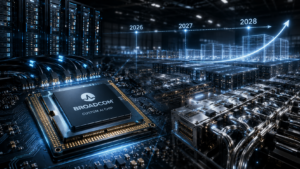
The forecast represents a dramatic increase from Broadcom’s earlier expectations and highlights just how aggressively major technology companies are continuing to invest in AI computing infrastructure.
Broadcom’s optimism is particularly significant because the company supplies custom AI accelerators and networking technology to some of the world’s biggest technology companies.
Its latest results therefore provide another window into the enormous amount of computing capacity being built to support AI models and services.
Broadcom Raises Its AI Chip Outlook
Broadcom’s latest forecast puts its AI semiconductor business on a dramatically higher trajectory.
The company expects approximately $115 billion in AI chip sales during fiscal 2027, followed by about $230 billion in fiscal 2028.
That would mean AI chip revenue roughly doubles between those two fiscal years.
Broadcom had previously expected more than $100 billion in AI chip sales for fiscal 2027. The new projection indicates that demand from major customers has continued to accelerate.
Importantly, these numbers are Broadcom’s forecasts, not guaranteed future revenue.
But the size of the projection shows how confident CEO Hock Tan is about the demand pipeline.
Broadcom’s AI Revenue Is Already Surging
The latest outlook comes after another exceptionally strong quarter for Broadcom’s AI semiconductor business.
In fiscal third-quarter results, Broadcom reported approximately $16.7 billion in AI semiconductor revenue, up dramatically from the same period a year earlier.
AI semiconductor revenue accounted for a significant portion of Broadcom’s overall quarterly business and helped push total company revenue to approximately $29.59 billion.
The company also reported that its AI semiconductor sales had tripled compared with the previous year.
That growth demonstrates that the AI infrastructure boom is no longer just an Nvidia story.
Broadcom has become one of the major beneficiaries of the second layer of the AI hardware ecosystem.
Custom AI Chips Are Driving Much of the Growth
One of Broadcom’s biggest advantages is its role in designing custom AI accelerators.
Instead of every technology company relying exclusively on off-the-shelf GPUs, some of the largest AI developers are increasingly developing specialized chips designed around their own workloads.
Custom chips can potentially improve efficiency, performance and cost for large-scale AI deployments.
Broadcom provides technology and engineering expertise that helps companies build these specialized processors.
According to reporting on the latest results, custom AI chips represented about 73% of Broadcom’s $16.7 billion AI semiconductor revenue in the latest quarter.
That makes custom silicon one of the most important growth areas in the company’s AI strategy.
OpenAI, Anthropic and Meta Are Part of the Demand Story
Broadcom’s optimism is being supported by major AI customers.
The company has identified future deployments involving companies including Anthropic, OpenAI and Meta, alongside Google’s massive AI infrastructure requirements.
Broadcom said it has visibility into significant future deployments, including approximately 10 gigawatts for Anthropic, 5 gigawatts for OpenAI and 3 gigawatts for Meta.
These figures illustrate the scale of computing infrastructure that leading AI companies expect to require.
As AI models become larger and AI agents perform more tasks, companies need enormous amounts of computing power for both training and inference.
That translates directly into demand for accelerators, networking equipment, advanced packaging and related semiconductor technologies.
Why 2028 Is So Important
The biggest surprise in Broadcom’s latest outlook is not the $115 billion figure for 2027.
It is the company’s expectation of approximately $230 billion in AI chip revenue in fiscal 2028.
That projection suggests Broadcom believes AI infrastructure spending will continue expanding rapidly even after today’s enormous data-center buildout.
In other words, the current AI boom may not simply be a short-term infrastructure cycle.
It could develop into a multi-year expansion in computing capacity.
That would have major consequences for semiconductor manufacturers, data-center operators, memory suppliers, networking companies and the broader technology industry.
AI Data Centers Need More Than GPUs
One reason Broadcom can benefit from the AI boom even while Nvidia dominates AI accelerators is that modern AI data centers require much more than GPUs.
Large AI clusters need:
- Custom AI accelerators
- High-speed networking
- Switching technology
- Advanced packaging
- Optical connectivity
- Memory
- Power infrastructure
- Cooling systems
- Data-center equipment
Broadcom has significant exposure to several of these areas.
This means the company’s AI opportunity is not dependent entirely on competing directly with Nvidia’s GPU products.
Instead, Broadcom is positioned around the infrastructure required to connect and operate huge AI computing systems.
The AI Chip Market Is Becoming More Customized
The latest Broadcom numbers also highlight an important trend in the semiconductor industry.
Big technology companies increasingly want hardware optimized for their own AI workloads.
Google has developed its TPU architecture.
Amazon has its own AI accelerators.
Microsoft and Meta have also invested heavily in custom silicon.
OpenAI and Anthropic are increasingly exploring specialized computing infrastructure.
This creates a growing market for companies like Broadcom that can help technology companies design and deploy custom chips at massive scale.
The result could be a more diverse AI hardware market rather than one completely controlled by a single accelerator architecture.
Broadcom Says Demand Visibility Extends Through 2028
Perhaps the strongest part of Broadcom CEO Hock Tan’s message is the company’s confidence about future demand.
Broadcom said it has secured enough supply and has visibility into deployments extending into 2028.
This matters because semiconductor companies typically face major challenges when demand suddenly accelerates.
Manufacturing capacity, advanced packaging, memory and networking components can all become bottlenecks.
If Broadcom already has visibility into large future AI deployments, it suggests that many of the biggest customers are planning their infrastructure well in advance.
The AI Infrastructure Race Is Getting More Expensive
The bullish Broadcom outlook also reveals how expensive the AI race has become.
Technology companies are spending enormous amounts on data centers, chips, electricity and networking infrastructure.
Reuters reported that major technology companies’ AI spending is expected to reach hundreds of billions of dollars, reinforcing the scale of the infrastructure buildout.
The economics are therefore becoming increasingly important.
AI companies must generate enough revenue from AI products and services to justify these enormous infrastructure investments.
If AI applications produce strong returns, spending could continue for years.
If returns disappoint, companies could eventually slow their infrastructure purchases.
There Are Still Risks to Broadcom’s Forecast
Broadcom’s outlook is extremely bullish, but several factors could challenge it.
The first is the sustainability of Big Tech’s AI spending.
Companies can increase capital expenditure rapidly for several years, but eventually investors may demand stronger returns.
Another risk is competition.
Broadcom is not the only company targeting custom AI accelerators. Nvidia is developing new platforms, while Marvell and other semiconductor companies are competing for custom-chip opportunities.
Memory supply is another potential bottleneck.
As AI data centers expand, demand for high-bandwidth memory and other advanced components can grow faster than manufacturing capacity.
AI Spending Could Also Become More Efficient
There is another potential complication.
AI hardware is becoming dramatically more efficient.
New chips can deliver more performance per watt, and AI models are becoming more efficient in some workloads.
That creates an interesting paradox.
More efficient AI can reduce the amount of hardware needed for individual tasks.
But lower computing costs can also encourage companies to run far more AI workloads.
If AI becomes cheap enough, businesses may deploy it across customer service, coding, search, robotics, analytics and thousands of other applications.
That could ultimately increase total demand for computing rather than reduce it.
Broadcom Is Benefiting From the Shift Beyond Nvidia
The AI hardware industry is increasingly moving beyond the idea that one company will supply every important component.
Nvidia remains one of the most powerful companies in AI computing, but Broadcom’s results demonstrate that the ecosystem around AI is enormous.
Companies need custom chips, networking, optical systems and infrastructure alongside GPUs and accelerators.
Broadcom is positioning itself as a critical supplier within that broader ecosystem.
Its latest forecast suggests the company believes this opportunity could become enormous.
What Does Broadcom’s Forecast Mean for the AI Industry?
If Broadcom’s projections prove accurate, the AI industry could remain in an infrastructure expansion phase for several more years.
That would mean continued demand for:
AI accelerators: More chips will be needed to train and run increasingly capable AI systems.
Custom silicon: Large AI companies will continue designing specialized chips for their own workloads.
Networking: Larger AI clusters require faster connections between processors and data-center systems.
Memory: AI workloads consume enormous amounts of high-performance memory.
Power and cooling: Massive AI data centers require increasingly large amounts of electricity and thermal-management infrastructure.
The AI boom is therefore creating demand across the entire semiconductor supply chain.
Is the AI Chip Boom Becoming a Bubble?
Broadcom’s forecast will inevitably fuel debate over whether AI infrastructure spending has become excessive.
The question is not whether companies are spending huge amounts of money—they clearly are.
The bigger question is whether the economic value created by AI will eventually justify that spending.
Broadcom’s bullish outlook suggests the company sees enough customer demand to support continued investment.
But investors should remember that forecasts extending to 2028 involve considerable uncertainty.
AI technology, competition, interest rates, regulation and customer spending priorities can all change significantly over two years.
What Happens Next?
The next major test for Broadcom will be whether actual AI chip orders continue to validate its increasingly optimistic projections.
If demand from OpenAI, Anthropic, Meta, Google and other large customers continues growing, Broadcom could become one of the biggest semiconductor beneficiaries of the AI infrastructure race.
The company’s ability to scale production will also matter.
AI demand is growing at a pace that can put pressure on manufacturing and supply chains.
Broadcom therefore needs both strong customer demand and reliable access to the components required to fulfill those orders.
Read More:- Anthropic Wins Back U.S. Government Trust After Pentagon AI Dispute
Final Takeaway
Broadcom is sending one of the clearest signals yet that the AI chip boom could continue well beyond 2026.
The company expects approximately $115 billion in AI chip revenue in fiscal 2027 and around $230 billion in fiscal 2028—a forecast that implies AI infrastructure demand could remain enormous for years.
The growth is being driven increasingly by custom AI chips and massive deployments planned by some of the world’s biggest technology companies.
But Broadcom’s numbers should be viewed as a forecast, not a guarantee.
The AI industry still faces questions around spending efficiency, competition, chip supply, energy requirements and whether AI applications will generate enough economic value to justify the infrastructure investment.
For now, however, Broadcom’s message is clear: the AI hardware race is nowhere near finished, and the biggest wave of chip demand may still be ahead.