Uber has officially launched autonomous rides in London with British artificial-intelligence startup Wayve, marking a major step for robotaxis in one of Europe’s most challenging urban environments.
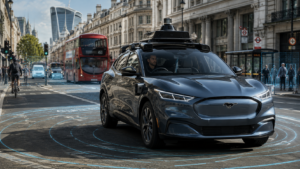
The service began on September 3, 2026, with Uber riders in London able to be matched with vehicles equipped with Wayve’s autonomous-driving technology. However, these are not fully driverless rides yet. A trained human safety driver remains inside the vehicle and can take control when necessary.
The launch makes London the second European city where Uber offers robotaxi rides, following its autonomous service in Zagreb, Croatia.
For Uber, the London launch is another piece of its rapidly expanding autonomous-vehicle strategy. For Wayve, it represents the public deployment of an AI driving system that has been developed and tested on London’s roads for years.
Uber and Wayve Bring AI-Powered Driving to London
The partnership combines Uber’s ride-hailing platform with Wayve’s autonomous-driving technology.
Instead of developing its own single robotaxi vehicle, Uber is building a broader autonomous mobility network by working with multiple technology and vehicle partners.
Wayve provides the AI driving system, while Uber provides the customer-facing platform and access to its huge network of riders.
Uber’s official London page describes the service as autonomous rides powered by Wayve and made available through the Uber app.
This model could eventually allow Uber to introduce autonomous vehicles in multiple cities without needing to manufacture the vehicles or develop every part of the self-driving stack itself.
Are London’s Uber Robotaxis Fully Driverless?
No—not yet.
The first phase of the London service uses a trained human safety operator inside the vehicle.
The operator monitors the autonomous system and is able to intervene if the vehicle encounters a situation where human control is necessary. This approach is partly connected to the UK’s regulatory framework for autonomous vehicles.
The distinction matters because the term “robotaxi” can suggest that there is nobody inside the car.
In London’s initial deployment, the vehicle is doing much of the driving, but a human remains available as a safety backup.
The companies can therefore gather real-world passenger and driving experience while regulators continue developing the framework for more advanced autonomous operation.
What Cars Are Being Used?
The initial London service uses Ford Mustang Mach-E electric vehicles equipped with Wayve’s autonomous-driving technology.
The initial fleet is deliberately small. AP reported that fewer than 20 vehicles were being used at launch, while other reports described the initial deployment as a small fleet that will expand gradually.
That limited rollout gives Wayve and Uber an opportunity to monitor how the system performs in real passenger journeys before expanding the service.
London is a particularly demanding environment for autonomous vehicles because cars must navigate dense traffic, cyclists, pedestrians, narrow streets, roundabouts and constantly changing road conditions.
How Does Wayve’s AI Driver Work?
Wayve takes a different approach to autonomous driving from systems that rely heavily on detailed high-definition maps and large collections of manually programmed rules.
The company describes its technology as Embodied AI and says its AI Driver is designed to learn from experience and understand the surrounding environment.
Wayve’s AI Driver is described as a vehicle-agnostic software platform capable of supporting autonomous driving across different vehicles and locations.
The system uses information from the vehicle’s sensors and AI models to interpret what is happening around the car and make driving decisions.
That approach is designed to help the technology scale across different cities rather than requiring a completely separate driving system for every location.
Why London Is Such a Big Test for Wayve
London is not an easy city for autonomous driving.
Roads can be narrow and congested, pedestrians frequently cross streets in unpredictable ways, cyclists share limited road space with cars and traffic patterns can change rapidly.
The city also contains complex intersections and roundabouts that require vehicles to understand subtle interactions between road users.
For an AI driving system, successfully operating in London therefore provides a valuable test of whether autonomous technology can handle highly variable real-world environments rather than only controlled or relatively predictable roads.
Wayve has been developing and testing its autonomous-driving technology in the UK for years, making London an important environment for the company’s approach.
How Will Riders Get a Wayve Robotaxi?
The service is being integrated into the Uber experience rather than requiring passengers to use a completely separate ride-hailing application.
Eligible Uber users can be matched with a Wayve-equipped autonomous vehicle when requesting a ride in the relevant service area.
Uber has also been collecting interest from London users ahead of the launch through its platform.
Passengers can experience the autonomous system while still having a trained human safety driver in the vehicle.
This makes the rollout closer to a supervised autonomous ride service than the fully driverless robotaxi operations already seen in some parts of the United States and China.
Uber’s Bigger Robotaxi Strategy
The Wayve partnership is only one part of Uber’s autonomous strategy.
The company has partnered with numerous autonomous-vehicle developers and vehicle manufacturers as it attempts to build a global network of self-driving transportation.
Uber has announced relationships involving companies including Wayve, Waymo, Motional, Volkswagen and others. The strategy allows Uber to position itself as the platform connecting autonomous fleets with passengers.
That could become increasingly important if autonomous vehicles become a major part of urban transportation.
Instead of competing to build one universal robotaxi, Uber can potentially operate a marketplace containing autonomous vehicles from multiple partners.
Wayve Has Major Backing for Its AI Driving Technology
Wayve’s London launch comes after significant investment in the company.
In February 2026, Wayve raised $1.2 billion from investors including Nvidia, Uber and major automotive companies, giving the company a reported post-money valuation of approximately $8.6 billion.
That funding reflects the growing competition around autonomous driving and the belief among major technology and automotive companies that AI-powered vehicles could become a major transportation market.
Uber’s investment also strengthens the relationship between the two companies.
Uber and Wayve Are Already Looking Beyond London
The partnership is not limited to the UK.
In March 2026, Wayve, Uber and Nissan announced plans to work together on robotaxis in Japan, with a planned pilot in Tokyo using Nissan vehicles powered by Wayve’s AI Driver.
The Tokyo project is particularly interesting because Japan presents another difficult autonomous-driving environment, with dense urban roads, complex layouts and strict safety expectations.
Wayve’s broader goal is to create a driving intelligence that can operate across vehicles and geographies rather than remaining tied to one city.
Why This Matters for Uber
Uber’s business has historically depended on human drivers.
Autonomous vehicles could eventually change that model dramatically.
If self-driving cars become reliable and economically viable, Uber could potentially reduce its dependence on human drivers while maintaining its position as the platform connecting riders with transportation.
But that transition is unlikely to happen overnight.
Autonomous driving still faces technical, regulatory, insurance and public-acceptance challenges.
The London launch is therefore better viewed as a major step in Uber’s long-term strategy rather than proof that human drivers are about to disappear from Uber immediately.
What This Means for Human Uber Drivers
The growth of robotaxis naturally raises concerns among professional drivers.
If autonomous vehicles eventually become cheaper to operate than human-driven cars, ride-hailing companies could have a strong economic incentive to increase their use.
However, the current London service still requires a trained human safety operator.
That means the immediate impact on conventional Uber drivers is limited compared with what could happen if regulators eventually permit large-scale fully driverless operations.
The transition will likely depend on how quickly autonomous technology improves, how regulators respond and whether passengers actually prefer robotaxi rides.
London Is Becoming a New Robotaxi Battleground
Uber and Wayve are not the only companies interested in London.
Other autonomous-driving companies are also preparing for the UK market, including Waymo and Baidu.
That could turn London into an important European testing ground for competing approaches to autonomous transportation.
The competition will not simply be about which company has the best AI.
Companies will also have to demonstrate safety, reliability, regulatory compliance, scalability and economic viability.
A system that works in a controlled environment is not enough. It needs to work repeatedly on real streets with real passengers.
The Biggest Challenge Is Still Full Autonomy
The launch represents meaningful progress, but there is still a significant gap between supervised autonomy and a completely driverless robotaxi.
A human safety driver can intervene when the AI encounters something unexpected.
Removing that human fallback requires regulators and technology developers to have much greater confidence that the autonomous system can handle rare and difficult situations without assistance.
That is one reason London’s initial service is being introduced gradually.
The companies can collect real-world data and passenger experience while continuing to improve the technology and work through regulatory requirements.
What Happens Next?
The immediate goal will be to expand the London service gradually while demonstrating that Wayve’s AI Driver can operate safely in increasingly complex conditions.
The companies also have ambitions beyond London.
Wayve and Uber’s planned work with Nissan in Tokyo shows that the partnership is being designed as a global autonomous-mobility platform rather than a one-city experiment.
For Uber, the broader strategy is clear: autonomous vehicles are becoming an increasingly important part of the company’s future transportation network.
For Wayve, the London launch is an opportunity to prove that its AI-first approach can move from testing and demonstrations into everyday passenger transportation.
Final Takeaway
Uber and Wayve have officially brought AI-powered autonomous rides to London, marking an important milestone for Europe’s robotaxi industry.
But London’s first Uber robotaxis are not completely driverless. Trained human safety drivers remain inside the vehicles during the initial rollout.
The significance of the launch goes beyond a handful of cars.
Uber is building an autonomous transportation network around partnerships, while Wayve is attempting to prove that its AI Driver can navigate some of the world’s most complicated urban environments.
If the technology and regulatory framework continue to mature, today’s supervised rides could eventually become the foundation for fully autonomous Uber journeys.
For now, London is the testing ground—and Wayve’s AI is officially behind the wheel.
Read More:- Meta Shuts Down Cameras on Thousands of AI Glasses Over Privacy Tampering
FAQ
Did Uber launch robotaxis in London?
Yes. Uber and British autonomous-driving company Wayve launched supervised autonomous rides in London on September 3, 2026.
Are Uber’s London robotaxis fully driverless?
No. The initial service has a trained human safety driver inside the vehicle who can intervene when necessary.
Which cars are being used for Uber’s London robotaxi service?
The initial deployment uses Ford Mustang Mach-E electric vehicles equipped with Wayve’s autonomous-driving technology.
What is Wayve AI Driver?
Wayve AI Driver is an autonomous-driving software system based on end-to-end AI and machine learning. Wayve describes it as a vehicle-agnostic platform designed to operate across different vehicles and locations.
How can passengers get a Wayve robotaxi?
The autonomous rides are integrated into the Uber platform, meaning eligible passengers can be matched with a Wayve-equipped vehicle through the Uber app.
Why is the London launch important?
London is a difficult environment for autonomous vehicles because of dense traffic, cyclists, pedestrians, narrow streets and complex road layouts. Successfully operating there could demonstrate the scalability of Wayve’s AI approach.
Is Uber replacing human drivers with robotaxis?
Not immediately. The London service still requires a human safety driver. The longer-term impact on human drivers will depend on technology, economics and future regulations.
Will Uber and Wayve launch robotaxis in other countries?
The companies are already planning expansion. Wayve, Uber and Nissan have announced plans for a robotaxi pilot in Tokyo, Japan.