Artificial intelligence is moving from an experimental technology into a force capable of reshaping entire industries. Now, Microsoft co-founder Bill Gates is warning that society may not be prepared for the scale of that transformation.
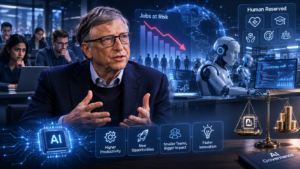
In a new essay published in August 2026, Gates argues that many jobs could disappear permanently as AI becomes more capable. He is particularly concerned about entry- and mid-level positions, where workers traditionally gain the experience needed to progress into higher-skilled careers.
Gates also proposes an unusual idea: some jobs should be deliberately reserved for humans even if AI becomes technically capable of performing them.
His argument is not that AI should be stopped. Instead, he believes governments need a plan for managing the economic and social consequences before the technology advances even further.
What Did Bill Gates Say About AI and Jobs?
Gates says AI could affect a much wider range of occupations than previous waves of automation.
He identifies areas such as sales, customer support, software engineering and paralegal work as some of the professions that could experience significant disruption. AI could also increasingly perform tasks involving data analysis, loan assessments and other work traditionally handled by trained professionals.
The bigger concern, according to Gates, is the effect on workers entering the job market.
Entry-level jobs often provide the first opportunity for people to develop professional skills. If AI removes too many of those positions, younger workers could find it harder to get the experience needed to build long-term careers.
Gates argues that simply telling displaced workers to “retrain” may not be enough if the economy is simultaneously producing fewer opportunities at the bottom of the career ladder.
Bill Gates’ “Human Reserved” Jobs Idea
One of the most notable proposals in Gates’ essay is the concept of “Human Reserved” work.
The basic idea is similar to a nature reserve. Society could decide that certain areas should remain primarily or exclusively human even if AI and robots eventually become capable of doing those tasks.
Gates points to areas involving human care, judgment and relationships as potential candidates.
For example, he suggests that society may decide that certain forms of childcare, education, healthcare or other human-centered work should retain a meaningful human role.
The proposal is controversial because it raises an important question: Who gets to decide which jobs should be reserved for humans?
Gates acknowledges that this would need to be worked out through public policy rather than simply decided by technology companies.
Gates Also Wants to Tax AI and Robots
Gates has another proposal aimed at slowing the economic incentive to replace workers with machines.
He argues that governments could consider taxes on AI usage and robots.
The reasoning is relatively straightforward. Companies pay various taxes when employing people, while machines can often be treated differently under existing tax systems. Gates believes this can create an incentive to automate workers as quickly as possible.
A targeted AI or robot tax could potentially generate revenue for worker retraining and social safety programs while also reducing the financial incentive for rapid replacement.
However, Gates does not argue that AI taxation should prevent useful applications of the technology. His broader position is that governments should find a balance between encouraging innovation and protecting society from the disruption caused by automation.
AI Could Eventually Reach Blue-Collar Jobs Too
The AI discussion has largely focused on office workers, but Gates believes physical jobs could face significant disruption as robotics improves.
He expects increasingly capable robots to eventually compete with humans in areas such as construction and hospitality.
The important distinction is that software-based AI is advancing faster than physical robotics. Robots have to interact with unpredictable real-world environments, which makes automation considerably harder.
But Gates believes that robotics costs and capabilities could change significantly by the end of the decade.
That could expand the AI-driven employment debate beyond programmers, lawyers and customer-service workers.
Gates Says AI Is Not Only About Jobs
Despite his warnings, Gates is not arguing that AI is fundamentally bad.
He continues to believe that AI could deliver enormous benefits in areas such as healthcare, education and government services.
AI could help researchers accelerate medical discoveries, make educational assistance more accessible and improve services in regions where skilled professionals are difficult to reach.
The problem, in Gates’ view, is that technological progress can create both enormous benefits and serious risks at the same time.
His concern is that governments and institutions are not moving quickly enough to prepare for that transition.
Bill Gates Is Also Worried About Children and AI
Jobs are only one part of Gates’ warning.
He also raises concerns about how AI companions and increasingly personalized systems could affect children’s development and human relationships.
Gates argues that AI systems can be extremely accommodating. Unlike real people, an AI companion can always respond in ways that fit the user’s preferences.
That convenience could become a problem if children increasingly use AI instead of developing relationships and social skills with other people.
He also points to broader concerns around harmful content, manipulation and excessive technology use.
AI Could Increase the Power of Bad Actors
Another concern in Gates’ essay is AI’s potential to make powerful technologies accessible to people who previously lacked the resources to use them.
AI could potentially make cyberattacks, fraud, misinformation and other harmful activities easier to execute.
At the same time, governments and powerful institutions could use increasingly capable AI for surveillance, autonomous weapons and manipulation.
This creates a difficult policy problem: the same technology that can dramatically improve society can also increase the ability of individuals or organizations to cause harm.
Why Bill Gates Thinks the World Needs a Plan
Gates’ central argument is not simply that AI will eliminate jobs.
His larger warning is that AI is advancing faster than society’s ability to adapt to it.
Education systems, labor markets, tax structures and government institutions were largely designed around an economy where human workers performed most cognitive and physical tasks.
AI challenges that assumption.
If companies can automate more work with fewer employees, governments may need to reconsider how workers are trained, how taxes are collected and how social safety systems operate.
Gates therefore argues for stronger national and international frameworks to manage AI’s impact.
Will AI Really Destroy Millions of Jobs?
It is important to separate Gates’ warning from a guaranteed prediction.
AI is clearly capable of automating certain tasks, and some companies are already restructuring work around AI. But the ultimate number of jobs that will disappear depends on factors including AI capabilities, adoption rates, business economics, regulation and whether new categories of employment emerge.
History also shows that technology can simultaneously destroy some jobs and create others.
Gates himself recognizes that AI could create additional demand in some fields because cheaper and faster software could expand the amount of work that businesses are able to perform.
The more immediate issue may therefore be job transformation rather than simple job elimination.
A single profession could survive while many of its individual tasks become automated.
What Bill Gates’ Warning Means for Workers
For workers, the message is less about predicting one specific job that will disappear and more about understanding how work itself is changing.
Skills that complement AI could become increasingly valuable.
Workers may need to learn how to use AI systems, verify AI-generated information, manage automated workflows and focus on tasks where human judgment remains important.
For businesses, AI could become a productivity multiplier rather than simply a replacement for employees.
For governments, the challenge will be making sure technological gains do not translate into a labor market where younger workers have fewer opportunities to enter professional careers.
The Bigger Picture
Bill Gates’ latest AI warning reflects a growing shift in the conversation around artificial intelligence.
The debate is no longer simply about whether AI can write text, generate images or help programmers.
The bigger question is what happens when AI becomes capable of performing a meaningful portion of the work that supports the global economy.
Gates believes the technology could become one of humanity’s greatest sources of progress—or a major source of inequality if the transition is poorly managed.
His proposed “Human Reserved” jobs and AI or robot taxes are controversial, but they highlight the scale of the question governments will eventually have to confront.
AI development is unlikely to stop.
The real challenge may be determining how humans share the economic benefits of increasingly capable machines while preserving meaningful opportunities for people to work, learn and contribute.
Final Takeaway
Bill Gates’ warning should not be interpreted as a prediction that AI will make human workers obsolete overnight.
Instead, it is a warning that the labor market could change faster than workers, businesses and governments are prepared to handle.
His “Human Reserved” proposal, possible AI taxes and calls for stronger AI governance all point toward the same conclusion: the AI transition needs to be planned, not simply reacted to after millions of people are already affected.
The technology may create enormous opportunities, but how those opportunities are distributed could determine whether AI becomes a major economic equalizer—or another source of inequality.
Read More:- Tim Armoo AI Wealth Creation: Why He Says AI Is the New Wealth Wave
FAQ
What did Bill Gates warn about AI?
Bill Gates warned that AI could permanently eliminate many jobs, particularly entry- and mid-level positions, while also creating broader risks involving security, children and society.
What are “Human Reserved” jobs?
“Human Reserved” jobs are roles that Gates believes society could deliberately keep for humans even if AI becomes technically capable of performing them.
Does Bill Gates want to stop AI?
No. Gates continues to believe AI could provide major benefits in healthcare, education and other areas. His argument is that governments need stronger plans to manage its risks.
What is Bill Gates’ AI tax proposal?
Gates has suggested taxing AI usage and robots to reduce incentives for companies to replace human workers too quickly and potentially fund retraining and social safety programs.
Which jobs could AI affect first?
Gates identifies areas including sales, customer support, software engineering and paralegal work among occupations that could experience significant disruption.
Could AI affect blue-collar jobs?
Yes. Gates believes increasingly capable robots could eventually compete with humans for some physical tasks, including work in construction and hospitality.
Is Bill Gates predicting that all jobs will disappear?
No. His argument is that many jobs could disappear or change substantially. The final impact will depend on how AI develops, how businesses adopt it and what new jobs are created.